Posts, this year focus upon arts and crafts and today I look out towards the art of others. I visited the thought-provoking Tout Quarry Sculpture Park & Nature Reserve. on Sunday 22nd March 2026. It was a very enjoyable adventure. These are my reflections and some of the photographs.
Didn’t I have a lovely time the day I went to Portland
I had never visited the tied Dorset Island of Portland before. I had passed close by about thirty years ago whilst walking the Dorset Coastal Path. I didn’t have the legs on that occasion to manage the diversion. Recently, I found myself staying at a Weymouth Holiday Park for a week with Portland looming large on my horizon.
The BBC’s Mark Steel’s in Town episode on Portland offered an enticing introduction. After some further internet research, I was strongly attracted to visiting the Tout QuarrySculpture Park. I do find old industrial heritage archaeology evocative and the idea of repurposing a disused quarry as a sculpture park appealed.
On a rural Dorset community bus later in the week, our bus driver told passengers the tale of taking a tourist coach party onto the Isle of Portland. He informed these tourists that they would need to show their passports. He was joking, but somehow there is something unusual about travelling on to this tied island.
I awoke early on the Sunday morning to wonderful March sunlight and clear and very blue skies. I had decided to visit very early, so that I could do some photography, benefiting from the relative peace and early morning light. The regular No.1 bus took me across the water and onto the island. It was then a very steep ascent, I could have walked from where I was staying, but I wanted to conserve energy for seeking out sculptures. As the bus climbed and climbed, we passed old terraced homes which must have originated in the far earlier quarrying era.
My homework suggested that the bus stop I needed was Portland Heights. There was a clue in the title; but I had not appreciated how high we were going. My past experience of quarries had been that they were invariably at sea level. By geological necessity this one was located at a high point on the island. After leaving the bus, the views back towards Weymouth and Chesil Beach were amazing.
Looking towards Chesil Beach and Weymouth
We are the Memory Stones, we are the Memory Stones
In Brighton, I once heard the ghostly refrain from an outdoor broadcast of the film Quadrophenia – we are the mods, we are the mods! In a similar way, the Memory Stones met me and greeted me as I left the No.1 bus with a friendly, loud and proud echo of the past. Art simultaneously fondly remembered the quarrying heritage, celebrated arriving at Tout QuarrySculpture Park and in an ephemeral and uncertain world suggested the importance of remaining and remembering.
“Fallen Fossil” by Stephen Marsden“Hearth” by Timothy Shutter
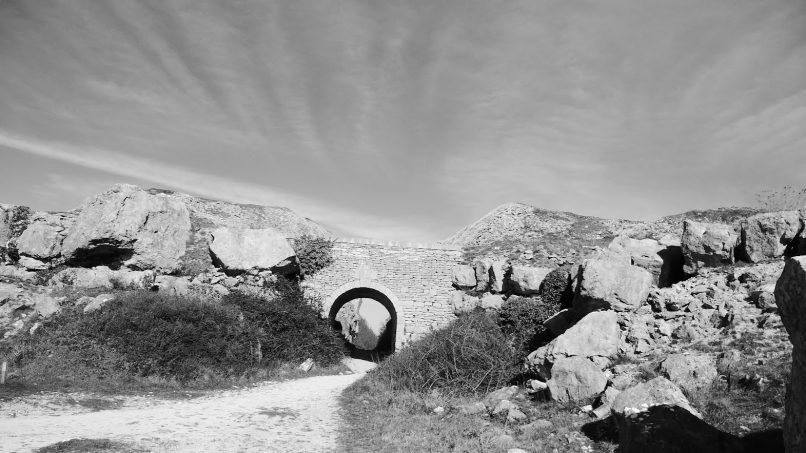
Tout Quarry Sculpture Park is close by the Memory Stones, yet its magic is being part of the landscape, rather than being apart from the landscape. So, although I knew I was close, it took some time to stumble across my first sculpture.
An Easter egg hunt for all ages
Tout QuarrySculpture Park is free to visit. This takes me back to the free music festivals of thirty years ago, before music festivals became commercial enterprises. This is more than saving money, it is about engaging with something in a non-transactional way.
For myself, Tout QuarrySculpture Park felt like going back to the 1960s and 1970s. The site felt cared for, rather than curated, landscape reimagined, rather than a Disneyesque visitor attraction. I could have spent eight minutes or eight hours there; no stewards, no tickets, just a landscape with added sculptures and ghosts of memories.
The creative and inspired idea not to include signage of each sculpture frustrated me in a strangely positive way. The only sign I saw was a sensible caution about health and safety. Other than that, you had to use your eyes and your legs, you had to engage with the art, it was not purely passive consumption of art. That said, don’t underestimate the joy of discovery.
At times my old eyes missed a sculpture right in front of me, sometimes a shift in position and perspective resulted in a revelation. There was plenty of leg work, early on this Sunday morning the only other visitors were casually walking their dogs. I am sure I could have asked them for directions, but that wouldn’t have been as much fun.
Even in March the terrain was very dry and dusty with the overhead sun shining brightly up on this island of stone. As I navigated through passages between rocks I was reminded of the spaghetti westerns from the sixties. I spent a few hours happily photographing sculptures. The sunshine, sculptures and the abandoned landscape made me feel quite trippy as I searched out art in nature.
Sculpture as art of the open air
In doing the preparation for this post, I discovered this Henry Moore quotation.
Sculpture is an art of the open air. Daylight, sunlight, is necessary to it, and for me, its best setting and complement is nature. (Henry Moore)
I took many photographs, mainly in dynamic monochrome, this worked well with the morning sunlight. The majority of sculptures alluded me. The one’s that I did find, which revealed themselves to me were more than enough. I do recommend visiting the learningstone.org site which offers a downloadable map highlighting and labelling sixty of these “hidden” sculptures. Even using this map after the event, it proved difficult to label many of my photographs. In what follows, I have included some photographs which I have been able to identify, as well as, a few wildcards.
“Wreck” by Rosie Leventon“Still Falling” by Antony Gormley“Representation of a Baroque Garden” by Shelagh Wakely“Philosopher’s Stone” by Robert Harding
Stoned Love
In conclusion, that wonderful Supremes song Stoned Love comes to mind.
Yes, literally Tout QuarrySculpture Park is about a love of stone. Quarrying was dangerous with many lives lost, but there must have been an intimacy with the Portland stone being quarried. There is continuity with the love of stone, creatively and imaginatively continued through the work of the sculptors. In viewing the sculptures, the love of stone is evident.
However, there is a strong counter cultural element here. Whilst, Portland stone was quarried to fulfil orders, the sculptures I viewed appeared to freely express what the sculptors chose to express. I found myself in the realms of another state of consciousness. I am not sure you can get stoned on stone, but there is something magical about this place. Stoned love “… will light up, it will surely light up darkened worlds if you just believe.” (The Supremes, 1970). The art and the landscape certainly lightened up my world on my visit and for that I am grateful.
The term “Mary tree” refers to an individual sculpture made out of old contorted woody rosemary herb plant stems. I see beauty and meaning in what others might regard as ugly. I recycle and craft stems which most gardeners would put onto their compost heaps. A process very compatible with the cycle of life ethos of woodlanddecay.com.
The first Mary tree was created as a sculpture about five years ago, but at that time it was never fully realised. At the beginning of 2026, I knew that I needed to shift from reading, writing and thinking towards feeling, sensing and intuiting. Whilst, here I am writing again, the creative shift I am writing about has been meaningful and enjoyable. The theme for this site last year was psychogeography. This year I am consciously engaging with arts and crafts, in many ways though an unconscious undercurrent of psychogeography accompanies my crafting.
I enjoy reflecting upon what a woody rosemary herb stem say’s to me. The following four labels here, frame the results of my reflections; The Mary Tree, The Ruminator, Time’s Erosion and TheLightning Tree. In one way, the contorted beauty of these stems does not require the imposition of labels. In another way, labelling encourages deeper active engagement with each sculpture and for myself at least this has proved meaningful.
The Mary Tree
The Mary Tree
The original Mary tree is known simply as The Mary Tree. About five years ago I was struck by the beauty of this woody rosemary herb stem. In particular the stem, up close looked like the trunk of a hundred-year-old tree. The roots inverted here look like the branches of a tree.
The Mary Tree (Macro)
These roots once searched underground for water and now we glimpse their hidden beauty. Staging these sculptures became a necessity and I began to appreciate the need for a base. In nature these plants had been grounded and in art they needed to be grounded. In this case, I used a hand-crafted piece of Welsh slate I found as the base. I created a simple diorama with some small rocks and grass growing around the base of The Mary Tree, which is struggling to grow out of a gap in the slate.
The Ruminator
The Ruminator
A person sits very, very alone on a lump of flint. The dark blackness of the flint shines through in places, echoing a dark depression. This is not a happy place. The person is cast adrift on this rock, the healing balm of human interaction missing from their repetitive deliberations. The thoughts of The Ruminator are contorted and twisted, hopefully evident in this contorted sculpture. Yearning arms out stretched, yet legs tightly and paradoxically crossed – simultaneously suggesting hold me/go away! The faces of some people reflect the worries of a lifetime in frown lines and wrinkles. Similarly, The Ruminator has become contorted and caught up in the dark thoughts of a lifetime.
Time’s Erosion
Time’s Erosion
Time’s Erosion is by far my favourite sculpture.
In parallel to working with this Mary tree I was reading a novel. There was a reference to one of the older characters displaying time’s erosion. I thought what a wonderful phrase to capture what we all experience in later life.
I then understood what this sculpture was talking to me about – the heavy, yet inevitable toll of the passage of time. I began to see the sculpture in a similar way to an autopsy image of an old human heart. A once beating heart removed from the centre of the chest of an old body. In a similar way to a surgeon, I removed this central part of the rosemary herb plant, severely severing stems as part of this process. The central part of this rosemary plant fulfilled a similar role to the heart, pumping the nutrients of life around the plant.
Time’s Erosion sits on a piece of old rock. I was pleasantly surprised when I added the sealant. The sealant brought out colours in the rock and the Mary tree that were very compatible, yet this was a pleasing surprise, rather than a conscious choice. When I gaze upon Time’s Erosion, I see something different every time, a beautiful carrier of a remembered past. This is not a sad sculpture, more a healthy acknowledgement of inevitability.
The Lightning Tree
The Lightning Tree
Once a suitable woody rosemary herb plant has been selected, I tend to hang it in the apple tree. The elements of wind, rain and sun clear away any debris and help to dry out the plant. However, there is still work to be done with the “raw” woody material. There is an outer bark-like skin which has to be removed with a knife and tweezers. Whilst, this could be left on, it would be prone to mould and also experience has taught me that this outer skin often becomes lose when applying the sealant.
A pleasant consequence of this stripping down is becoming intimate with your Mary Tree. You feel it, you see it from different angles and you sense it in different ways. Initially, I thought of this sculpture as an alien lifeform. Viewed horizontally I imagined it crawling over the surface of our earth looking for signs of life. However, with time it increasingly suggested to me a tree struck by lightning. Desolate yet proud trees, you sometimes see standing alone in fields.
There was a rationale to remove the roots to make it look more realistic. There was also a rationale to leave the roots and celebrate their rarely seen art and twisted charm. I decided to set this sculpture on a rough old piece of wood which had already been treated with green preservative. I added the round stone to rest the sculpture upon and make some sense out of the inclusion of the roots.
The creative realisation of a Mary tree is sometimes aided through looking at related images. On googling “The Lightning Tree” I had an unexpected epiphany. I am always on the lookout for folklore/mythology relevant to what I sculpt. I noted the strong associations between the rosemary herb and memory/remembering.
The top Google hit was a surprise – The Settlers singing The Lightning Tree, used as the theme for the children’s television series Follyfoot. This took me back to my childhood and Sunday teatimes. We would have freshly baked cake/bread, which my Mum, Dad, sister and myself would eat watching family Sunday teatime television. Follyfoot and Black Beauty were family favourites on those Sundays, along with Catweazle and Stig of the Dump.
Happy memories, today, the Settlers singing The Lightning Tree also evokes the light and darkness depicted in the film The Wicker Man. The wonderful lyrics urge us to grow, grow the lightning tree, it’s never to late for you and me and I am completely captivated in the singer’s spell.
Woody Rosemary Practicalities and Possibilities
Understandably, in a world a wash with internet guidance and now supplemented by artificial intelligence, advice on how to grow woody rosemary herb is lacking. I do like the heretical nature of the task at hand. Initially to grow rosemary so that it becomes woody. The task is frustrating, but nature’s message to me, is that this process requires patience. Typically, it takes six or seven years for a rosemary herb plant to become woody. Even then properly cultivated rosemary herb does not become woody.
There isn’t the opportunity to buy woody rosemary at your local garden centre. I have cultivated herbs for decades and it was a happy accident that I began to notice the beauty emerging from forgotten rosemary plants in old pots. Whilst rosemary herb plants in the ground can and do go woody, such stems are likely to be far larger than the stems featured here. Rosemary herb has to be forgotten, before it can be reimagined.
Dreams come true if you want them to, if you want them to, then it’s up to you. (The Lightning Tree – The Settlers)
As our climate changes, rosemary in pots exemplifies the struggle these plants have with the drought conditions on our South Coast. The positive news is that rosemary herb is easy to propagate. I have plants in preparation which are about four years old. They were propagated by putting cuttings in water for a fortnight until roots had formed and then putting these small plants into potting compost. I am using some soft wire to pull stems together on the four-year-old plants, but this is experimental.
The key is patiently forgetting rosemary, rather than cultivation. I do have some more old woody rosemary stems, which I am waiting to speak to me. I am certain, I will create another Mary tree, but I do not know when and what form will be suggested to me.
On the 4th November (2025) I went on an enthusiastic pilgrimage to a sewage pumping station, begging the question why?
I discovered Sir Joseph William Bazalgette (Bazalgette) and his contribution to civil engineering about fifteen years ago. I was delving into project management pre-history, the early days, when learning about the management of large projects was still embryonic.
I never anticipated my deep dive would take me into the world of sewage and sanitation projects and the even murkier activities of the projectors. In The Age of the Projectors, Keller (1966) offered us a definition of projectors as “the promoters of schemes for industrial expansion on the grand scale.” This firewalled History Today article is well worth a read if you are interested and have access.
Strangely, projectors remain completely hidden to most academics and most of society. Projectors definitely did exist as I will illustrate by contrasting their activities with the achievements of Bazalgette.
The next section introduces and explains the forgotten activities of the projectors. London would have looked very different if they had secured the funding Bazalgette secured for the London sanitation projects. Next, I contrast Bazalgette’s achievements with those of the projectors he was encountering. For myself, Bazalgette took on the guise of a super hero. Heroes need to be understood in opposition to villains, in this case projectors active in London at this time.
I visit Crossness Pumping Station, and focus upon how I perceived Bazalgette tangibly differentiating himself from the projectors he was encountering. Finally, I conclude on the past, present and future of the projectors. My desire is to remember Bazalgette’s more subtle achievement – a very different way from the projectors of managing large scale industrial projects.
The Forgotten Projectors
It is difficult to fully appreciate and engage with the suffering of Londoners at the time of the Victorian cholera epidemics. It is the medical advances of scientists such as John Snow which offer us something more tangible, more hopeful. Similarly, we look to the Embankment, the Main Drainage and the Crossness Pumping Station as tangible positive outcomes of Bazalgette’s successful management of large projects. We may lose site of others unsuccessfully competing to undertake these public works. The project environment Bazalgette and the Metropolitan Board of Works (MBW) were challenging becomes less evident.
MBW Logo
It was only as I delved into the murky world of the projectors that Bazalgette came into contrasting view. In all honesty, I hadn’t heard about his work and I hadn’t set out to study him. I discovered that he was consciously and symbolically challenging the projectors when seeking funding for the programme of London sanitation projects. His innovativeness, defiance of previous norms and social consciousness caught my imagination.
Keller (1966) offered a very balanced historical overview of the projectors. Whilst, he didn’t focus upon the London sanitation projects, he probably would have seen the projectors as a necessary precursor to Bazalgette’s public works. In essence, the projectors encouraged local authorities, governments and societies to dare to dream about expensive progressive visions of the future.
We take notions of progress for granted today, but this wasn’t always the case. Keller (1966) regarded projectors and their projects as characterising a phase in history up to about 1660. However, the terminology of projectors was still in use throughout the 18th and 19th Centuries and projectors were still operating at the time of the London sanitation projects (see examples in the next section).
Accounts of projectors cross traditional academic discipline boundaries with references to projectors evident within technology, innovation, engineering, entrepreneurship, political and literary histories. Johnathan Swift explicitly referred to projectors in Gulliver’s Travels. This famous novel was originally published anonymously due to its critique of prominent figures and institutions within society and politics. Swift depicted the projectors as luring the gullible into fantastic engineering schemes, yet when these works failed, the projectors departed in search of new people to trick into such schemes.
More subtly, it has been suggested that Swift was critiquing certain members of England’s Royal Society and the scientists and scholars engaged in experimentation intended to yield practical applications. Keller (1966) favoured a more balanced perspective, but did acknowledge that projectors had a bad name in terms of deceiving themselves and others and dazzling their victims with technical terms.
Bazalgette vs The Projectors
The challenge for Bazalgette and the MBW was to differentiate their reputable project activities from the more speculative activities of projectors.
What examples of projectors were evident at this time?
The partnership of Napier and Hope and Thomas Ellis aimed to profit from the conversion of raw sewage from the outfalls although both ventures failed as a consequence of the collapse of the capital investment markets in 1866.
The Great London Drainage Company promoted by John Morewood proposed making a profit from metropolitan sewage by applying it to agriculture.
MBW had to undermine the credibility of another projector Wicksteed’s London Sewage Company.
Railway projectors such as the Thames Railway Company wanted to develop railways into the centre of London along the banks of the Thames.
These examples may be regarded by some as entrepreneurs simply seeking to compete for public funds. However, my reading of Bazalgette and MBW activities was that they were concerned that such projects had the potential to undermine the public perception of the London sanitation projects and the utility of the significant public funding required.
How did Bazalgette seek to differentiate the London sanitation projects from the activities of the projectors?
The London sanitation projects can be differentiated from the projects of the projectors in terms of innovations which would be regarded as project management best practices a century later. Innovations evident included; transparency, contracting, leadership and governance and process-based knowledge.
Transparency – The process of undertaking major projects became far more transparent. Government commissions preceded the London sanitation projects reflecting a desire to understand the nature of health problems affecting London with a view to finding effective solutions. Closer scrutiny of the funding of major projects became increasingly evident.
Contracting – Large-scale contracting was informed by learning from the construction of barracks during the Napoleonic wars. Competitive tendering for large projects replaced earlier arrangements whereby clients made arrangements with each master craftsman. Contractors increasingly engaged in competitive tendering processes and as part of this process agreed to penalty clauses being written into contracts.
Leadership and Governance – Bazalgette and the MBW proactively challenged the activities of the projectors. They worked closely with a range of key stakeholders including the government, the engineering profession, the contractors and the media in order to gain societal approval for their projects.
Process-based knowledge – Project-based processes were beginning to be undertaken during this era, differentiating these projects from the earlier more opportunistic projects of the projectors.
The London sanitation projects were perceived at the time as being successful and with the benefit of hindsight they still appear successful. The projects acted as an exemplar of what could be achieved. They gave impetus to local government in London and other local authorities beyond. Bazalgette and the MBW through the London sanitation projects effectively addressed the number one cause of death in London at that time. Whilst not always elegant they appear to have succeeded in both encouraging and meeting growing project expectations of government and society. Histories of project management typically begin in the 1950s, but many of the field’s subsequent best practices were evident on the London sanitation projects.
Visiting Crossness Pumping Station
On the 4th November 2025, I had the pleasure of visiting the Crossness Pumping Station in order to engage tangibly with the historic management of sewage in London.
Bazalgette Train EngineCrossness Pumping Station
It was a pleasant surprise to undertake the final part of my journey on the Royal Arsenal Narrow Gauge railway, pulled along by the suitably named Bazalgette engine (see above). We found ourselves next to the current Thames Water treatment works. Smells in this instance added to rather than distracted from the visitor experience.
Volunteers on the railway and at the pumping station had a passion and enthusiasm for their “work” and there was a wonderful sense of community. We started with a very informative talk on the background history. We were then taken on a fascinating guided tour by Arnie, who had effectively transitioned from plumber to charismatic tour guide.
Previously, I had seen images inside the pumping station, but still the irony of beauty contained within the pumping station made a big impression. I want to focus on three insights relevant to the projectors which I gained from my visit and the informative narrations, although there was so much more to the tour.
1. High up on the outside of the pumping station a carving of Bazalgette’s head was pointed out to us. Today, in an age of self-promotion and celebrity this might be viewed as ego. However, I choose to regard it as Bazalgette taking ownership/responsibility for the project. In contrast to projectors promising the world, failing to deliver and then disappearing, symbolically Bazalgette is still visible in 2025.
Figs and Senna Pods
2. Inside the pumping station we focus on the decorative iron working beautifully painted in rich colours. It seems excessive and out of context in a sewage pumping station, but this contradiction just adds to the beauty of the spectacle. Our guide explained how Bazalgette needed to make tangible this project, which had benefitted from large amounts of public money, at a time when such spending on infrastructure was a relatively new undertaking.
We were asked to look very closely at the decorative work and we realise that we are looking at figs and senna pods (see image above). A sanitation joke hidden in plain sight. Again, in contrast to the projectors who invariably cut financial corners, excessive decorative work symbolises the antithesis of cutting corners.
3. We visited the building where the opening ceremony banquet was held. I’d seen the pictures before, but the idea of a banquet in a sewage pumping station is still hard to grasp. It is explained in terms of messaging to civic dignitaries and funding bodies what their funding had enabled. Again, we encounter a contrast with the projectors of that era. You could imagine projectors hosting a banquet when seeking funding, rather than after the project was completed.
The Projectors – Past, Present and Future
Past – In this post, I have summarised my peer reviewed paper, The Victorian London sanitation projects and the sanitation of projects. This paper was published in 2013 in the International Journal of Project Management. I am afraid academic papers tend to be firewalled by the publishers, but if you have journal access, the paper title above leads to the journal log in page.
If you are interested in learning more about the projectors, Steve Reeve and myself had the pleasure of supervising the doctorate of Kristina Zekonyte. Her focus shifted from my fascination with Bazalgette and the London sanitation projects towards contributing to a deeper historical understanding of the projectors. Clicking on her title below should take you to the successfully completed doctoral thesis, which thankfully is not firewalled.
Present – Today, forgotten projectors are rarely acknowledged in historical accounts of Bazalgette’s considerable contribution to the effective sanitation of London. More generally, the existence and prevalence of projectors is rarely acknowledged in theories and practices of project management. Today, embracing the latest artificial intelligence searching for the history of the projectors, you are likely to be taken down a history of visual aids rabbit hole.
Future – As I wandered around the Crossness Pumping Station, I was amongst visitors and volunteers of a similar age to myself. History is very appealing and relevant when you have more past than future. However, amongst all the brave new world talk of artificial intelligence and other innovations, forgetting the past can and should be questioned.
“Those who cannot remember the past are condemned to repeat it.” (George Santayana, 1905)
I suspect Bazalgette would be saddened to witness how a large industrial project such as HS2 is being managed by the brightest minds in business and government today. Grand schemes failing to deliver what societies have financed is nothing new. For myself the projectors whom Bazalgette tangibly differentiated himself from still exist, if only you look beyond the very expensive suits and top of the range smart phones.
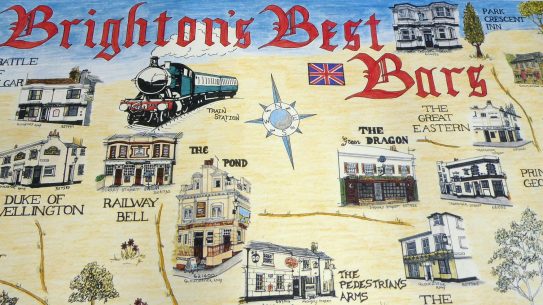
If we want to know the best Brighton pubs, we have to go back to the early 1990s; I couldn’t tell you the year. I walked into an independent bookshop. It may have been the garishly painted Public House Bookshop, fitting, but I really cannot remember. I spotted an art print, the Brighton’s Best Bars, a thing of beauty, printed on high quality art paper. I purchased it, impressed with the detail of the original images of pubs hand painted and wonderfully detailed.
The numbers beneath each pub refer to landline telephones, this is a time before the internet and social media. I do not know the name of the artist and what selection criteria they applied. I do know that I visited many of these pubs in the 1990s/2000s.
It is autumn, 2025 and I haven’t drunk alcohol in a long time and rarely visit pubs. Most of the pubs are still serving or have been re-imagined (names/décor etc). These two categories of pub would make for an interesting walk/pub crawl, but I will leave such adventures for those “thirstier” than myself.
The theme for posts in 2025 has been PSYCHOGEOGRAPHY – relationships between geographical landscapes and the unconscious. Famous psychogeographers would drift around cities such as Paris with little purpose to their wanderings (wonderings). I concede my urban wandering does have a purpose, I even designed a MAP of the 7 locations.
I delayed writing this post for a few years, mindful of ghosts of distant memories and reticent to exhume my past. Psychogeography offered a framework to make sense of the changing landscape of my past. I had to focus on the lost pubs, that was my only option.
I had arrived in Brighton in 1987, and discovered a city in need of exploration. I was probably more of a psychogeographer then, than today, fairly aimlessly drifting along the quieter back streets of Brighton randomly sampling the pubs I discovered.
In the next section, I list those pubs featured still serving and having maintained their original name. Next, I list those pubs featured, but today re-imagined. Please note this is my best effort at the time of writing, changes inevitably happen, particularly given the precarious nature of the licensed trade. I next focus upon those pubs which no longer exist. I conclude with an intriguing Promotional offer and a section less intriguingly welcoming Updates.
Best Brighton Pubs – Still serving
The following roll of honour, in alphabetical order, acknowledges the 24 pubs still serving, at the time of writing. This is approximately 35 years after the art print was published.
Battle of Trafalgar, Bedford Tavern, Colonnade Bar, Crescent, Cricketers, Druids Head, Fortune of War, Great Eastern, Green Dragon, Hand in Hand, Heart and Hand, Ye Olde King and Queen, Ladies Mile, Lion and Lobster, Long Man of Wilmington, Marine Tavern, Park Crescent Inn, Pond, Prince George, Railway Bell, Regency Tavern, Royal Sovereign and Shakespeare’s Head and The Windmill.
Over the decades there have been changes such as the relaxation of licensing hours and the smoking ban. Equally, there have been changes in the economy and society, such as the pandemic. It is impressive how popular pubs thrive and adapt despite the challenges. Many pubs come and go, but the pubs chosen by the art print artist as the “best” are largely still serving.
Best Brighton Pubs – Re-imagined
Pubs are sometimes re-imagined, the physical building remains largely intact, but the pub name, theme and décor change. It has been more challenging to identify these re-imagined pubs. I believe these 13 pubs have been re-imagined. I have listed them alphabetically, based on the original art print, they are as follows:
Battle of Waterloo became Brighton Rocks
(The) Conqueror became Bottom’s Rest
(The) Geese Have Gone Over the Water became The Geese
(The) George Beard became the Eagle
(The) Lamb and Flag became Crowns
(The) Landsdowne Arms became Cooper’s Cask
Oliver Cromwell Tavern became The Palmeria
(The) Pedestrians Arms became The Foundry
Royal Exchange became Haus on the Hill
(The) Star became The Mucky Duck
(The) Volunteer became The Mash Tun
(The) Windsor Tavern became The Earth and Stars
(The) Walmer Castle became The Independent
The scale of these re-imagining’s can be major or minor. As a pub changes its identity you can feel more or less welcome. Reminiscing, I remember having to ask for a key code to access the toilets at The Star. At The Walmer Castle, there was a lovely cosy room at the back. I wish I had gone in The Pedestrians Arms, what a wonderful name for a small pub. And the re-imagined Brighton Rocks, what a clever name given the Rock Place location and the famous Graham Greene Brighton novel.
Best Brighton Pubs – Last orders
Inevitably, this third category of pub proved to be the least easy to locate. Invariably, these pubs were no longer discernible as those pubs featured in the art print. Thankfully, in small print the artist included road names beneath each pub image which helped to pinpoint locations. I then established “approximate” postcodes as I searched for these pub locations today. The upside was that postcodes worked well with Google mapping. The downside was that this wasn’t precise in locating where a pub once stood with buildings and roads changing over decades.
Montpelier (Yesterday)Montpelier (Today)Princess Victoria (Yesterday)Princess Victoria (Today)
In ordering these lost pub locations, I wanted to walk from the West to the East of Brighton and Hove. My early homes were in the West of the city and later homes in the East. In essence, the locations of the 7 lost pubs provide a linear walk, starting in Hove and ending in Kemptown. After considerable desk research, my MAP of the 7 lost pubs was ready. It was a fairly bright October morning when I started. I needed the light for the black and white photography, but by the end of the walk, it was grey and damp and my mood similar.
I chose to begin the walk at the beginning of Lansdowne Road walking East towards the city centre. I had forgotten how enjoyable Lansdowne Road can be, similar to a priest hole passage in an old house. I moved from West to East largely unseen and without the congestion of Western Road in search of the Montpelier Inn (BN1 3BT).
This building has listed status, complicating the redevelopment of the site. The pub appears to have had an interesting/chequered history. I remember living very nearby on York Road, as well as, on St Michaels Place, but I don’t think I ever ventured into the Montpelier Inn. I lived in houses euphemistically labelled homes of multiple occupation (HMOs), although today, I could think of other labels. The Montpelier Inn was difficult to photograph as redevelopment was evidently ongoing. I didn’t want a builder thinking I was a HMRC investigator and equally I am not sure that they would share my interest in psychogeography.
Next, it is a pleasant/straight forward walk continuing along Montpelier Terrace and Upper North Street to the site of the Princess Victoria (BN2 1RP). I drank in this pub many times with my Dad, as well as on my own. Its attraction was how close it was to the centre of Brighton, although many visitors to the city seemed unaware of its existence. Dad and I would have a few drinks in here and then stroll down Regent Hill to meet my Mum outside Marks and Spencer‘s, on Western Road, happy days.
It wouldn’t be Brighton without a visit to the seafront and the artist located Trogs Tavern on, the Kings Road, the main seafront road. So, I head South, Marlborough Street works well, before crossing the busy Western Road and then skirting around the edge of the large Churchill Square shopping centre.
I occasionally would bet on the football. As I pass the Ladbrokes bookmakers, I am tripping back in time. I remember going into this shop and the cashier had to go around the back to get my winnings from the safe. I think the bet might have been on Jose Antonio Reyes scoring the most goals for the opening month in the Premier League. It’s the safe bit of this distant memory that sticks with me, sadly Reyes died too young.
I believe Trogs Tavern was located between the Metropole Hotel and Regency Square, but this is guesswork. I have been unable to find a historical record of Trogs Tavern. However, the Granville Hotel was located about where the artist located Trogs Tavern. I go through Tripadvisor reviews of the Granville Hotel from twenty years ago and find a reference to a Trogs Restaurant being attached to the hotel for a time. Trogs restaurant then appears to have moved to the site of Bom Banes on George Street and the Granville Hotel became No.124 by Guesthouse.
As I stare at No.124, I am wary of being perceived as a voyeur, but I believe I am looking towards the site of Trogs Tavern.
I now go in search of the Norfolk Arms (BN2 9QA) which was another elusive pub to trace, but first the route. I walk East along the seafront towards the Palace Pier. This proves to be an emotive walk. It is a seafront walk I rarely do and normally only out of the tourist season. I reminisce about the site of the Shelter Hall today; in 1987 it was the Tourist Information Centre.
Seafront ghosts surprise me, but the seafront always was an evocative and ever-changing area, drenched in emotions, both good and bad. I remember leaving one of the HMOs with my belongings in bin bags, walking along the seafront to my next home, a lovely flat in Kemptown. Various keys to the HMO now surplus to requirement. I ritualistically threw them into the sea; a sort of banishing ritual.
More walking and less reminiscing are required as I reach the Palace Pier I turn North. At the time of writing the Steine Gardens Road development project was ongoing, so hard hats might be required. I walk North past the Old Steine Gardens and head North until I reach Victoria Gardens. I pick up Grand Parade heading North and find the now closed former location of the Brighton Brewdog.
The desk research complication was that there was a Norfolk Arms in Brighton which the internet acknowledges goes back to 1824 before the site was used for the Norfolk Hotel on the seafront. However, the artist located the pub in question on Grand Parade. It appears that the site of this Norfolk Arms was redeveloped (not just reimagined) with another pub built on the same site called Hector’s House and subsequently the Brighton Brewdog.
The polytechnic/university has a highly regarded Art and Design Faculty near to the location of what was the Norfolk Arms. I suspect this pub may have been very local for the artist. I never went inside the pub, but the campus location stirs up ghosts for myself, both good and bad. I decide to capture a front facing shot of the pub location. It’s challenging as I wait for a gap in the cars and lorries. Equally, I wait for a gap in the students passing by, whilst noting how they “drift” in a style unique to students.
The route to the next pub is fairly straightforward. First, I retrace my steps back down Grand Parade until I reach Edward Street and then head East until I reach the High Street and then head South until I reach the junction with St James Street.
Ranelagh (Yesterday)Ranelagh (Today)
I know exactly where I am going, The Ranelagh Arms (BN1 3FG). It used to be one of my boss’s locals and we would often meet up here as a work group. These were happy and sociable times. I remember invariably it was lively with an equally vibrant outdoor area in the summer. It became the Tiki Hut, but at the time of writing it was on the market. In time it might be reimagined as a pub. When I visited it was sadly boarded up, with the ghosts of memories trapped inside.
I now have a very short walk to the Leconfield Arms (BN2 2JL), back up the High Street to Edward Street and then East until I reach J.W. Lennon’s. This was the John Lennon reimagining of the Leconfield Arms, which subsequently closed. So, perhaps a case of “imagine there’s no J.W. Lennon’s, it’s easy if you try.” I went into the Leconfield a few times, but my memories are vague. I do remember the pub layout/bar being parallel to Edward Street, but sorry that is not much of a testimonial.
Leconfield (Yesterday)Leconfield (Today)
Enough reminiscing, I need to move along to the final pub, the Stag (BN2 1JP). Again, I head East on Edward Street until I reach the crossroads. Then head a short distance South down Upper Bedford Street and find the final pub site has been completely redeveloped.
Stag (Yesterday)Stag (Today)
In my drinking days, I often drank in the Stag. They served Oranjeboom on draft, which was nice. I liked the layout of the pub, many different spaces to lose yourself. I lived at the top end of Freshfield Road at that time and would visit the Freshfield, Cuthbert and Stag all in a line going downhill towards the sea. I would then retrace my steps back up the hill.
One ironic memory was that the Cuthbert had a wonderful painting of a Stag. I do remember a time when all three of these pubs were thriving, with sing-a-longs in the Freshfield. I also remember their decline, sitting in relatively empty pubs, today all three pubs have gone, a sad note to conclude this sentimental journey.
The walk took a leisurely hour and a half with stops for photography and it was just under 3 miles. However, at the end of the walk I felt very weary, although more of an emotional weariness than a physical weariness. Its 1.45pm and I decide to stop on my way to my Saltdean home at the Lobster Pot. I don’t want a drink, but I am in need of soul food. A large portion of chips is purchased for therapeutic reasons.
The wonderful Chinese proprietor remembers me, demonstrating this by acknowledging that I have retired. Yes, today I have retired from so much of my former life. That said, I am no longer lost, like I was in the 1980s and 1990s. I believe my drifting days are over.
Promotional offer
The art print featured here has travelled with me as I moved around Brighton over 35 years. However, I never once put it up on a wall. There are a few creases, but given the journey we have both been on, it is in very good condition. Both as art and as a piece of local history, it merits a far wider audience, than being rolled up in my study.
If there is a publican from one of the featured “still serving” pubs, who would like to have it, please do let me know. The art print would make a great conversation piece to display in your pub and I would be happy to update this post letting readers know the particular pub to visit to see it for themselves.
Best Brighton Pubs – Updates
I would like to acknowledge the name of the artist responsible for the wonderful original art print. If anybody knows their name, please do contact me (see below). I will not be updating this post as pub circumstances/status change. However, if anyone spots any errors do let me know and I will correct them. I was surprised how easy it was to mis locate a lost pub.
There is a comments facility below, but the “spam police” can be overly enthusiastic. The easiest means of contact is via the CONTACT page, which generates an email to me.