Category: Books

Some of the books in my life

  • Managing and Leading Organizational Change-Book Review

    Managing and Leading Organizational Change-Book Review

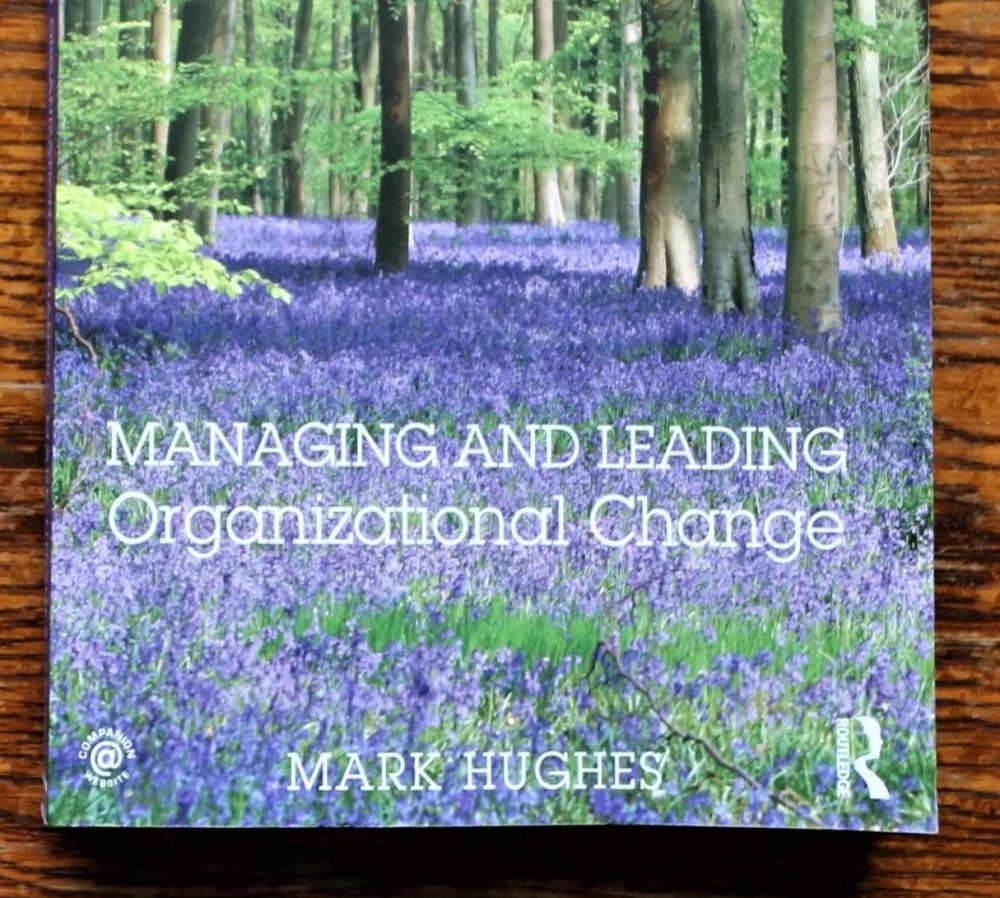
    I was delighted to read this appreciative review of my final textbook Managing and Leading Organizational Change and grateful to Dr David Wilkinson for taking the time to write it.

    In academic circles, despite the money students and university libraries invest in such texts, textbook authoring is surprisingly unfashionable. David fairly explains why such academic scepticism about textbooks exists, thankfully for myself he doesn’t bracket me in this category.

    What I most appreciated in his review was that he appeared to understand the deeply embedded intent in my writing. In an ideal world organizational change theories and practices would be informed by the latest research in the leading academic journals. The danger is that we assume that this ideal is the reality, I don’t believe it is.

    After decades of reading organizational change journal papers, I struggle with some of the content. In all honesty, some of it is too intellectual for me to comprehend – my bad! Other papers about organizational change leave me pondering if an organizational change is the primary interest of the author or an instrumental means to an end – publication in a prestigious journal.  My workshops and writing have largely been informed by reading journal papers, but sometimes the most useful contributions to organizational change theory and practice are not in the most prestigious journals, but instead they are in the less prestigious journals and books.

    As a textbook author I see my role as a scholar, rather than a researcher. A researcher gathers new knowledge, a scholar critically interprets existing knowledge.  I explain this further in the preface of the new textbook, this preface should be freely available on the preview pages of the book on online sites.

    As a scholar I see my role as acting as an intermediary between what is being written and published by trustworthy academics and student and practitioner audiences. I want to guide readers towards the more reliable and valid literature.  Also, I want to guide readers away from less reliable and valid literature. I remain troubled by the simplistic associations that the most prestigious Business Schools always offer the most reliable and valid organizational change insights.  My academic life has involved questioning organizational change knowledge. As I move into a later phase of my academic life, I now have more questions than answers, but I wouldn’t have it any other way.  

    Myth-understanding Organizational Change

    The first chapter of the textbook compiles many of the organizational change myths I encountered during my career. In hindsight, the chapter was far too philosophical for an introductory chapter of a textbook. However, I do provocatively believe that engaging with and understanding organizational change myths is as important as busting these myths.

    Follow the link for a final draft of the first chapter – Myth-understanding organizational change.

  • Pandemonium: Towards a Retro Organization Theory (Burrell, 1997)

    Pandemonium: Towards a Retro Organization Theory (Burrell, 1997)

    Withdrawn from the University of North London Library

    A wonderfully weird book

    I only managed to read half of this book, or did I?

    In the body of the book, the top half of each book page goes forward in the normal linear manner, whilst the bottom half of each page goes backward, with arrows attempting to assist the reader on what is a difficult navigation.  This is illustrated in the Linearity Kills extract below.

    Linearity Kills - Extract from Pandemonium
    Linearity Kills – Extract from Pandemonium

    I reached what we traditionally think about as the end list of references, what Burrell (1997) refers to as the pandemonium municipal library.  This was in the centre of the book, at which point there was a full-page illustration of an entrance/exit and I went through the exit as I knew I was going to struggle reading pages going backward. My specialism is organizational change – going forward.

    The book has some wonderful insights into organization theory, but I was reading the book to inform a historiography project of my own and I didn’t have the time for the playful creativity of the way the book was organized. We have an annual research conference which goes back years, there is a style guide to assist early career researchers in formatting their abstracts, Burrell (1997) is used as a best practice exemplar of formatting, playful creativity is alive and well in universities. As Burrell (1997) states linearity kills, so let’s go backward.

    Studying organizational theory in the 1980s

    I am a second-year undergraduate and my memories are very vague.  However, I remember the lecturers becoming excessively excited about a new textbook – Sociological Paradigms and Organisational Analysis (Burrell and Morgan, 1979). It was the course text for the organizational theory module and in those days, you bought the course text (or I certainly did, see photo of my student copy).   The dilemma was that the students didn’t really understand the textbook and didn’t share the excitement of the lecturers.  The lecturers decided to invite Gibson Burrell over to do a guest lecture, unfortunately, we understood the textbook even less after his talk.  Years later I learned to love the book and although it became fashionable to question the paradigmatic analysis it spawned, I still enjoy fondling this classic.

    Chronarchy in the UK

    I purchased Pandemonium (Burrell, 1997) (see photograph) after reading Burrell’s (1992) chapter ‘Back to the future’.  In this chapter, he was a pioneer making connections between temporality and organization change prefacing later debates about temporality by many years.  In what is still a very provocative chapter he warned that we are easy prey to chronarchy (oddly the spell checker keeps attempting to change this word to ‘coronary’, perhaps a precursor to the future).

    Moving forwards (ho ho), in the conclusions he suggested that the management of change as taught lacked self-reflexive analyses of issues of substantive and thematic temporalism.  He favoured spiral time which at the time seemed silly but having lived through organizational changes and the repetition of old ways of working as new ways of working, it seems eminently plausible.  He suggested that organizational analysts should be historiographers. Today this is accepted, but back then it was a bit different.  I began to appreciate that to go forwards I needed to go backward.

    The 2012 London Olympic Games

    In the spirit of avoiding linearity and avoiding chronarchy we find ourselves at the Olympic Games celebrating history and interweaving the past with the present in a creative, yet also a subversive way.  In order to appreciate the importance of the National Health Service (NHS) we had to revisit the past of the NHS in the ceremony. The opening ceremony was so special that Danny Boyle was quizzed on the inspiration behind it and Pandaemonium 1660 – 1886 (Jennnings, 2012) was acknowledged with Danny Boyle quoted in the Foreword to the 2012 edition (see photograph of the book).  I purchased this book which is best described as a compendium of moments from human history.  The subtitle helps to highlight the intent of Jennings (2012) – The coming of the machine as seen by contemporary observers.  It is an era which has fascinated me as we witness the precursors to the OD practitioners, change managers and project managers of today. At this time Projectors were very prevalent, yet rarely acknowledged today and very absent from progressive textbook histories.

    Back to the past

    I have jumped all over the place in a weird homage to Burrell (1997) we can return to his weird book and the opening page which appears perversely to be going in a linear direction.  He cites an earlier edition of Humphrey Jennings book as his inspiration and justification for mixing up the text.

    Normally, the symbolic ordering of our lives takes place textually on the page or the screen but it is laid out in very, very particular ways.  These constrain our thought and our ability to envisage a set of other possibilities. (Burrell, 1997:1)

    Two decades later this quotation has very real meaning for me. I enjoy writing but most of my writing is performance managed by peers or markets.  I am enjoying writing these posts with no need for validation by peers or market forces, it is hard to convey how liberating that feels and the possibilities such liberation raises for writing in a less ordered manner.  I am listening to Robert Merlin’s Adventures of Robinson Crusoe Soundtrack which accompanied the early sixties black and white TV series as I write this. I have reminisced about my student days and remembered the wonderful opening ceremony for the Olympic Games. Nobody is ever going to publish such meanderings or pay me to write in such an unordered manner.

    Today I have resisted textual symbolic ordering. I like to draft these posts, and then schedule posting for a later date.  Tomorrow, I may not resist textual symbolic ordering and may change this post as it is still in draft form.  Today, we do not just allude to spiral time, we can embrace it.  As Burrell (1997: 25) hasn’t featured as prominently as I hoped, but then again everything is textually permissible in the world of Pandemonium, I give him the final words.

    Thank you very much for coming.  This bunker was constructed fifteen years ago with capital provided by a book called Sociological Paradigms and Organisational Analysis.  Since its building, I have rarely ventured forth into the campus except for the occasional foray.

    WULBA Archivist

    Further Reading

    Burrell, G. (1992). Back to the future: time and organization. In M. Reed., and M. Hughes (1992) (Eds) Rethinking Organization: New Directions in Organization Theory and Analysis, pp.165-182. London: Sage Publications Ltd.

    Burrell, G. (1997). Pandemonium. London: Sage Publications Ltd.

    Burrell, G. and Morgan, G. (1979). Sociological paradigms and organisational analysis: Elements of the sociology of corporate life. Aldershot: Gower Publishing.

    Jennings, H. (2012). Pandaemonium 1660–1886: The coming of the machine as seen by contemporary observers. London: Icon Books Ltd.

  • Book Review – The social construction of management: Texts and identities (Harding, 2003)

    Book Review – The social construction of management: Texts and identities (Harding, 2003)

    Withdrawn from the University of Reading Library

    I was frustratingly late for the social construction of management party.

    I am rarely invited to parties these days and metaphorically speaking I would probably end up arriving late to the party or decline the invitation. In academia new ways of acting, thinking and writing appear to me as parties to which some people are invited and engage, it takes time to find the right parties and normally the world has moved on by the time that I arrive.

    I lived through the arrival of post-modernism in management and organization studies.  Looking back, it was an enjoyably disruptive party characterized by loud proclamations and knowledge mayhem.  I remember Karen Legge describing herself in one of her publications as ‘flirting with the post-modernist heuristic’. A wonderful way of saying I am in my car sat just outside the front door of the party.

    I was late to the social constructionist party and in all honesty, the cool kids had long departed by the time I showed up.  I must concede today I don’t really get Practice Theory, but based on previous engagement lead times, I should get it five years into my retirement, I think there is a joke in there, but at this point, it is beyond me.

    I show up to the social constructionist party too late, everyone is clearing up the debris which is very apparent and tangible.  Oddly, it is an informative standpoint to dig back into what we know with the passage of time. The significant contributions are discernible from the wasted party poppers and burst balloons. After the party, a level of reason prevails.  I have found myself sitting happily in a largely empty social constructionist party venue reading through all the ephemera (books and papers). There is a lot more I want to say about social constructionism, but I better get back to Harding (2003).

    I acquired the book for a few pounds last year via one of the usual online retailers, it was in hardback and in good condition. Although subsequently, I have taken my dayglo highlighters to it, so there are now signs of at least a party going on inside my head.  I have enjoyed the provocations of Nancy Harding, particularly when she writes with Jackie Ford.  There was a disparaging term in use many decades ago when I was a young social science undergraduate – ‘fake comrade’.

    In universities, I have been disappointed by the many critical scholars who live affluent lives yet talk the talk of radical Critical Theory (CT). I once asked a keynote CT professor at a conference when the low paid women workers he had been researching for many years in insecure insurance jobs would be emancipated, he claimed not to understand the question. Bad news for these women, but their labours contributed considerably to his promotions and progression, so not all bad news.  

    I have never been a Critical Theorist and never will be, it would be disingenuous for me to adopt such a position.  However, when I read Nancy Harding she comes across as the antithesis of a ‘fake comrade’, I don’t share all of her radical views, but I certainly share her passion for change and academic identity being all about challenging orthodoxy.

    I do like the title The social construction of management: Texts and identities (Harding, 2003).  This book was published in 2003 when the party music was still playing, they hadn’t run out of cider and that idiot hadn’t been sick all over the sofa. It reads as a radical read today, but it must have been even more intoxicating back in the early part of the last decade.  The title appears fairly benign, but the content is far from benign.

    …management texts are based on a foundational myth that ‘proves’ the need for management.  This myth states that without management the world will descend into chaos and anarchy. (Harding, 2003:53)

    We are now getting close to the unease I have been dancing around in this blog post. Harding (2003) throughout the book is critical about managers, management and large parts of management studies. In many ways, this is a book more about the destruction, rather than the construction of management. She cleverly deconstructs management as a science, as legal authority, as art, and as modernity.  These deconstructions still appear valid fifteen years later, although they are far from the mainstream understanding of management.

    However, it is difficult to offer a sustained critique of management given it is a dynamic and ambiguous process which is highly context dependent.  Creatively, management textbooks become the critical target and provide the unifying narrative for the book.  As a textbook author, I am familiar with such critiques – the party that never ends. 

    Typically, the critical scholar will complain that in a 6500-word chapter there was not a single reference to postcolonialism, or disability or environmentalism or whatever (insert whatever is important to you). It is impossible to include everything in every chapter and for me, it begs the question why not write your own textbook focussed on whatever floats your boat, rather than criticizing the textbooks of others? Certainly, I encountered many years ago a strong critique of change management in academic journals and this critique was missing from many of the textbooks I was reading, so I began to bridge what was being researched with what was being taught.

    Back to Harding (2003), her concern with textbooks and by association, their authors were not pedantic in terms of what was missing, but instead more substantive in terms of how they framed management theory and practice and for Harding (2003) how they constructed the identity of the manager.

    The potential manager reading about her/himself in the pages of the textbook and projecting themselves forward to when they are managers enacting the world of the text are simultaneously offered power while being subjected to that very power. (Harding, 2003:75)

    Some critical scholars choose not to use textbooks in their teaching and would never entertain the idea of writing a textbook, so we have an informal boycott of textbooks by many critical scholars.  My concern remains that if textbooks are an integral aspect of the knowledge landscape as Kuhn (1962) believed, readers of textbooks, in general, would benefit from authors from very different perspectives.

    I agreed with many of the ideas in Harding’s (2003) book and was rather pleased that I understood most of them, given some of the intellectual seams she mined.  However, to use that romantic platitude it is me not you, this textbook author was never going to fully embrace this particular book.

    WULBA Archivist

    Further Reading

    Harding, N. (2003) The social construction of leadership: Texts and identities.  London: Routledge.

    Hughes, M. (2016). Who killed change management? Culture and Organization 22(4): 330-347.

    Kuhn, T. (1962).The structure of scientific revolutions, 2nd ed. Chicago: University of Chicago Press.
  • Fashion and Utopia in Management Thinking (René ten Bos, 2000)

    Fashion and Utopia in Management Thinking (René ten Bos, 2000)

    Withdrawn from Imperial College London

    Fashion and Utopia in Management becomes fashionable

    I really enjoyed reading Fashion and Utopia in Management Thinking, I was unfamiliar with the writings of Bos and suspect I must have been following up a reference. I have been around long enough to have experienced the concept of management fashion becoming very fashionable and influential and then becoming unfashionable and less influential.  The wonderful writings of Eric Abrahamson spring to mind from this era, but for myself, it was David Collin’s Management Fashions and Buzzwords which had the biggest impact given his focus upon organizational change.

    I refer to his notion of critical-practical in workshops to this day, the idea that we need to reconcile critical thinking with practical application to challenges of organizational change in schools and hospitals. Unfortunately, organizational change writing polarizes between the happy talk of excessively positive and prescriptive writing or the misery, elitism, and arrogance of certain critical scholars.

    I try to write in the liminal space between these poles, Collins certainly achieved this goal and also Bos certainly achieved it in this book.  Bos approached this maturing fashion debate from the perspective of philosophy. I must admit I do not have a fraction of Bos’s insight into philosophy, but his art was making this book readable and engaging for readers like myself.

    Fashion and Utopia and Management Authority

    The book has a utopian element which always attracts me, the impossible dream of what might be, despite dystopia being far more evident than utopia. But he questions the quest for utopia offering us his unique way into management fashion.  In all our ‘moving forwards’ talk we search for a utopia we may never find.  There is a chapter entitled ‘Longing for Leadership’ which was probably why I acquired this book ‘leadership is very much a matter of staging’ (Bos, 2000: 66). 

    We tend to write and talk about leaders as managers of meaning. Here we get an alternative, Bos writes about the construction of leadership authority, but he also writes about the corrosion of authority informed by the writings of Bruce Lincoln. So the authority of leaders requires the corrosion of authority of others.

    We had to doubt the capabilities of managers before we could believe in leaders. I am not encouraging such a position and neither was Bos (2000), but it helps us to understand the shift from managers to leaders. This shift was never empirically informed it was a question of staging. Unfortunately, most people believe that this shift was empirically informed.

    ‘…the core tenet of this book: management fashions should not be criticized for being fashionable but for not having been able to get rid of utopian tendencies.’ (Bos, 2000: 181).

    This line of reasoning appears to have implications for organizational change theories and practices.  Those into appreciative inquiry will not like this, but how do we avoid utopian tendencies in our theories and practices of organizational change?

    ten Bos, R. (2000) Fashion and Utopia in Management Thinking. Amsterdam: John Benjamins Publishing Company.

    WULBA Archivist