Category: Culture

Culture – the way we do things around here

  • Understanding Sir Joseph William Bazalgette’s Battle with the Projectors

    Understanding Sir Joseph William Bazalgette’s Battle with the Projectors

    Introduction

    On the 4th November (2025) I went on an enthusiastic pilgrimage to a sewage pumping station, begging the question why?

    I discovered Sir Joseph William Bazalgette (Bazalgette) and his contribution to civil engineering about fifteen years ago. I was delving into project management pre-history, the early days, when learning about the management of large projects was still embryonic.

    I never anticipated my deep dive would take me into the world of sewage and sanitation projects and the even murkier activities of the projectors. In The Age of the Projectors, Keller (1966) offered us a definition of projectors as “the promoters of schemes for industrial expansion on the grand scale.” This firewalled History Today article is well worth a read if you are interested and have access.

    Strangely, projectors remain completely hidden to most academics and most of society. Projectors definitely did exist as I will illustrate by contrasting their activities with the achievements of Bazalgette.

    The next section introduces and explains the forgotten activities of the projectors. London would have looked very different if they had secured the funding Bazalgette secured for the London sanitation projects. Next, I contrast Bazalgette’s achievements with those of the projectors he was encountering. For myself, Bazalgette took on the guise of a super hero. Heroes need to be understood in opposition to villains, in this case projectors active in London at this time. I visit Crossness Pumping Station, and focus upon how I perceived Bazalgette tangibly differentiating himself from the projectors he was encountering. Finally, I conclude on the past, present and future of the projectors. My desire is to remember Bazalgette’s more subtle achievement – a very different way from the projectors of managing large scale industrial projects.

    The Forgotten Projectors

    It is difficult to fully appreciate and engage with the suffering of Londoners at the time of the Victorian cholera epidemics.  It is the medical advances of scientists such as John Snow which offer us something more tangible, more hopeful.  Similarly, we look to the Embankment, the Main Drainage and the Crossness Pumping Station as tangible positive outcomes of Bazalgette’s successful management of large projects.  We may lose site of others unsuccessfully competing to undertake these public works. The project environment Bazalgette and the Metropolitan Board of Works (MBW) were challenging becomes less evident.

    MBW Logo

    It was only as I delved into the murky world of the projectors that Bazalgette came into contrasting view. In all honesty, I hadn’t heard about his work and I hadn’t set out to study him.  I discovered that he was consciously and symbolically challenging the projectors when seeking funding for the programme of London sanitation projects.  His innovativeness, defiance of previous norms and social consciousness caught my imagination.

    Keller (1966) offered a very balanced historical overview of the projectors.  Whilst, he didn’t focus upon the London sanitation projects, he probably would have seen the projectors as a necessary precursor to Bazalgette’s public works.  In essence, the projectors encouraged local authorities, governments and societies to dare to dream about expensive progressive visions of the future. We take notions of progress for granted today, but this wasn’t always the case. Keller (1966) regarded projectors and their projects as characterising a phase in history up to about 1660. However, the terminology of projectors was still in use throughout the 18th and 19th Centuries and projectors were still operating at the time of the London sanitation projects (see examples in the next section). 

    Accounts of projectors cross traditional academic discipline boundaries with references to projectors evident within technology, innovation, engineering, entrepreneurship, political and literary histories.  Johnathan Swift explicitly referred to projectors in Gulliver’s Travels. This famous novel was originally published anonymously due to its critique of prominent figures and institutions within society and politics.  Swift depicted the projectors as luring the gullible into fantastic engineering schemes, yet when these works failed, the projectors departed in search of new people to trick into such schemes.  More subtly, it has been suggested that Swift was critiquing certain members of England’s Royal Society and the scientists and scholars engaged in experimentation intended to yield practical applications. Keller (1966) favoured a more balanced perspective, but did acknowledge that projectors had a bad name in terms of deceiving themselves and others and dazzling their victims with technical terms.

    Bazalgette vs The Projectors

    The challenge for Bazalgette and the MBW was to differentiate their reputable project activities from the more speculative activities of projectors. 

    What examples of projectors were evident at this time? 

    • The partnership of Napier and Hope and Thomas Ellis aimed to profit from the conversion of raw sewage from the outfalls although both ventures failed as a consequence of the collapse of the capital investment markets in 1866. 
    • The Great London Drainage Company promoted by John Morewood proposed making a profit from metropolitan sewage by applying it to agriculture. 
    • MBW had to undermine the credibility of another projector Wicksteed’s London Sewage Company
    • Railway projectors such as the Thames Railway Company wanted to develop railways into the centre of London along the banks of the Thames. 

    These examples may be regarded by some as entrepreneurs simply seeking to compete for public funds. However, my reading of Bazalgette and MBW activities was that they were concerned that such projects had the potential to undermine the public perception of the London sanitation projects and the utility of the significant public funding required.    

    How did Bazalgette seek to differentiate the London sanitation projects from the activities of the projectors?

    The London sanitation projects can be differentiated from the projects of the projectors in terms of innovations which would be regarded as project management best practices a century later. Innovations evident included; transparency, contracting, leadership and governance and process-based knowledge.      

    • Transparency – The process of undertaking major projects became far more transparent.  Government commissions preceded the London sanitation projects reflecting a desire to understand the nature of health problems affecting London with a view to finding effective solutions.  Closer scrutiny of the funding of major projects became increasingly evident.
    • Contracting – Large-scale contracting was informed by learning from the construction of barracks during the Napoleonic wars.  Competitive tendering for large projects replaced earlier arrangements whereby clients made arrangements with each master craftsman. Contractors increasingly engaged in competitive tendering processes and as part of this process agreed to penalty clauses being written into contracts. 
    • Leadership and Governance – Bazalgette and the MBW proactively challenged the activities of the projectors.  They worked closely with a range of key stakeholders including the government, the engineering profession, the contractors and the media in order to gain societal approval for their projects. 
    • Process-based knowledge – Project-based processes were beginning to be undertaken during this era, differentiating these projects from the earlier more opportunistic projects of the projectors.  

    The London sanitation projects were perceived at the time as being successful and with the benefit of hindsight they still appear successful.  The projects acted as an exemplar of what could be achieved. They gave impetus to local government in London and other local authorities beyond.  Bazalgette and the MBW through the London sanitation projects effectively addressed the number one cause of death in London at that time.  Whilst not always elegant they appear to have succeeded in both encouraging and meeting growing project expectations of government and society. Histories of project management typically begin in the 1950s, but many of the field’s subsequent best practices were evident on the London sanitation projects.

    Visiting Crossness Pumping Station

    On the 4th November 2025, I had the pleasure of visiting the Crossness Pumping Station in order to engage tangibly with the historic management of sewage in London.

    It was a pleasant surprise to undertake the final part of my journey on the Royal Arsenal Narrow Gauge railway, pulled along by the suitably named Bazalgette engine (see above). We found ourselves next to the current Thames Water treatment works. Smells in this instance added to rather than distracted from the visitor experience.

    Volunteers on the railway and at the pumping station had a passion and enthusiasm for their “work” and there was a wonderful sense of community. We started with a very informative talk on the background history. We were then taken on a fascinating guided tour by Arnie, who had effectively transitioned from plumber to charismatic tour guide.

    Previously, I had seen images inside the pumping station, but still the irony of beauty contained within the pumping station made a big impression. I want to focus on three insights relevant to the projectors which I gained from my visit and the informative narrations, although there was so much more to the tour.

    1. High up on the outside of the pumping station a carving of Bazalgette’s head was pointed out to us. Today, in an age of self-promotion and celebrity this might be viewed as ego. However, I choose to regard it as Bazalgette taking ownership/responsibility for the project. In contrast to projectors promising the world, failing to deliver and then disappearing, symbolically Bazalgette is still visible in 2025.

    Figs and Senna Pods

    2. Inside the pumping station we focus on the decorative iron working beautifully painted in rich colours. It seems excessive and out of context in a sewage pumping station, but this contradiction just adds to the beauty of the spectacle. Our guide explained how Bazalgette needed to make tangible this project, which had benefitted from large amounts of public money, at a time when such spending on infrastructure was a relatively new undertaking.  We were asked to look very closely at the decorative work and we realise that we are looking at figs and senna pods (see image above). A sanitation joke hidden in plain sight. Again, in contrast to the projectors who invariably cut financial corners, excessive decorative work symbolises the antithesis of cutting corners.

    3. We visited the building where the opening ceremony banquet was held.  I’d seen the pictures before, but the idea of a banquet in a sewage pumping station is still hard to grasp. It is explained in terms of messaging to civic dignitaries and funding bodies what their funding had enabled. Again, we encounter a contrast with the projectors of that era. You could imagine projectors hosting a banquet when seeking funding, rather than after the project was completed.

    The Projectors – Past, Present and Future

    Past – In this post, I have summarised my peer reviewed paper, The Victorian London sanitation projects and the sanitation of projects. This paper was published in 2013 in the International Journal of Project Management. I am afraid academic papers tend to be firewalled by the publishers, but if you have journal access, the paper title above leads to the journal log in page.

    If you are interested in learning more about the projectors, Steve Reeve and myself had the pleasure of supervising the doctorate of Kristina Zekonyte. Her focus shifted from my fascination with Bazalgette and the London sanitation projects towards contributing to a deeper historical understanding of the projectors. Clicking on her title below should take you to the successfully completed doctoral thesis, which thankfully is not firewalled.

    Projectors in seventeenth century England and their relevance to the field of project management

    Present – Today, forgotten projectors are rarely acknowledged in historical accounts of Bazalgette’s considerable contribution to the effective sanitation of London. More generally, the existence and prevalence of projectors is rarely acknowledged in theories and practices of project management. Today, embracing the latest artificial intelligence searching for the history of the projectors, you are likely to be taken down a history of visual aids rabbit hole.

    Future – As I wandered around the Crossness Pumping Station, I was amongst visitors and volunteers of a similar age to myself. History is very appealing and relevant when you have more past than future. However, amongst all the brave new world talk of artificial intelligence and other innovations, forgetting the past can and should be questioned. 

    Those who cannot remember the past are condemned to repeat it.” (George Santayana, 1905)

    I suspect Bazalgette would be saddened to witness how a large industrial project such as HS2 is being managed by the brightest minds in business and government today.  Grand schemes failing to deliver what societies have financed is nothing new. For myself the projectors whom Bazalgette tangibly differentiated himself from still exist, if only you look beyond the very expensive suits and top of the range smart phones.
  • Whatever happened to the best Brighton pubs of the 1990s?

    Whatever happened to the best Brighton pubs of the 1990s?

    Introduction

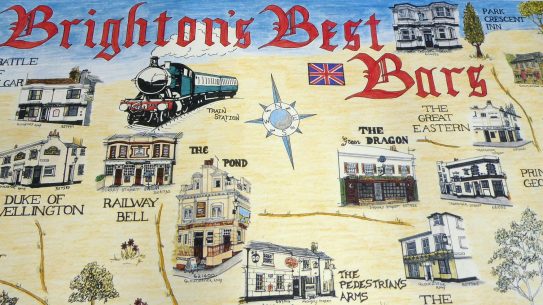
    It’s the early 1990s; I couldn’t tell you the year. I walked into an independent bookshop. It may have been the garishly painted Public House Bookshop, fitting, but I really cannot remember. I spotted an art print, the Brighton’s Best Bars, a thing of beauty, printed on high quality art paper. I purchased it, impressed with the detail of the original images of pubs hand painted and wonderfully detailed. The numbers beneath each pub refer to landline telephones, this is a time before the internet and social media.  I do not know the name of the artist and what selection criteria they applied. I do know that I visited many of these pubs in the 1990s/2000s. 

    It is autumn, 2025 and I haven’t drunk alcohol in a long time and rarely visit pubs.  Most of the pubs are still serving or have been reimagined (names/décor etc). These two categories of pub would make for an interesting walk/pub crawl, but I will leave such adventures for those “thirstier” than myself.

    The theme for posts in 2025 has been PSYCHOGEOGRAPHY – relationships between geographical landscapes and the unconscious. Famous psychogeographers would drift around cities such as Paris with little purpose to their wanderings (wonderings). I concede my urban wandering does have a purpose, I even designed a MAP of the 7 locations.

    I delayed writing this post for a few years, mindful of ghosts of distant memories and reticent to exhume my past. Psychogeography offered a framework to make sense of the changing landscape of my past.  I had to focus on the lost pubs, that was my only option. 

    I had arrived in Brighton in 1987, and discovered a city in need of exploration. I was probably more of a psychogeographer then, than today, fairly aimlessly drifting along the quieter back streets of Brighton randomly sampling the pubs I discovered.  

    In the next section, I list those pubs featured still serving and having maintained their original name. Next, I list those pubs featured, but today reimagined.  Please note this is my best effort at the time of writing, changes inevitably happen, particularly given the precarious nature of the licensed trade.  I next focus upon those pubs which no longer exist. I conclude with an intriguing Promotional offer and a section less intriguingly welcoming Updates.

    Still serving

    The following roll of honour, in alphabetical order, acknowledges the 24 pubs still serving, at the time of writing. This is approximately 35 years after the art print was published.

    Battle of Trafalgar, Bedford Tavern, Colonnade Bar, Crescent, Cricketers, Druids Head, Fortune of War, Great Eastern, Green Dragon, Hand in Hand, Heart and Hand, Ye Olde King and Queen, Ladies Mile, Lion and Lobster, Long Man of Wilmington, Marine Tavern, Park Crescent Inn, Pond, Prince George, Railway Bell, Regency Tavern, Royal Sovereign and Shakespeare’s Head and The Windmill.

    Over the decades there have been changes such as the relaxation of licensing hours and the smoking ban. Equally, there have been changes in the economy and society, such as the pandemic.  It is impressive how popular pubs thrive and adapt despite the challenges. Many pubs come and go, but the pubs chosen by the art print artist as the “best” are largely still serving.

    Reimagined

    Pubs are sometimes reimagined, the physical building remains largely intact, but the pub name, theme and décor change. It has been more challenging to identify these reimagined pubs. I believe these 13 pubs have been reimagined. I have listed them alphabetically, based on the original art print, they are as follows:

    Battle of Waterloo became Brighton Rocks

    (The) Conqueror became Bottom’s Rest

    (The) Geese Have Gone Over the Water became The Geese

    (The) George Beard became the Eagle

    (The) Lamb and Flag became Crowns

    (The) Landsdowne Arms became Cooper’s Cask

    Oliver Cromwell Tavern became The Palmeria

    (The) Pedestrians Arms became The Foundry

    Royal Exchange became Haus on the Hill

    (The) Star became The Mucky Duck

    (The) Volunteer became The Mash Tun

    (The) Windsor Tavern became The Earth and Stars

    (The) Walmer Castle became The Independent

    The scale of these reimagining’s can be major or minor. As a pub changes its identity you can feel more or less welcome. Reminiscing, I remember having to ask for a key code to access the toilets at The Star.  At The Walmer Castle, there was a lovely cosy room at the back. I wish I had gone in The Pedestrians Arms, what a wonderful name for a small pub. And the reimagined Brighton Rocks, what a clever name given the Rock Place location and the famous Graham Greene Brighton novel.

    Last orders

    Inevitably, this third category of pub proved to be the least easy to locate. Invariably, these pubs were no longer discernible as those pubs featured in the art print. Thankfully, in small print the artist included road names beneath each pub image which helped to pinpoint locations. I then established “approximate” postcodes as I searched for these pub locations today.  The upside was that postcodes worked well with Google mapping. The downside was that this wasn’t precise in locating where a pub once stood with buildings and roads changing over decades.

    In ordering these lost pub locations, I wanted to walk from the West to the East of Brighton and Hove. My early homes were in the West of the city and later homes in the East.  In essence, the locations of the 7 lost pubs provide a linear walk, starting in Hove and ending in Kemptown. After considerable desk research, my MAP of the 7 lost pubs was ready.  It was a fairly bright October morning when I started.  I needed the light for the black and white photography, but by the end of the walk, it was grey and damp and my mood similar.

    I chose to begin the walk at the beginning of Lansdowne Road walking East towards the city centre. I had forgotten how enjoyable Lansdowne Road can be, similar to a priest hole passage in an old house. I moved from West to East largely unseen and without the congestion of Western Road in search of the Montpelier Inn (BN1 3BT). This building has listed status, complicating the redevelopment of the site.  The pub appears to have had an interesting/chequered history. I remember living very nearby on York Road, as well as, on St Michaels Place, but I don’t think I ever ventured into the Montpelier Inn.  I lived in houses euphemistically labelled homes of multiple occupation (HMOs), although today, I could think of other labels. The Montpelier Inn was difficult to photograph as redevelopment was evidently ongoing. I didn’t want a builder thinking I was a HMRC investigator and equally I am not sure that they would share my interest in psychogeography.

    Next, it is a pleasant/straight forward walk continuing along Montpelier Terrace and Upper North Street to the site of the Princess Victoria (BN2 1RP).  I drank in this pub many times with my Dad, as well as on my own. Its attraction was how close it was to the centre of Brighton, although many visitors to the city seemed unaware of its existence. Dad and I would have a few drinks in here and then stroll down Regent Hill to meet my Mum outside Marks and Spencer‘s, on Western Road, happy days.

    It wouldn’t be Brighton without a visit to the seafront and the artist located Trogs Tavern on, the Kings Road, the main seafront road. So, I head South, Marlborough Street works well, before crossing the busy Western Road and then skirting around the edge of the large Churchill Square shopping centre.  I occasionally would bet on the football. As I pass the Ladbrokes bookmakers, I am tripping back in time. I remember going into this shop and the cashier had to go around the back to get my winnings from the safe. I think the bet might have been on Jose Antonio Reyes scoring the most goals for the opening month in the Premier League. It’s the safe bit of this distant memory that sticks with me, sadly Reyes died too young.

    I believe Trogs Tavern was located between the Metropole Hotel and Regency Square, but this is guesswork.  I have been unable to find a historical record of Trogs Tavern. However, the Granville Hotel was located about where the artist located Trogs Tavern.  I go through Tripadvisor reviews of the Granville Hotel from twenty years ago and find a reference to a Trogs Restaurant being attached to the hotel for a time. Trogs restaurant then appears to have moved to the site of Bom Banes on George Street and the Granville Hotel became No.124 by Guesthouse. As I stare at No.124, I am wary of being perceived as a voyeur, but I believe I am looking towards the site of Trogs Tavern.

    I now go in search of the Norfolk Arms (BN2 9QA) which was another elusive pub to trace, but first the route.  I walk East along the seafront towards the Palace Pier. This proves to be an emotive walk. It is a seafront walk I rarely do and normally only out of the tourist season. I reminisce about the site of the Shelter Hall today; in 1987 it was the Tourist Information Centre. Seafront ghosts surprise me, but the seafront always was an evocative and ever-changing area, drenched in emotions, both good and bad. I remember leaving one of the HMOs with my belongings in bin bags, walking along the seafront to my next home, a lovely flat in Kemptown. Various keys to the HMO now surplus to requirement. I ritualistically threw them into the sea; a sort of banishing ritual.

    More walking and less reminiscing are required as I reach the Palace Pier I turn North.  At the time of writing the Steine Gardens Road development project was ongoing, so hard hats might be required. I walk North past the Old Steine Gardens and head North until I reach Victoria Gardens.  I pick up Grand Parade heading North and find the now closed former location of the Brighton Brewdog.

    The desk research complication was that there was a Norfolk Arms in Brighton which the internet acknowledges goes back to 1824 before the site was used for the Norfolk Hotel on the seafront. However, the artist located the pub in question on Grand Parade. It appears that the site of this Norfolk Arms was redeveloped (not just reimagined) with another pub built on the same site called Hector’s House and subsequently the Brighton Brewdog.

    The polytechnic/university has a highly regarded Art and Design Faculty near to the location of what was the Norfolk Arms. I suspect this pub may have been very local for the artist. I never went inside the pub, but the campus location stirs up ghosts for myself, both good and bad. I decide to capture a front facing shot of the pub location. It’s challenging as I wait for a gap in the cars and lorries. Equally, I wait for a gap in the students passing by, whilst noting how they “drift” in a style unique to students.

    The route to the next pub is fairly straightforward. First, I retrace my steps back down Grand Parade until I reach Edward Street and then head East until I reach the High Street and then head South until I reach the junction with St James Street.

    I know exactly where I am going, The Ranelagh Arms (BN1 3FG). It used to be one of my boss’s locals and we would often meet up here as a work group. These were happy and sociable times.  I remember invariably it was lively with an equally vibrant outdoor area in the summer. It became the Tiki Hut, but at the time of writing it was on the market. In time it might be reimagined as a pub.  When I visited it was sadly boarded up, with the ghosts of memories trapped inside.

    I now have a very short walk to the Leconfield Arms (BN2 2JL), back up the High Street to Edward Street and then East until I reach J.W. Lennon’s. This was the John Lennon reimagining of the Leconfield Arms, which subsequently closed. So, perhaps a case of “imagine there’s no J.W. Lennon’s, it’s easy if you try.”   I went into the Leconfield a few times, but my memories are vague.  I do remember the pub layout/bar being parallel to Edward Street, but sorry that is not much of a testimonial. 

    Enough reminiscing, I need to move along to the final pub, the Stag (BN2 1JP). Again, I head East on Edward Street until I reach the crossroads. Then head a short distance South down Upper Bedford Street and find the final pub site has been completely redeveloped.

    In my drinking days, I often drank in the Stag. They served Oranjeboom on draft, which was nice. I liked the layout of the pub, many different spaces to lose yourself. I lived at the top end of Freshfield Road at that time and would visit the Freshfield, Cuthbert and Stag all in a line going downhill towards the sea.  I would then retrace my steps back up the hill.  One ironic memory was that the Cuthbert had a wonderful painting of a Stag. I do remember a time when all three of these pubs were thriving, with sing-a-longs in the Freshfield.  I also remember their decline, sitting in relatively empty pubs, today all three pubs have gone, a sad note to conclude this sentimental journey.  

    The walk took a leisurely hour and a half with stops for photography and it was just under 3 miles.  However, at the end of the walk I felt very weary, although more of an emotional weariness than a physical weariness. Its 1.45pm and I decide to stop on my way to my Saltdean home at the Lobster Pot. I don’t want a drink, but I am in need of soul food. A large portion of chips is purchased for therapeutic reasons. The wonderful Chinese proprietor remembers me, demonstrating this by acknowledging that I have retired. Yes, today I have retired from so much of my former life. That said, I am no longer lost, like I was in the 1980s and 1990s. I believe my drifting days are over.

    Promotional offer

    The art print featured here has travelled with me as I moved around Brighton over 35 years. However, I never once put it up on a wall. There are a few creases, but given the journey we have both been on, it is in very good condition. Both as art and as a piece of local history, it merits a far wider audience, than being rolled up in my study.

    If there is a publican from one of the featured “still serving” pubs, who would like to have it, please do let me know. The art print would make a great conversation piece to display in your pub and I would be happy to update this post letting readers know the particular pub to visit to see it for themselves.

    Updates

    I would like to acknowledge the name of the artist responsible for the wonderful original art print.  If anybody knows their name, please do contact me (see below).  I will not be updating this post as pub circumstances/status change. However, if anyone spots any errors do let me know and I will correct them. I was surprised how easy it was to mis locate a lost pub.

    There is a comments facility below, but the “spam police” can be overly enthusiastic. The easiest means of contact is via the CONTACT page, which generates an email to me.

  • Bill Drummond as The Life Model

    Bill Drummond as The Life Model

    The strange but true account of imagining and writing up the 33rd year (1986/1987) of Bill Drummond’s life, for his The Life Model memoir.

    Update 27/02/26

    The Life Model project has creatively evolved with the passage of time. In parallel, the penkilnburn.com site has evolved. At the time of writing the site is themed as a Foot Note. Under the Cata Logg heading you should find The Life Model section. This section offers an interesting overview of the chronological evolution of thinking around the project.

    The seventy years contained within The Life Model will be aired within Foot Note over seventy consecutive days between the 19th of February and the 28th of April. The heading Index should take you to a listing of these days. But there is a helpful cautionary note that nothing is fixed in the Penkiln Burn Universe, let alone stable.

    Introduction

    I was fortunate enough to be one of 168 separate contributors to The Life Model, which purports to be a Bill Drummond memoir at 70.  In subversively imagining The Life Model we wrote independently, yet with a common intent.  Contributions cover, both what might have been consciously going on (over), and unconsciously going on (under).  In some chapters, “a troubled dream” is included, because we all have the occasional troubled dream.

    The concept of transience is embraced through The Life Model project. In the spirit of transience, The Life Model is accessible annually on a continuous 71-day cycle. Intriguingly, each day you can either read the written word or listen to the spoken word or both, but only for that day (no bingeing).

    It was reassuring to find my contribution acknowledged because at times it felt closer to a dream or a postmodern prank, rather than something tangible. More seriously, it is heart warming to witness how this project caught the imaginations of people from very different places and probably very different backgrounds.  

    Also, I am struck by the huge amount of time and energy that must have gone into conceptualizing, curating and realizing The Life Model.

    It’s 2022 – The year everything was creatively cut up

    These are my reflections on the process of contributing to The Life Model.  The big caveat is that my reflections today are subject to the same transience characterising the bigger project (words in this post may have to change at some point).

    “I guess for me it has always been about the process and not the produce.”

    (Bill Drummond, 28th of December 2022)

    Twitter was still fairly functional in the autumn of 2022.  By happy accident rather than clever design on October 12th, 2022, I saw a tweet inviting contributions, it simply read:

    With a life as eventful and extraordinary as Bill Drummond’s, what could be more interesting than reading the memoirs of The Man himself? Well, writing them yourself of course!

    The penkilnburn.com post to which I responded, no longer exists, but began with a gentle tirade against the music industry for exploring and exploiting its past, rather than investing in its future. There was an acknowledgement of the futility of the memoirs of musicians and artists. How, they see their history from their perspective. A plea to explore transitions such as turning 70, rather than wallowing in nostalgia and then came the offer.

    And I would sell each of those Seventy Years of my past to 70 separate individuals who wanted to buy them. And the price for one year of my past would be One Thousand Words.

    Authors could be as adventurous as they wanted in writing the memoir for their particular year, focusing on one event real or imagined, or just the day-to-day drudgery. One thousand words would be written by seventy different and separate individuals.  We were no longer in the realms of ‘his story’, more ‘our stories’ of his story. As Thunderbirds puppets might have said – anything can happen in the next 1000 words! 

    There was a twist, you couldn’t pick one year from seventy.  Authors would be randomly selected and years randomly allocated.  This creative twist should not be underestimated, I would struggle to write 1000 words about my life at the age of five and certainly would have struggled writing up the fifth year of Bill Drummond. Then again there was an emphasis on creativity, so I suspect it would have been fun. 

    I still have the coat rack label from my primary school (see below). When I was five this was an essential part of my identity, as well as, more importantly where I would find my coat.  My label suggested a little person on the verge of steaming through life.

    My coat rack label (age 5) featuring a steam train

    We knew that this would be Bill Drummond’s memoir, but that each of the contributors would be acknowledged. He acknowledged the unknown element of how this project might be perceived and what might happen post-publication, but this just added to the mischief.  All we had to do was email Bill Drummond, a week later, names would be drawn out of a hat. 

    I spent my working life writing for academic publications. Good writing distinguished from bad writing through peer review with objective selection apparently deciding the work which merited publication.  However, my lived experience was an academic publication lottery informed by thinly disguised subjective choices.  So, I warmed to the transparency of the Bill Drummond random hat selection methodology and mixing metaphors I was happy to throw my hat into his ring.  There were over two hundred emails and mine was one of the randomly chosen “over” emails.

    What was beautiful though was that nobody was rejected as there were related creative writing opportunities for everybody (under, over and dreams).  If I contrast this with academic writing for publication, typically nine out of ten journal paper submissions are rejected (sorry that will be the last reference to academia, but yes, I am still bitter). 

    The following is a verbatim extract from an email I received from Bill Drummond on the 21st of October 2022.

    Your name has now been drawn from the hat. You were one of the first 70 names to be drawn from the hat. Your year is from the 29th of April 1986 to the 28th of April 1987 when I was 33 years old.  I look forward to receiving your one thousand words of my memoir, by the 1st of January 2023. Your one thousand words of my memoir must be written in the first person as if you were me writing it. And when I have received your 1,000 words, I will return a “certificate” stating that you are now the rightful owner of that year in my life.

    I was very pleased with my random allocation for the year 1986/1987.  As it transpired, it was a threshold year for Bill Drummond. It was also a threshold year for the music industry and even for myself. As it happens 1987 was the year that I landed and began working and living in Brighton, but before I met Moai.

    It’s 1986 – Imagine there’s no internet, it’s easy if you try …

    Corporate social communications we take for granted today did not exist in 1986, no social media, no email, and no internet.  When we wanted information about bands, we read music newspapers (such as NME, Sounds and Melody Maker), rather than effortlessly searching the internet.

    Social media was non-existent, not even a little sperm swimming about in the warm sleazy vagina of Silicon Valley.

    Record sleeves were an important source of information as well as fanzines and flyers distributed at concerts.   If you were particularly into a band you embarked upon a kind of decoupage assembling and reassembling the information you could acquire.

    In my teens and twenties, I remember writing to bands and invariably they would reply.  It was about information, but also about connection, in many ways, it was a precursor to the commodified information and connection of social media today. In the 1980s, I wrote to the KLF and was delighted to receive an early draft of The White Room and further information (see image below).

    Info Page - When Mark wrote to the KLF (includes Zenarchy - A Case History)

    It’s 2022 – What can we see through the 1986/1987 portal?

    I corresponded with the KLF/Bill Drummond almost forty years earlier. Now, I had been randomly selected and randomly allocated to go back to that very era.  William Burroughs believed that through cut-ups the truth leaks out.  I certainly felt like a Space Cadet travelling through time to write up Bill Drummond’s 33rd year.  I wanted to embrace and perhaps relive the context of that time and that space. My background reading suggested that Bill Drummond definitely wasn’t a Velvet Underground fan and certainly, he had some ‘issues’ with Andy Warhol. So potential for some creative discord there.

    G.P.O on United by Throbbing Gristle sang ‘You become me, and I become you’. I had to go back to my 1986/1987 self.  Back to the music that was enthusing and informing me. I would have to catch a wave and surf the creative emotions of that era, if I was to become Bill Drummond.  Whereas for Bill Drummond and Lou Reed, Elvis had provided a background soundtrack for their evolving musical passions.  For myself, the Velvet Underground was the mood music playing in my 1986/1987 head.

    Velvet Underground songs enabled a creative portal between today and yesterday to open up.  I wrote up the 33rd– year chapter of Bill Drummond’s life using lyrics and their associated stories from Velvet Underground songs. The opening paragraph of the chapter hopefully illustrates my emotions.

    Every time that Jennie put on a radio nothing was going down at all.  But, then on one fine morning, Jennie tunes into a New York radio station.  She didn’t believe what she heard at all.  She is shaking to that fine, fine music, her life saved by rock ‘n’ roll.   Jennie was a five-year-old Lou Reed hearing Elvis Presley’s ‘Heartbreak Hotel’ on his radio

    I am not a musician, but Lou Reed’s wonderful observations on life helped me to channel a musician’s muse.  I love the notion of hypnagogic pop triggering cultural memories of the past. I hoped that Velvet Underground lyrics, as well as, guiding me might trigger memories in a reader.  I was mindful of copyright and although the opening lines should be recognisable to a knowing reader, they were slightly altered because of my lack of courage.  Although, perversely given this is going to be Bill Drummond’s memoir and he took a stance against copyright, I think we are going to be alright.

    It’s 2022 – Zenarchy in the UK (or at least in the Brighton suburb of Saltdean)!

    I chose to take my time writing and rewriting the chapter. I enjoyed the creative playfulness of the chapter writing process.  I found it therapeutic to reminisce and reflect. Surprisingly, writing the biography of somebody else helped me to make some sense of my evolving biography and my transience.

    An Easter Island Moai figure has resided in my garden for many years. Early one Saturday, on a magical May morning Moai and I went down to the seafront to look at the sea view over the English Channel. Moai, always playful, posed in various places along the seafront and I shared this imagery with Bill Drummond. He was reminded (see information sheet above) about writing (or not writing) ‘Zenarchy: A Case History’ and hopefully he enjoyed the Zenarchy notion of Easter Island by the South Coast.  I was never going to blow anything or anyone up, but perhaps my life had been about dabbling in a little Zenarchy, certainly that is something to meditate on.

    It’s 2023 – What time is love?

    I am at an age/stage in my life with the luxury of doing activities for their intrinsic satisfaction, rather than for the extrinsic rewards which dictated my earlier life. The Conservative Party like to call people like me, ‘economically inactive’ and I am happy with such disparagement.  

    It was still a joy to receive a very extrinsic reward through the post in the form of a beautifully crafted Deed of Ownership for the 33rd year of Bill Drummond’s life.  I was always uneasy with that cliché in organizations ‘Can I borrow Mark’ and there is a similar unease with any notion of owning any aspect even conceptual of somebody else. 

    The jpg accompanying the Deed of Ownership covering the 33rd Year of the life of Bill Drummond

    That said, it is a wonderful unique artefact which I have framed and hung on the wall in my hall.  It has given me and those that I have shared it with much joy. 

    It’s 15th May 2024

    Graphic for accessing the spoken word version of The Life Model.

    I have just listened to Bill Drummond reading my “above” account of the thirty third year of his life, wow! What a wonderful postmodern moment, I haven’t a clue about the reality of this year of his life and I am very happy with that.

    The 33rd year audio file is best listened to on penkilnburn.com, but as Bill Drummond acknowledges the website is “fading fast…Crumbling…Falling through the cracks in this World Wide Web.” Woodlanddecay.com is on a similar trajectory, the clue is in the site title, but in the meantime…

    For posterity, I made a crude copy of the 33rd year audio file by placing my phone/recorder next to a speaker. This act reminded me of placing a cassette recorder next to a radio to record music in the early 1970s. So, so wrong, though accessible below, now with an inevitable ghostly echo added.

    As well as my “over” account of this year, Tracey Moberly offers her “under” account of this year. This account is read by Tam Dean Burn and offers a fascinating account of what might have been going on beneath the surface during this year. In places, it seems far closer to reality than my creative imaginings. Though I do not remember the attempted murders of Ian McCullough and Julian Cope, then again I wasn’t there.

    Postcript

    At the time of writing there is an overview on penkilnburn.com of how thinking evolved on The Life Model. Originally a physical book was envisaged, but The Life Model was finally realised as spoken novel. There is an honest acknowledgement on the site that:

    “In reality, some of those that had taken those risks in writing those words felt cheated that there was no physical book to put on their shelf and smell the pages of or even sign their copy of and give copies to friends and family as gifts.”

    That has not been my experience as a contributor. A physical book would have been nice, but I have enjoyed the way this creative project has evolved. I am grateful to have been involved in this project. I enjoyed time travelling back to when I used to write to bands such as the KLF and TG. They would write back to me, rather than somebody in their social media department liking one of my posts, everything commodified. I enjoyed reflecting on a year of somebody else’s life. I never imagined that they would read my reflections back to me. The whole postmodernist subversion of the biography creation process has been fun.

    And finally, in the Deed of Ownership for the thirty third year I have a unique piece of art. It hangs alongside Gee Vaucher’s Liberty, a Paul Cannell signed lithograph of the Screamadelica cover and a Jimmy Cauty signed lithograph America Shut Up! My foot note would be something along the lines of despite the up and downs it has been an enjoyable trip.

    This is the place where all roads meet:

  • Psychedelic Consciousness at Breaking Convention 2023

    Psychedelic Consciousness at Breaking Convention 2023

    Summary – A verdant reflection on participating in the Breaking Convention 2023 conference at Exeter University and exploring magical worlds within nature.

    Introduction

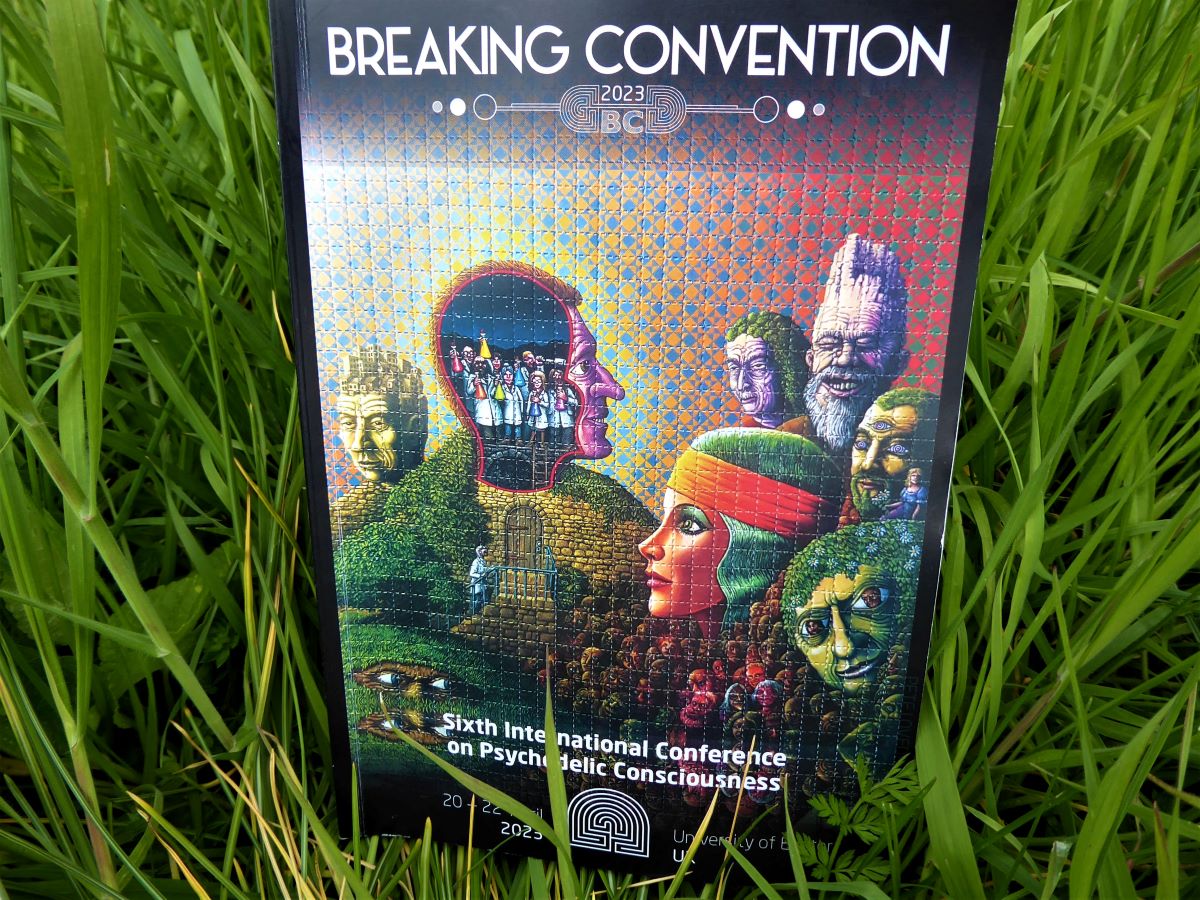
    I enjoyed Breaking Convention 2019, so much that I resolved to attend the next one, Breaking Convention 2023 (BC 2023).  The venue shifted from the historic naval buildings of Greenwich to the more rural setting of Exeter.  BC 2023 brought together researchers, therapeutic practitioners, philosophers, historians and many others interested in psychedelics and psychedelic consciousness. My interests are around shamanism/nature religion, meditation and gently disrupting my too-often sleeping consciousness. 

    I attended two headline talks (Graham Hancock and Paul Stamets) and three sessions. In total fifteen thought-provoking talks. I know it isn’t about quantity.  My point is that there wasn’t one that I regretted attending, which is not normally the case when attending academic conferences.  Every speaker spoke with enthusiasm, rather than instrumentality. I was repeatedly gently provoked to step outside my everyday consciousness and think differently.

    Communitas: Psychedelic Dance Culture and Emergent Spiritualities Session.  On Thursday, five papers took us from the apocalyptic poet Terence Mckenna through to a radically different vision of how to undertake a funeral. In between we learnt about raving in Welsh forests, spirituality within festivals and that Tekno definitely is not Techno. My epiphany was Giorgia Gaia referencing Genesis P.Orridge, his spirit was with us in this countercultural session.

    Mind and Metaphysics Session. On Friday I was primed and ready to go deeper. Susan Blackmore asked us repeatedly and poignantly – are you conscious?  I have slept-walked through too much of my life and her question had real personal meaning. The William James invocation to apply the requisite stimulus to access other worlds was highlighted during the session. All five presentations unified around the ethereal/illusionary nature of psychedelic experiences and the challenges of meaningfully studying this field.  I enjoyed bathing in this fascinating ontological world these presentations conjured up, even if a few times I was out of my depth.

    Psychedelic Semantics Session. On Saturday, we began preparations to return to everyday reality with three very able guides. Patricia Pisters reminded us to think about what we don’t see as much as what we see through the medium of film. Rosalind Stone encouraged us to think about how through language and metaphor consciousness is repeatedly framed and mediated in different ways and with different agendas.

    Andy Letcher offered the summation of the whole convention rhetorically asking – are psychedelic experiences actually ineffable? I had enjoyed his talk at the 2019 conference warming to his blend of humility and authority, quite rare in the academic world. His differentiation of extrovertive mystical experiences from introvertive mystical experiences offered a gateway. In terms of psychedelic consciousness, it is the extrovertive, oneness with nature consciousness which particularly fascinates me.  Ineffable captures it, but I will attempt to share some of the other worlds I experienced in parallel to BC 2023.

    Forgotten World – A Woodland Path Less Travelled

    My magical place is a path by the River Teign at Steps Bridge near Exeter.  I discovered this path over thirty years ago and revisit it whenever I am in the area. On a sunny day when the river is low, the light shines through the trees and bounces on the rocks, the river changes colour with dappled reflections of trees. Birds sing and water sounds contained within the woodland canopy are amplified by way of accompaniment to this natural psychedelic show. On the Thursday morning I visited, the Teign was quite high, dampening what was still a magical walk.

    Steps Bridge (nr Exeter) on a Misty Morning
    Steps Bridge (nr Exeter) on a misty morning

    The next bit was unscripted, the two hourly bus which would return me to Exeter was involved in an accident. It was time to go over to the other side of the B3212 until hopefully, another bus arrived. I ventured into Bridford Wood on the other side of Steps Bridge uncertain of where I was going and outside the certainty of my usual Steps Bridge walk. 

    As I ventured deeper into the wood, I found myself on paths far less travelled than my usual walk.  I had no real route or plan, just a desire to explore.  I found myself on magical paths used mainly by animals and only a few people.  The photograph does not do justice to the experience but remember we are in the realms of the ineffable/illusionary. An accident had taken me into a forgotten world of less travelled footpaths.

    Bridford Wood - Footpath less travelled
    Bridford Wood – Footpath less travelled

    Overlooked World – Garden on a Wall

    The university was at the top of a hill and I was staying at a budget hotel at the bottom of the hill. Gurdjieff and Ouspensky encouraged strenuous exercise to access mystical states, but the demanding climb up the hill didn’t enable me to access these worlds.  However, as I climbed the hill, I discovered an overlooked world. Slowly walking up the Howell Road I noticed a garden growing on the top of an old brick wall.  There was this whole ecosystem with a diversity of plants growing along the top of the wall.  This wasn’t the work of a gardener, some other universal gardener was at work. 

    Plants growing on a old brick wall

    I am sure there is Magic in everything, only we have not sense enough to get hold of it and make it do things for us. (Frances Hodgson Burnett, The Secret Garden)

    More plants growing on a old brick wall

    Each day I would stop to photograph the garden, yet everyone else seemed to be oblivious to this garden.  What they made of the bloke preoccupied with the top of an old wall I do not know, yet I was reminded of liminal worlds out there, yet often unseen.

    Even more plants growing on a old brick wall

    Another World – University Gardens

    In my academic life, I visited many university campuses.  Over the last decade, they invariably appeared to be building sites. It went like this, knockdown functional buildings and build even larger and even shinier buildings. In parallel big banners proclaimed environmental credentials without any reflexivity around their destruction/construction fetish. Celebrations of elite status and league-table successes attempted to exorcise all humility from their campuses. Higher education became transactional – would you like our student accommodation package with your qualification?

    University of Exeter Gardens
    University of Exeter Gardens

    I am certain there is some envy of elite institutions and elite academics on my part, but beyond this, I cherish my recovery from academia and the adventure of exploring other worlds.  I enjoyed the presentations on Saturday morning, but felt in need of some respite from the large powerful phallic buildings, before the final headline speaker.  I ventured into the university gardens and it was like stepping through a portal into another world within a world.

    The gardens go back to the 19th Century.  I wondered what the long established trees made of buildings being repeatedly destructed and constructed in the name of progress.  These gardens are accessible to all regardless of wealth, very different to higher education today.  These gardens are nurtured and cultivated by gardeners, a different world to Bridford Wood.

    Walking around the gardens I was reminded of The Well Gardened Mind book.  That book and these gardens offer a metaphor for another world a very different higher education. My message to University Vice Chancellors would be that it isn’t about the size of their big and shiny new buildings.  It is about the students and staff in those buildings, how they grow together and how knowledge is exchanged and cultivated.

    Final Reflections on the Breaking Convention 2023 Conference

    I found myself empathising with those presenting as the numbers in a presentation room inevitably ebbed and flowed. I empathised with their sometimes anxious non-verbal communications just before they shared with us their enthusiasm. Equally, I empathised with the organizers and how effectively they made the magic happen.  The metaphor of a swan comes to mind on such occasions, certainly from a participant’s perspective I largely perceived the serenity above the surface.

    Hoffman Hall (staging celebrating the natural world)
    Hoffman Hall (staging celebrating the natural world)

    In the university gardens, I met a fellow traveller and we happily talked for half an hour about big stuff and little stuff and our conference experiences. What you might call a two person Final Plenary orchestrated by our shared passion for nature. 

    For me, it was a therapeutic break from the everyday challenges of modern life. An opportunity to glimpse other worlds and imagine possible futures.  I talked with some lovely people who I will never meet again, yet their warmth reminded me of the promise that awaits when you wake-up and explore other worlds.  Thank you to the organizers, presenters and participants for making it such a successful conference.

    Links

    Breaking Convention Site

    https://www.breakingconvention.co.uk/

    The Well Gardened Mind Book

    https://www.suestuartsmith.com/book

    Exploring Nature and Psychedelic Consciousness at Breaking Convention 2023