Category: Into nature

  • Visiting Tout Quarry Sculpture Park & Nature Reserve

    Visiting Tout Quarry Sculpture Park & Nature Reserve

    Introduction

    Posts, this year focus upon arts and crafts and today I look out towards the art of others.  I visited the thought-provoking Tout Quarry Sculpture Park & Nature Reserve (subsequently referred to here as the Tout Quarry) on Sunday 22nd March 2026. It was a very enjoyable adventure. These are my reflections and some of the photographs.

    Didn’t I have a lovely time the day I went to Portland

    I had never visited the tied Dorset Island of Portland before. I had passed close by about thirty years ago whilst walking the Dorset Coastal Path.  I didn’t have the legs on that occasion to manage the diversion. Recently, I found myself staying at a Weymouth Holiday Park for a week with Portland looming large on my horizon. The BBC’s Mark Steel’s in Town episode on Portland offered an enticing introduction. After some further internet research, I was strongly attracted to visiting the Tout Quarry. I do find old industrial heritage archaeology evocative and the idea of repurposing a disused quarry as a sculpture park appealed.

    On a rural Dorset community bus later in the week, our bus driver told passengers the tale of taking a tourist coach party onto the Isle of Portland. He informed these tourists that they would need to show their passports. He was joking, but somehow there is something unusual about travelling on to this tied island.

    I awoke early on the Sunday morning to wonderful March sunlight and clear and very blue skies. I had decided to visit very early, so that I could do some photography, benefiting from the relative peace and early morning light.  The regular No.1 bus took me across the water and onto the island. It was then a very steep ascent, I could have walked from where I was staying, but I wanted to conserve energy for seeking out sculptures. As the bus climbed and climbed, we passed old terraced homes which must have originated in the far earlier quarrying era.  My homework suggested that the bus stop I needed was Portland Heights. There was a clue in the title; but I had not appreciated how high we were going.  My past experience of quarries had been that they were invariably at sea level. By geological necessity this one was located at a high point on the island. After leaving the bus, the views back towards Weymouth and Chesil Beach were amazing.

    Looking towards Chesil Beach and Weymouth

    We are the Memory Stones, we are the Memory Stones

    In Brighton, I once heard the ghostly refrain from an outdoor broadcast of the film Quadrophenia – we are the mods, we are the mods! In a similar way, the Memory Stones met me and greeted me as I left the No.1 bus with a friendly, loud and proud echo of the past.  Art simultaneously fondly remembered the quarrying heritage, celebrated arriving at Tout Quarry and in an ephemeral and uncertain world suggested the importance of remaining and remembering.

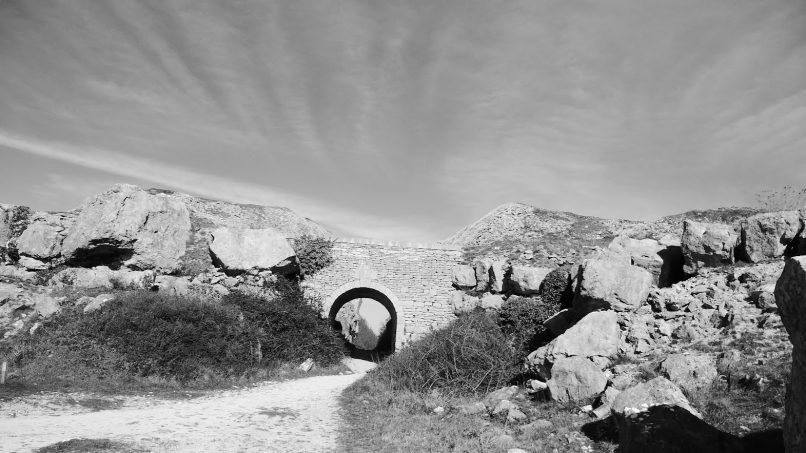
    Tout Quarry is close by the Memory Stones, yet its magic is being part of the landscape, rather than being apart from the landscape. So, although I knew I was close, it took some time to stumble across my first sculpture.

    An Easter egg hunt for all ages

    Tout Quarry is free to visit. This takes me back to the free music festivals of thirty years ago, before music festivals became commercial enterprises.  This is more than saving money, it is about engaging with something in a non-transactional way. For myself, Tout Quarry felt like going back to the 1960s and 1970s. The site felt cared for, rather than curated, landscape reimagined, rather than a Disneyesque visitor attraction.  I could have spent eight minutes or eight hours there; no stewards, no tickets, just a landscape with added sculptures and ghosts of memories.

    The creative and inspired idea not to include signage of each sculpture frustrated me in a strangely positive way. The only sign I saw was a sensible caution about health and safety. Other than that, you had to use your eyes and your legs, you had to engage with the art, it was not purely passive consumption of art. That said, don’t underestimate the joy of discovery. At times my old eyes missed a sculpture right in front of me, sometimes a shift in position and perspective resulted in a revelation. There was plenty of leg work, early on this Sunday morning the only other visitors were casually walking their dogs.  I am sure I could have asked them for directions, but that wouldn’t have been as much fun.

    Even in March the terrain was very dry and dusty with the overhead sun shining brightly up on this island of stone. As I navigated through passages between rocks I was reminded of the spaghetti westerns from the sixties. I spent a few hours happily photographing sculptures.  The sunshine, sculptures and the abandoned landscape made me feel quite trippy as I searched out art in nature.

    Sculpture as art of the open air

    In doing the preparation for this post, I discovered this Henry Moore quotation.

    Sculpture is an art of the open air. Daylight, sunlight, is necessary to it, and for me, its best setting and complement is nature. (Henry Moore)

    I took many photographs, mainly in dynamic monochrome, this worked well with the morning sunlight. The majority of sculptures alluded me. The one’s that I did find, which revealed themselves to me were more than enough.  I do recommend visiting the learningstone.org site which offers a downloadable map highlighting and labelling sixty of these “hidden” sculptures. Even using this map after the event, it proved difficult to label many of my photographs. In what follows, I have included some photographs which I have been able to identify, as well as, a few wildcards.

    “Wreck” by Rosie Leventon
    “Still Falling” by Antony Gormley
    “Representation of a Baroque Garden” by Shelagh Wakely
    “Philosopher’s Stone” by Robert Harding

    Stoned Love

    In conclusion, that wonderful Supremes song Stoned Love comes to mind.

    Yes, literally Tout Quarry is about a love of stone. Quarrying was dangerous with many lives lost, but there must have been an intimacy with the Portland stone being quarried. There is continuity with the love of stone, creatively and imaginatively continued through the work of the sculptors. In viewing the sculptures, the love of stone is evident.  However, there is a strong counter cultural element here. Whilst, Portland stone was quarried to fulfil orders, the sculptures I viewed appeared to freely express what the sculptors chose to express. I found myself in the realms of another state of consciousness. I am not sure you can get stoned on stone, but there is something magical about this place.  Stoned love “… will light up, it will surely light up darkened worlds if you just believe.” (The Supremes, 1970). The art and the landscape certainly lightened up my world on my visit and for that I am grateful.
  • Creating Art from the Rosemary Herb: The Mary Tree Concept

    Creating Art from the Rosemary Herb: The Mary Tree Concept

    Introducing the Mary trees

    The term “Mary tree” refers to an individual sculpture made out of old contorted woody rosemary herb plant stems. I see beauty and meaning in what others might regard as ugly.  I recycle and craft stems which most gardeners would put onto their compost heaps. A process very compatible with the cycle of life ethos of woodlanddecay.com.

    The first Mary tree was created as a sculpture about five years ago, but at that time it was never fully realised.  At the beginning of 2026, I knew that I needed to shift from reading, writing and thinking towards feeling, sensing and intuiting. Whilst, here I am writing again, the creative shift I am writing about has been meaningful and enjoyable. The theme for this site last year was psychogeography. This year I am consciously engaging with arts and crafts, in many ways though an unconscious undercurrent of psychogeography accompanies my crafting.

    I enjoy reflecting upon what a rosemary stem say’s to me. The following four labels here, frame the results of my reflections; The Mary Tree, The Ruminator, Time’s Erosion and The Lightning Tree. In one way, the contorted beauty of these stems does not require the imposition of labels. In another way, labelling encourages deeper active engagement with each sculpture and for myself at least this has proved meaningful.

    The Mary Tree

    The Mary Tree

    The original Mary tree is known simply as The Mary Tree.  About five years ago I was struck by the beauty of this rosemary stem.  In particular the stem, up close looked like the trunk of a hundred-year-old tree. The roots inverted here look like the branches of a tree. 

    The Mary Tree (Macro)

    These roots once searched underground for water and now we glimpse their hidden beauty.  Staging these sculptures became a necessity and I began to appreciate the need for a base. In nature these plants had been grounded and in art they needed to be grounded.  In this case, I used a hand-crafted piece of Welsh slate I found as the base.  I created a simple diorama with some small rocks and grass growing around the base of The Mary Tree, which is struggling to grow out of a gap in the slate.

    The Ruminator

    The Ruminator

    A person sits very, very alone on a lump of flint.  The dark blackness of the flint shines through in places, echoing a dark depression.  This is not a happy place.  The person is cast adrift on this rock, the healing balm of human interaction missing from their repetitive deliberations. The thoughts of The Ruminator are contorted and twisted, hopefully evident in this contorted sculpture. Yearning arms out stretched, yet legs tightly and paradoxically crossed – simultaneously suggesting hold me/go away! The faces of some people reflect the worries of a lifetime in frown lines and wrinkles. Similarly, The Ruminator has become contorted and caught up in the dark thoughts of a lifetime.

    Time’s Erosion

    Time’s Erosion

    Time’s Erosion is by far my favourite sculpture.

    In parallel to working with this Mary tree I was reading a novel.  There was a reference to one of the older characters displaying time’s erosion. I thought what a wonderful phrase to capture what we all experience in later life. I then understood what this sculpture was talking to me about – the heavy, yet inevitable toll of the passage of time.  I began to see the sculpture in a similar way to an autopsy image of an old human heart. A once beating heart removed from the centre of the chest of an old body. In a similar way to a surgeon, I removed this central part of the rosemary plant, severely severing stems as part of this process.  The central part of this rosemary plant fulfilled a similar role to the heart, pumping the nutrients of life around the plant.

    Time’s Erosion sits on a piece of old rock. I was pleasantly surprised when I added the sealant.  The sealant brought out colours in the rock and the Mary tree that were very compatible, yet this was a pleasing surprise, rather than a conscious choice. When I gaze upon Time’s Erosion, I see something different every time, a beautiful carrier of a remembered past. This is not a sad sculpture, more a healthy acknowledgement of inevitability.

    The Lightning Tree

    The Lightning Tree

    Once a suitable woody rosemary plant has been selected, I tend to hang it in the apple tree. The elements of wind, rain and sun clear away any debris and help to dry out the plant. However, there is still work to be done with the “raw” woody material.  There is an outer bark-like skin which has to be removed with a knife and tweezers. Whilst, this could be left on, it would be prone to mould and also experience has taught me that this outer skin often becomes lose when applying the sealant.

    A pleasant consequence of this stripping down is becoming intimate with your Mary Tree. You feel it, you see it from different angles and you sense it in different ways.  Initially, I thought of this sculpture as an alien lifeform.  Viewed horizontally I imagined it crawling over the surface of our earth looking for signs of life. However, with time it increasingly suggested to me a tree struck by lightning. Desolate yet proud trees, you sometimes see standing alone in fields. There was a rationale to remove the roots to make it look more realistic.  There was also a rationale to leave the roots and celebrate their rarely seen art and twisted charm.  I decided to set this sculpture on a rough old piece of wood which had already been treated with green preservative.  I added the round stone to rest the sculpture upon and make some sense out of the inclusion of the roots.

    The creative realisation of a Mary tree is sometimes aided through looking at related images.  On googling “The Lightning Tree” I had an unexpected epiphany. I am always on the lookout for folklore/mythology relevant to what I sculpt. I noted the strong associations between rosemary and memory/remembering. The top Google hit was a surprise – The Settlers singing The Lightning Tree, used as the theme for the children’s television series Follyfoot. This took me back to my childhood and Sunday teatimes. We would have freshly baked cake/bread, which my Mum, Dad, sister and myself would eat watching family Sunday teatime television.  Follyfoot and Black Beauty were family favourites on those Sundays, along with Catweazle and Stig of the Dump.  Happy memories, today, the Settlers singing The Lightning Tree also evokes the light and darkness depicted in the film The Wicker Man.  The wonderful lyrics urge us to grow, grow the lightning tree, it’s never to late for you and me and I am completely captivated in the singer’s spell.

    Rosemary practicalities and possibilities

    Understandably, in a world a wash with internet guidance and now supplemented by artificial intelligence, advice on how to grow woody rosemary is lacking.  I do like the heretical nature of the task at hand. Initially to grow rosemary so that it becomes woody.  The task is frustrating, but nature’s message to me, is that this process requires patience. Typically, it takes six or seven years for a rosemary plant to become woody. Even then properly cultivated rosemary does not become woody.  There isn’t the opportunity to buy woody rosemary at your local garden centre.  I have cultivated herbs for decades and it was a happy accident that I began to notice the beauty emerging from forgotten rosemary plants in old pots.  Whilst rosemary plants in the ground can and do go woody, such stems are likely to be far larger than the stems featured here.  Rosemary has to be forgotten, before it can be reimagined.

    Dreams come true if you want them to, if you want them to, then it’s up to you. (The Lightning Tree – The Settlers)

    As our climate changes, rosemary in pots exemplifies the struggle these plants have with the drought conditions on our South Coast. The positive news is that rosemary is easy to propagate.  I have plants in preparation which are about four years old.  They were propagated by putting cuttings in water for a fortnight until roots had formed and then putting these small plants into potting compost. I am using some soft wire to pull stems together on the four-year-old plants, but this is experimental. The key is patiently forgetting rosemary, rather than cultivation.  I do have some more old rosemary stems, which I am waiting to speak to me.  I am certain, I will create another Mary tree, but I do not know when and what form will be suggested to me.

  • New Forest Old Memories

    New Forest Old Memories

    Introduction

    I was fortunate enough to visit the New Forest in the first week of October this year. It was a calculated gamble in terms of the weather. Fortunately, I was blessed with bright sunshine most days and even a hint of frost early in the mornings. I wanted to be part of the autumnal transition from summer into winter.  Oddly, I found myself reflecting on my autumnal transition into my winter.

    Into the Forest

    I had visited and enjoyed the New Forest a few times previously.  However, the dilemma was that I tended to stay in Southampton and travel into the forest.   This worked well but I wanted to experience the early morning autumnal sun rising.  This time I found a Holiday Village (see Eat, Sleep, Play section) which enabled me to experience the forest on my doorstep. 

    Most mornings after meditation and breakfast, I walked into the New Forest with the sun rising. The slight frost made everything appear silver. The rising sun warmed the frosted common creating a wonderfully exhilarating atmosphere.  I hope the photographs give you a flavour of the experience.  It didn’t feel cold enough to wear gloves, but it was a reminder that that time was quickly approaching.

    In this early morning sunlight, I saw many deer, but they were reluctant to pose for a photograph.  The other animals that were less camera-shy were the pigs.  It was pannage time when the pigs were released onto the common land to eat the acorns.  This is important, because the acorns are toxic for the other animals on the common, so a natural win/win.

    A pig enjoying pannage freedoms in the New Forest

    I was staying in Landford, located between Salisbury and Southampton, tending to explore the forest between Landford and Nomansland. I have just Googled the derivation of Nomansland and it isn’t a reference to a feminist haven, but rather an acknowledgement that it is ‘anyone’s land’ (see the WSHC link for further discussion). There is still a need to respect landowner privacy, but there is more freedom to roam than we have in Sussex.  The New Forest is punctuated with common land, small tracks, minor roads and small villages. My walking seemed to revolve around the village of Bramshaw.  I typically walked for six hours each day, returning to my campsite for a late lunch. The footpaths were very quiet, particularly on the weekdays and it was very peaceful.

    Going Backwards

    At a very early age forests enchanted me.  Dad would take me for walks in the forest at the bottom of the lane behind our home. As I grew up and got into Pogles’ Wood (see post), I regularly asked my parents if the forest we were visiting was where the Pogles lived. They always offered suitably ambiguous answers to keep the magic alive. These days I find myself consciously and unashamedly going backwards.

    When Fly Agaric mushrooms appeared overnight beneath the silver birch tree in our garden they fascinated me.  In later life, I have enjoyed photographing forest fungi, but the Fly Agaric is not so evident in the chalky Sussex countryside.  I decided to challenge myself to photographically capture the Fly Agaric image whilst roaming the New Forest. I struggled with my self-imposed challenge until I met a man walking his dog. I asked if he had seen any.  He suggested he had seen some on Half Moon Common and where exactly I might find them.

    The location title Half Moon Common added to my quest, behind the co-op wouldn’t have worked so well.   The Fly Agaric’s charm is rather fleeting and the drama of their arrival soon fades.  The implication was the next morning my sunrise walk was to Half Moon Common. It was a joy to find the Fly Agaric, though its charm was fading (see image).  I noticed nearby groups of silver birch trees and decided to explore them later in the week.

    I walked many miles, alternating with lighter rest and recuperation days. On one such day, I decided to visit Porchester Castle. Again, as a child I loved castles, I suspect then I could imagine how they might have been. Today my imagination is no longer finely tuned, but I have found myself gravitating back to castles on my travels. They do still tell stories if you let them. Porchester Castle was a new experience.  It overlooks the Solent sitting wonderfully proud in the landscape.

    Going Forward

    I enjoyed my autumn adventure in the New Forest, but I have never been as aware of my autumn as I was during this last week, deep inside woodland decay heaven.  The leaf mould beneath my feet, many trees toppled over and now rotting.  It was the cycle of life stuff, new growth, new beginnings, but that was not my future.

    Forests are a multi-sensory experience. I was feeling/experiencing the forest and its transition, but not fully sensing it. My sight and hearing have inevitably diminished over the decades.  I walked over fifty miles during the week and I am grateful that was still possible.  However, increasingly aches and creaks are part of the walking experience.

    A young Fly Agaric mushroom recently emerged

    I went in search of the Fly Agaric just emerging and was delighted to be rewarded (see image).  What a wonderful specimen. I was down on my hands and knees worshipping it with my camera.  A mother and daughter kindly came over to check I hadn’t fallen over.  A fall would have been understandable. I regularly grazed my knees as a child, in later life we had a different type of fall to avoid.

    As a child, I didn’t know that the Fly Agaric has an intimate/symbiotic relationship with decaying silver birch trees. The beautiful tree in our garden died, and the Fly Agaric posing for me in the New Forest was at the base of a decaying silver birch tree.

    Eat, Sleep, Play

    In later life, I prefer to prepare food for myself. I was a fussy eater as a child and again I seem to be a fussy eater these days, though now for different reasons.  I had a wonderful epiphany this year, why not use campsites rather than budget hotels? I love nature, but tents are not for me. However, I stay on campsites in what I think of as a park home, though in this instance they were referred to as lodges (see image).

    They have a large lounge with a television, a kitchen with all the white goods I have at home, bedrooms and a shower room. It is a home-from-home. I can eat what I like, when I like and listen to my music without worrying about the people in the next room.  Equally, I sleep better without all the noise present even in a quiet hotel. At my campsite, I was away from the road traffic of the city centre hotel and I slept well every night for seven nights.

    Greenhill Farm worked out well, with a friendly greeting on arrival. They provided very modern, well maintained and clean accommodation. I could have happily lived there for seven months rather than seven days. It was a “premium” holiday village, but happy to pay the premium for such a wonderful location.  There was a bus stop near the entrance enabling me to travel either to Southampton or Salisbury.  After visiting Totton to buy my food, I was set up for the week.

    In conclusion

    A wonderfully mellow holiday enabled me to experience nature up close and personal. A stimulating setting to reflect upon life.  Hopefully, a few more adventures are still to come…

    Links

    Greenhill Farm Holiday Village

    https://lovatparks.com/locations/new-forest/green-hill-farm-holiday-village/

    The New Forest Tourist Board

    https://www.thenewforest.co.uk/

    Wiltshire and Swindon History Centre

    https://wshc.org.uk/the-quiet-nomansland/

    New Forest Old Memories
  • The Rock Walk – Wakehurst Place

    The Rock Walk – Wakehurst Place

    Walk on the edge of a rocky outcrop with ancient yew tree roots for company letting the Rock Walk take you to another time and place.

    Updated June 22, 2025

    At the end of this post, I have included coverage of the Loder Valley Nature Reserve, nested within Wakehurst Place, once again open to the public.

    Introduction

    I regularly find myself drawn to the Rock Walk at Wakehurst Place.  In this post, I want to convey its magic through words and images.  I have a suspicion that most paying visitors do not reach the Rock Walk.  It is far away from the main attractions and amenities which adds to the otherworldly charm.  The Rock Walk stretches for about half a mile with the walk to the Rock Walk longer than the walk itself. I tend to approach it via Westwood Lake which makes for a breathtaking route. The Rock Walk is signposted on maps and with signage.  However, there is a path above the outcrop at times which could mean you walk parallel to the outcrop photographs featured here, which would be a pity. 

    Yew tree roots appear to flow over the landscape

    The Kew.org website succinctly captures the special essence of this walk.

    The Rock Walk is a magnificent hiking experience, full of looming rock outcrops, gnarled yew tree roots and shafts of light and deep shade.  Tracing the side of Bloomers Valley, this breath-taking part of the High Weald dates back 140 million years.

    This quotation neatly captures the time-travelling element of the walk. Also, the ‘shafts of light and deep shade’ is very appropriate. The light changes with the different seasons and the colouring of the rock and the vegetation changes dramatically with the seasons. My last visit when I took the photographs featured here was Friday 8th December 2023. My expectations were not high given what a damp winter that we have had.  However, the greens were particularly vivid and the dampness seemed to enhance the spectacle, though I am biased. My one deviation from the official descriptor would be ‘hiking experience’.  It is a relatively short walk, though it packs a lot of charm into a short distance.

    Weathered Sandstone (art in nature)

    Another Perspective

    My camera tends to be my companion on walks, but I felt it would be good to compare my impressions with somebody else.  After a short search, I found the most popular and informative post was on the Wild About Here site.  The are many excellent photographs of the Rock Walk and information about the geography and origins of the Rock Walk. Kriss MacDonald (the photographer/author) includes Luce and Theo in many of her photographs, reminding me that part of the magic of this walk is indulging my inner child.  There are parts of the walk which conjure up notions of being on the edge of a mythical world.  Think of the Peter Jackson film sets for his Tolkien adaptations.

    The Yew is a magical tree frequently celebrated in folklore.  We are fortunate to have one of the finest yew forests in Europe not too far away at Kingley Vale, a wonderfully evocative forest.  However, the Rock Walk offers a window into the old and twisty roots of the yew, which I do not get elsewhere. It was evident that Luce and Theo were transported to other worlds as they explored the Rock Walk.  However, even for this older walker the Rock Walk takes me to imagined places other walks never reach.

    Yew tree roots evoke a sleeping coiled python

    Loder Valley Nature Reserve

    A nature reserve hidden away in a corner of Wakehurst Place recently caught my eye. The entrance is close to Westwood Lake (pictured below). You need a four-digit code from the Visitor Centre to gain access, which only adds to the charm and mystery of this nature reserve.

    The nature reserve closed in 2022, enabling ash dieback to be addressed. Only recently reopened, I visited for the first time on June 20th, 2025. A locked garden featured in one of my favourite childhood books, The Secret Garden, by Frances Hodgson Burnett.

    My four-digit code unlocks the gate. I am enthusiastic yet uncertain about what to expect. The map shows that the main pathway runs parallel to the lake (probably a continuation of Westwood Lake). There was a bridge over the lake leading to a shorter pathway on the other side. I didn’t have time to explore this pathway, but I did follow the main pathway from start to finish and back again (pictured below).

    The pathway took the form of a rough track which small conservation vehicles could use for access.  The nature reserve had inevitably benefited from being closed to visitors, and I felt privileged to share this space. Plenty of joyful bird song, as well as the sound of unseen animal life at ground level moving around.

    I did see a young deer, red in colour, a couple of times. Understandably, it didn’t want to pose for a photograph. I sensed the return of visitors was a learning curve for wildlife inhabitants.  I only saw two people in the hour and a half I spent roaming the nature reserve. I am not sure if they registered me as they sat in the Kingfisher Hide looking out over the lake.  I decided to leave them in peace, but I did check out the Hobby Hide and the Tern Hide.  The photograph below shows the view looking out from the Tern Hide. Sat inside this hide, eating lunch, the deer walked by on the shoreline.

    My visit was exhilarating, and I hope to return. Inevitably, this reserve will change with the seasons and with old growth dying away, feeding new growth.  A transitional exemplar of what woodlanddecay.com is all about. My only regret was not having time to check out the Rock Walk, but the bus back to Brighton only goes every two hours.

    The Rock Walk – Wakehurst Place