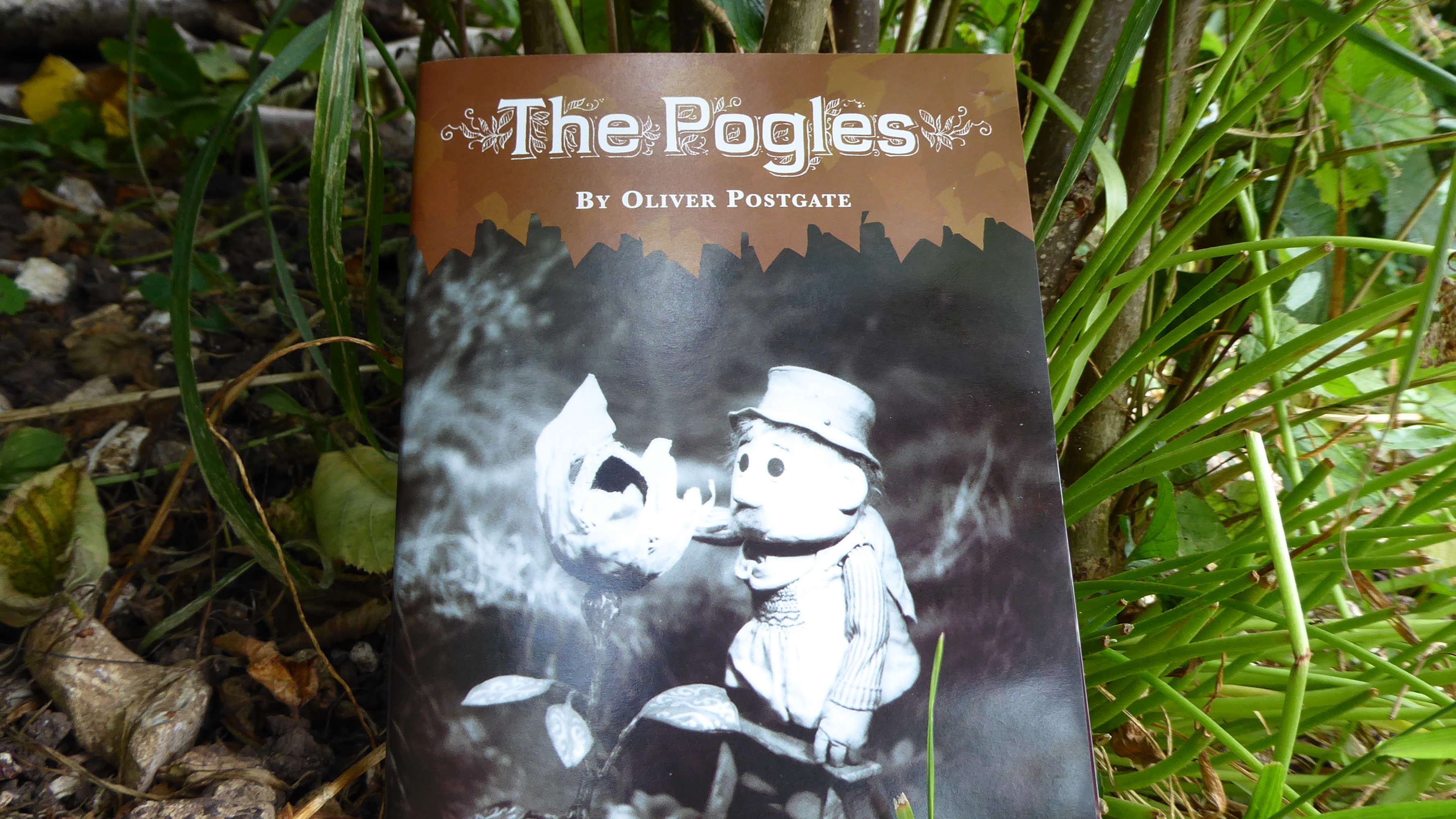
Category: Television

Television reviews and reflections

  • The Pogles: Banned by the BBC?

    The Pogles: Banned by the BBC?

    The children’s television programme The Pogles banned by the BBC and if so why? In this nostalgic post I reflect on what happened, or at least what I think happened.

    Introducing The Pogles

    This post will not be impartial, The Pogles made a huge impression on my formative early childhood years in the sixties and I believed that they were real. Many memorable children’s television programmes of the sixties and seventies were produced by Small Films.  The creative forces behind Small Films were Oliver Postgate and Peter Firmin.  Musical accompaniment came from Vernon Elliott and his Ensemble only adding to the magic. On the Small Films website, Oliver Postgate captures the essence of their enterprise.

    Once upon a time, not so long ago, there were two overgrown boys called Oliver and Peter. And Peter lived on a farm. It was a rather unusual farm because it didn’t grow any crops and there were no sheep or cows, but it was the home of Ivor the Engine, Noggin the Nog, the Clangers and of course Bagpuss. And there they made the most beautiful, the most brilliant, funny old Small Films in the whole wide world or so we like to think.

    Source: Small Films website

    Small Films produced The Pogles and Pogles’ Wood for the BBC between 1964 and 1968.  The Small Films site evocatively describes these programmes as “the story of woodland folk, who lived in a tree with a magic bean plant.” The farm in Kent in which The Pogles was filmed, incidentally backed onto a woodland.  I was fortunate to see Oliver Postgate and Peter Firmin in person at the National Film Theatre in 2004.  I have included a link at the end to footage taken by an audience member of this event.

    The Dragons’ Friendly Society

    Today, it is fairly easy to access clips of television on YouTube-type sites. If we go back twenty years, you had no access to these programmes.  You were reliant on programmes being rebroadcast  (unlikely to happen with banned programmes). This was a fertile context for urban myths to grow.

    In shamanism, you access other worlds through holes in the natural world. You visualize yourself going down the hole en route to the lower, middle or higher world.  The Dragons’ Friendly Society provided the portal to revisit The Pogles and Pogles’ Wood. This enabled me to rewatch episodes I had not seen in many decades. When I revisited the site to write this post, I had very mixed emotions.  The proclamation on the homepage reads:

    Congratulations! You have found the secret treasure of The Dragons’ Friendly Society. 

    Source: Dragons’ Friendly Society website

    Originally, it did feel like discovering treasure. Today, the homepage sadly remembers the passing of the two key players in this story – Oliver Postgate and Peter Firmin.

    You can purchase DVDs of The Pogles and Pogles’ Wood series (and Pogles’ Choice and Pogles’ End), but also there is freely available information to access on the site.  In searching the site for information pertinent to this post, I stumbled across a poignant reference to The Witch.

    Oliver Postgate will be telling us more stories of the Witch soon… please watch this space. There were a number of stories written for the Witch which were never filmed because the BBC considered them too scary.

    Source: The Dragons’ Friendly Society website

    A unique sadness surrounds a storyteller’s untold stories.  However, his stories of woodland folk live on, reimagined in the retelling.  Before exploring the BBC ban, I needed to re-watch the six episodes in question.

    Pogles' Wood DVD Cover
    Pogles’ Wood DVD Cover

    Watching The Pogles today

    It’s 2023 and I have just watched all six episodes of The Pogles series again. Watching television programming from over fifty years earlier is weird.  In my imagination, The Pogles exist in the most verdant of technicolour. However, Pogle reality is a much duller black and white.  We have been spoilt with the evolution of special effects over the past fifty years, probably at the expense of our imagination. That said, rewatching the episodes made for charming viewing and still captivated this viewer.

    A listing of episodes will often preface the storyline, but as you will see the titles below were very oblique even innocent (possibly intentionally, discussed further in the next section). The Magic Bean, A Silver Crown, Pogle Go Home! A Flower for Wishes, The Singing Bird and King of the Fairies.

    Mr Pogle goes into the wood in search of broad beans for Mrs Pogle, but all he can find is a very big bean.  As it transpires this is The Magic Bean. They plant the bean and the magic plant subsequently bears the baby.  Mr Pogle’s interaction with Mrs Pogle is very sexist. For example, at one point in this first episode, he threatens to tip Mrs Pogle out of bed if she doesn’t make his breakfast.  The subtler learning is that Pogles do not seem as obsessed with the need to work and consumerism as everyday folk outside the woods.

    A beautiful notion runs through the series that it takes a hedgepig (aka a hedgehog) to wake a Pogle because they are deep sleepers. However, in the second episode, they are woken by noisy fairies chattering too close to their home. Unable to quieten the fairies, they investigate why they are being noisy. They find a baby cradled in the magic plant wearing A Silver Crown.

    Mr Pogle on journeying into the wood meets an old lady whose cart is stuck. She asks for help and leaves saying ‘blessings on you, kind sir.’ However, the old lady (aka the witch) has stolen the baby and hidden it in her cart. The fairies warn Mr Pogle, urging Pogle Go Home! However, he is caught by the witch.

    Mrs Pogle troubled by the baby being stolen and the absence of Mr Pogle, turns to the magic plant for help.  The magic plant explains that the old lady is a witch and suggests A Flower for Wishes which will grant Mrs Pogle two wishes. Her first wish is to be with Mr Pogle, but it transpires the witch has trapped him in a wooden cage with the stolen baby nearby.  The witch then also places a wooden cage around Mrs Pogle.

    The witch wants the silver crown because it is the crown of the king of Fairyland. However, Mrs Pogle had cleverly hidden the crown inside their tree. The witch threatens to turn them into frogs unless Mrs Pogle reveals the location of the silver crown. Mrs Pogle uses her second wish to wish the witch into a bungle of twigs, all alight and burning.

    Mr and Mrs Pogle return home with their baby.  The fairies bring them The Singing Bird.  A jug of milk is left for the baby, but it is a trick. Mrs Pogle states ‘I don’t like it!’

    The jug is part of the trickery of the witch.  In the final episode, The King of the Fairies, the witch takes the form of an old boot attempting to kick down the door. Mrs Pogle shouts at the witch “You’re a horrible thieving hag!” The singing bird places the crown on the head of Mr Pogle giving him the power to banish the witch. They want to turn her into something, but the concern is that she will just turn back into herself.  Mrs Pogle concedes ‘It looks like there is nothing’, but this gives Mr Pogle an idea ‘nothing – be nothing at all.’ They turn the hag of the night into nothing.

    So, what’s not to like?

    Banned by the BBC?

    The logical place to start is with the BBC’s account of what happened.  On the 5th November 2015, the BBC site referred to banning The Pogles for the following reason.

    The first series was shown in 1965 and never shown again. The witch was considered far too scary for younger viewers.

    Source: BBC website

    The article was linked to the launch of the now-defunct BBC Store explaining that some television programmes previously banned were now being made available.

    Here’s a collection of a few programmes that were in their time on the BBC’s “do not show under any circumstance” list and a few that will probably never appear on the store.

    Source: BBC website

    An internet search reveals other commentaries which go beyond the official stated BBC position.  The musician Andy Bell offered another reason for the BBC ban “…because Mrs Pogle drank too much elderberry wine.” This is an intriguing notion. Though, Mr Pogle drank as much bilberry wine as Mrs Pogle. There was even an episode in which Mr Pogle shouts “Wife where’s my bilberry wine?”  Running with Andy Bell’s reasoning The Pogles were drinking bilberry wine for breakfast certainly not a good example for young children even in the permissive sixties. At this time, I was a big fan of Camberwick Green and my hero was Windy Miller. I remember an episode featuring him getting drunk on cider and falling asleep at work, not a good example for the young flour millers of tomorrow.

    Image of Mr and Mrs Pogle at home
    Image of Mr and Mrs Pogle at home

    In searching the internet, the challenge is that the search engine wants to tell me the story of why the BBC banned A Fairytale of New York by The Pogues, close but not close enough. I discovered the wonderful The Anorak Zone site with a ranking of The Pogle’s worst to best episodes. Episodes were ranked from least scary to most scary.  The ranking provided a very creative device to tell the story, as well as, the back story of why the BBC banned the series.   I concede that the quality of this ranking negated my desire to write this post, but as we say in television land – I’ve started so I will finish.

    I have included a link at the end to The Anorak Zone and it is recommended reading for Pogle scholars out there. I found it intriguing that according to Postgate’s autobiography Seeing Things it was explained by the BBC Head of Family Programmes that evil supernatural elements, including witches, were not welcomed.  The third episode Pogle Go Home is ranked as the scariest although with the caveat that there isn’t much to differentiate the scariness of episodes.

    The Spooky Isles account of the BBC ban majors on the magical aspect of Pogles’ Wood. For anyone still trying to grasp what these woodland folk were all about, Simon Ball on the Spooky Isles site neatly captures their essence.

    …the eccentric magical whimsy that was Pogles Wood, featuring a tiny woodland family who lived in a tree stump with their incomprehensible rabbit-squirrel hybrid pet Tog and a heroically alcoholic plant who played the violin, so long as he was plied with bilberry wine.

    Source: Spooky Isles website

    Simon reminds me that they were magical anarchists living in a woodland commune, at one with the wood and its other inhabitants.  They were the antithesis of role models for children and all the better for that.  Simon highlights The Pogles series being sold to the BBC unseen.  Remember this was the early days of children’s television programming and much of the content had already been repeated too many times. The other issue he highlights is the scheduling was just before the children had their afternoon nap, so it had to be relatively soporific. However, he highlights aspects of The Pogles that would have troubled a young mind:

    • Fairies hiding the fairy king’s baby in the boozy plant’s flower,
    • A terrifying witch, who bundles Mrs Pogle up into a sack and hides her under the floorboards,
    • A witch who kidnaps the baby,
    • The witch transforms herself into a boot to kick in the Pogles’ front door and
    • A magic wishing flower that in Mrs Pogle’s hands is used to burn the witch to a crisp!

    He cites Peter Firmin However, we were asked to do another series, so long as we lost the magic element. We introduced a son Pippin and his pet Tog and replaced the magic with educational material about the countryside, showing documentary footage of things like honey gathering and this revised show became Pogles’ Wood.”

    The Pogles was scary, but it was also magical. In the successful and very enjoyable Pogles’ Wood, we lost the witch and some of the woodland magic. That was the trade-off the BBC mandated to enable further commissions of Pogles’ Wood and other Small Films productions.

    Conclusion – The Trouble with Magic

    The Trouble with Magic - CD Rom Cover
    The Trouble with Magic – CD Rom Cover

    The merit of the BBC ban is contingent upon how you view Pogles’ Wood. The BBC probably fielded complaints from parents, so, on behalf of the audience, they were saying – too scary. Oliver Postgate conceded in his autobiography with hindsight that the first series was probably – too scary.  I watched all six episodes again in writing this post and could understand the scary banning rationale.  Equally, The Anorak Zone and Simon Ball (Spooky Isles) acknowledged what it must have been like for a small child – too scary.  Children sometimes have fears about not waking from sleep. So, the wonderfully existentialist notion of turning the witch to nothing would not have been ideal preparation for their afternoon nap.

    I believe that as well as the reasonable psychological child safety rationale for adding Pogles’ Wood to the BBC do not show under any circumstance list, there was a more cultural rationale. Witches and witchcraft have been demonised throughout history.  Whilst today witches and wizards are very prevalent in children’s and adult television programming, this was not the case fifty years ago.  

    Pogles’ Wood: The Trouble with Magic was a CD Rom of stories told in the Pogles annuals between 1967 and 1974.  It offers us glimpses of shamanic consciousness way ahead of their cultural acceptability today; journeying, the power animal, the connection with nature and the magical uses of plants.  The CD Rom which is still available from The Dragons’ Friendly Society offers a poignant ending to this tale of woodland folk, simultaneously celebrated and censored. You see the colourful illustrations from Peter Firmin accompanied by audio of Oliver Postgate telling the stories. His earthy and otherworldly voice tells the eighth and final story The Witch.  The storyteller’s story is no longer untold. We have a happy ending and if the BBC had allowed it, Pogles’ Wood would have had a happy ending. This concluding quotation is taken from the Introduction to The Trouble with Magic.

    …the central character was a particularly evil witch, and the BBC did not care for her. Had the BBC but known, the story cycle ends with the witch ceasing to be evil and becoming a friend.

    Source: Pogles’ Wood – The Trouble with Magic

    Links

    BBC releases programmes it had previously banned

    https://www.bbc.co.uk/news/entertainment-arts-34726735

    Camberwick Green (Series One, Episode Two) Windy Miller

    https://www.imdb.com/title/tt1256751/

    The Anorak Zone – Worst to Best The Pogles

    https://www.anorakzone.com/poglesrank.html

    The Dragons’ Friendly Society

    http://www.dragons-friendly-society.co.uk/

    From the desk of Erasure’s Andy Bell: Children’s Shows and Movies from the 60s and 70s

    https://magnetmagazine.com/2010/06/10/from-the-desk-of-erasures-andy-bell-childrens-shows-and-movies-from-the-60s-and-70s/

    Oliver Postgate and Peter Firmin National Film Theatre 2004

    https://www.youtube.com/watch?v=eIJ-CpLvww4

    Watch with Mother: How the Pogles Traumatised a Generation by Simon Ball

    https://www.spookyisles.com/pogles-watch-with-mother/

    The Pogles: Banned by the BBC?
  • Take the High Road (STV) – A Guilty Pleasure

    Take the High Road (STV) – A Guilty Pleasure

    Introduction

    Please see 400 episodes later – March 2024 update at the end of this post.

    As a child, I enjoyed the fantasy and adventure of Pogle’s Wood and how it could take me away to a magical place.   For myself, Take the High Road is a grown-up version of Pogle’s Wood.  For 25 minutes, my reality on the south coast of England is paused and I am transported to a far-away magical place. A place defined by beautiful countryside, where people actively engage with each other and the natural world surrounding them.  A place back in the 1980s, when life was tougher, yet perversely less complicated.

    This magical place is the small fictional village of Glendarroch.  The actual village is Luss, on the banks of Loch Lomond. At the heart of the village is a village shop/post office, further afield crofters live in the crofts.   The village is located within a country estate with a manor house and all that goes with that.  The drama appears to oscillate largely between the shop and manor house.  I enjoy watching an episode each day at around teatime. It provides a bridge for me between the real world of everyday living and the fantasy world of evening television.

    Take the High Road Croft
    Take the High Road Croft

    I am watching episodes in consecutive order and at the time of writing, I have reached number 21.  Episodes have been loaded up onto YouTube and I along with 500+ others have subscribed to Take the High Road. There is currently access via the STV Player, but I fear this may be temporary (see internet resources). My memories of watching Take the High Road as a teenager are hazy, but I do remember Mrs Mack. In doing my desk research for this post, I learn that the actress who played her Gwyneth Guthrie recently passed away. Mrs Mack made a big impression, she always wore a hat and at times scared my younger self. Although, as noted on Nostalgia Central (see internet resources), strong women characters were a strength of this programme.  I look forward to meeting her again in future episodes.

    A wonderfully weary theme tune

    The choice of the theme tune was inspired. The melody evokes Scottish Highlands, but it also evokes some of the emotions. It simultaneously calms and reassures, but also gently excites you.   It acts as a portal out of my everyday life today, into the fictional realm of Glendarroch. The theme tune is integral to this journey between worlds. When it plays at the end, I know it is signalling that it is time for me to return to my everyday life. 

    In the sixties, children’s lunchtime television programming which included Pogle’s Wood was called Watch with Mother.  This programming ended with a music box and a figure gently descending into its box. This is how the theme tune works for me at the end. The theme tune has a ghostly quality. Echoes of dramas, of past happiness and past sadness, with a hint of events still to happen.  The theme tune sounds like it was recorded on some old audiotape that stretched over time, before being transferred to a digital medium. It conveys exactly how I feel in my late fifties.  There is still a little mischief and merriment in me, but I need to be wound up if you want to hear my tune.  Sometimes I sound a bit wobbly, but at least I am authentically wobbly.

    Now that’s what I call an establishment shot

    You could drop in at any episode, as the storylines are not too complicated. I initially watched a later episode, but I had the time and the inclination to go back to the beginning and the very first episode. I was curious to learn how they would introduce this closed and quiet community to the wider world of a national television audience.  How do we step into a quiet meditation on another world?

    I think the label ‘establishment shot’ applies to setting the scene within a television drama. In the case of Take the High Road, the establishment shot set the scene for what was to come, but also signalled the pace of what was to come. The drama frequently focuses on the running of a country estate.  The estate manager is referred to as ‘the factor’.  In the opening shot of the opening episode, the camera focuses on the back of a man, who it transpires is the factor.  You cannot see his face so you cannot gauge any emotion. All you can see is his back as he looks out over the loch. He quietly looks at the calm waters for some time and you begin to wonder what is happening.  This is what is fashionably called ‘slow television’, but all of this was before slow television was fashionable.  And then his car phone goes in his range rover and the drama very slowly begins.

    Slightly unusual shots of the backs of actors reappear in later episodes.  Today, in a world of celebrities, faces are far more prominent on television.  A face can be very expressive, but it can also distract you from the dialogue.  When in Take the High Road they linger on the backs of actors, it does focus your mind on listening to the dialogue. I am not sure if this was intentional, or something else?

    Life before telecommunications

    Going back to the early 1980s reminds you how much today we take telecommunications for granted. In this era, there was no internet, no email, no mobile phones, except for a very rare car phone.  We are offered a glimpse of a simpler life and the advantages and disadvantages of such a way of life. There is a telephone at the village shop/post office and up at the manor house, but that is about it. Frequently, messages have to be relayed from these two telephones, by word of mouth.   The delivery and arrival of a baby are communicated by word of mouth, complicating what subsequently transpires.  Today, news coverage is so instantaneous and informative, if a little overwhelming.  This can be sharply contrasted with a newspaper journalist awaiting a call from his editor in the village shop/post office.  Inevitably, none of the social media platforms existed, but the human sentiments still existed. Gossip in Glendarroch leads to allegations taking the form of graffiti painted overnight. The next morning there is a shot of the local community reading the graffiti.  

    Take the High Road Scene
    Take the High Road Scene

    A slower pace and a gentler drama

    I used to watch the classic soap operas, when I was younger, such as Coronation Street and Emmerdale Farm before it became Emmerdale.  However, I completely turned against them and watched no soap operas for decades.  In the early days, Coronation Street was far more observational and far less dramatic. Dramas do arise in Take the High Road and I know the series becomes more dramatic in later 1990s episodes. However, these early episodes signpost a potential niche in television production. A new soap opera with a focus on rural life with plenty of landscape shots.  A soap opera with an emphasis on observing everyday life, rather than dwelling on the conflict and confrontations of life.  Now, that would be refreshingly different.

    A bird’s eye view for the closing shots

    Each episode concludes with the wonderful weary theme tune accompanying the closing titles.  The magic is that they filmed shots of the loch and surrounding countryside as the backdrop for the closing titles. An inspired choice, showcasing landscapes worth celebrating.  Today, we are used to high-definition drone footage of sweeping rural landscapes.  In the 1980s such innovations did not exist, so the film crew had to improvise. It appears that the closing titles were filmed by hanging out of a helicopter or a light plane. There isn’t the balancing facility on the cameras, something we take for granted today.  As a consequence, the footage is very shaky, to such an extent that you feel that you are up there in the sky with the camera person. An illusion just like I am sure the illusory nature of croft life, but for this viewer an engaging and worthwhile illusion.

    YouTube

    I am grateful to the uploader and I have been accessing episodes via this channel. The uploader openly acknowledges “I own none of the content in this video, nor the video itself. ‘Take The High Road’, and all the rights to it, belong exclusively to STV Group plc, and no copyright infringement is intended.”

    https://www.youtube.com/channel/UCkyKWXik379YEzRUn5jRZ9A

    The 400 episodes later update (March 2024)

    Writing the original post, I never envisaged watching 400
    episodes. Strangely, after reaching the 400th episode milestone I
    stopped watching and I do not envisage watching the final episodes. I enjoyed time travelling to a more innocent and community-orientated time.  I am grateful to all the actresses/actors and production team who made this wonderful escapist tea time viewing possible. And
    thanks to the YouTube uploader for making this series accessible once more. Many of the cast are deceased and I am sure many of the original viewers. I used to imagine the original viewers watching when Take the High Road was first broadcast and what they made of the controversies which played out in their living rooms. I do not want to spoil the drama for anyone who has yet to watch.  Obliquely, I can share how much I enjoyed the visit of Mrs Mack’s (Gwyneth Guthrie) sister and the modernisation of the Village Shop (very 21st century, but thankfully no automated self-service tills). I enjoyed watching the characters age in front of my eyes.  I was present for the birth of young Donald and later when he got into trouble at school. As mentioned in the original post, this drama was reputed to feature strong women characters and this belief has been confirmed and emphasised through my viewing.

    I have decided to celebrate my favourite characters.  However, with the big caveat that I enjoyed all performances and warmed to particular characters during particular storylines.

    Favourite Female Character – Grace Lachlan (Marjorie Thomson) As I reflect, she is the character I miss the most.  Almost, all of her appearances were set in her small croft kitchen. The magic was how she embraced firmness and seriousness as well as a huge amount of loving kindness. This combination was most apparent in her often humorous although almost always patient interactions with her son Dougal Lachlan (Alec Monteath). An honourable mention goes to Isabel Blair (Eileen McCallum).  In this case, her kingdom was not a croft kitchen, but a village shop, with a special mention to the splendid pinafores in her wardrobe.

    Favourite Male Character – Mr Murdoch (Robert Trotter), riddled with contradictions (poacher/church figure), loner yet in search of
    company, attracted to Mrs Mack, yet not attracted to Mrs Mack. As I reflect, he was the real enigma, I always felt there was more going on when he went off to the woods which we never knew about. An honourable mention goes to Rev Iain McPherson (John Young). He always brought wisdom and serenity to proceedings, yet still had to buy his chocolate biscuits covertly, if you want to know why you will have to watch for yourself.

    Internet Resources

    A note of caution when accessing internet resources.  They sometimes reveal future storylines and dramas, that unless you are a willing time traveller may spoil your viewing. A quick internet search revealed these three which I found interesting and informative.

    IMDb

    It is catalogued on IMDb using its later title High Road.

    The residents of the rural Scottish village of Glendarroch deal with issues ranging from crop failures and parish pump politics to infidelity, alcoholism and drug abuse.

    Whilst, they provide limited information it is worth drilling down into the ‘user reviews’.  They do offer a summary of what the show is all about from the perspective of the viewers.

    https://www.imdb.com/title/tt0163499/?ref_=tt_urv

    STV Player

    At the time of writing this updated post episodes from the last five series were accessible via the STV player.  However, availability appears to be for a fixed time, certainly worth checking in the first instance.

    https://player.stv.tv/summary/take-the-high-road/

    Nostalgia Central

    There is a very interesting and informative piece on Nostalgia Central. The show evolved out of an earlier show called Garnock Way, but this was deemed too gritty for viewing in England.

    https://nostalgiacentral.com/television/tv-by-decade/tv-shows-1980s/take-the-high-road/

  • The Dark Stream

    The Dark Stream

    I’ve spent the cold dark months of this winter lost inside the dark stream of Netflix. It’s like the web you browse and they browse. You gravitate towards genres, in my case dark detective stories. These have included Cracker, Waking the Dead, Dexter, Wallender (Lassgard), Wallender (Branagh) and Wallender(Henriksson). It’s odd in that I had a free choice, nobody coerced me, so why this genre? It’s very male, not so much the violence of murder, rather the aftermath of death, over and over again. A search for meaning in this dark existentialism. The detective’s investigation is a side story, in terms of the deeper search for meaning in a meaningless world. In the darker corners you witness a sad nihilism which is almost poetic. In Cracker it’s all about psychology. In Waking the Dead the emphasis is upon forensics. In Dexter it’s serial killinq and blood spatter, juxtaposed with sunny Miami, somehow it makes for a heady cocktail. And then Wallender interpreted by three very different lead actors, each actor interpreting the one author’s vision in slightly different ways, but all conveying a sense of isolation. In Wallender (Lassgard) there is a moment when Wallender asks a detective colleague who has been troubled by a gruesome murder if he needs to talk. The colleague says yes and Wallender hands him the card for a helpline…no one is there.

  • WDTV LIVE 2013

    WDTV LIVE 2013

    After a quiet and reflective period, I embraced technology on New Year’s Eve (2012), using a WDTV box. It wasn’t rocket science by most people’s standards, but for me it was a bit of a tipping point. I’d been interested in internet TV for some time, but did not want to invest in a new TV given that they are currently changing so rapidly. So after some casual surfing I decided that a small WDTV box was the way forward. The reviews suggested how simple and user friendly it was. I purchased it on-line on Saturday evening with tracking and then watched it moving on-line until it reached my home on Monday morning. Imagine if they were tracking people like that – HoHo.

    In the afternoon, I unboxed it, though this held no surprises as I had watched a film of it being unboxed on YouTube before deciding to purchase. I had done my homework and purchased a HDMI cable in advance, although this didn’t work the cable with red, white and yellow connectors they included worked and we were away. So a case of trying to be a bit too clever. It really was easy to set up. I have wireless and I just needed to let this little box know my wireless password. It downloaded a firmware update and then with a reboot installed it. The box was the size of my hand, yet performed in a manner similar to a computer. The interface was clear and user friendly. And then the exploration began. My motivations all related to spending my working days staring into this screen and I wanted to spend some of my evening leisure time in the lounge watching TV whilst reclining on the sofa and so far so good.

    The WDTV had about 26 web enabled channels for me to access some of them a bit marginal, but they had what I was after. BBC IPlayer to watch catch up TV, YouTube so that I could watch those esoteric documentaries and Snag Films which appeared to have some indie content. Also, they had various commercial offerings. I decided to test the technology by downloading a blockbuster movie and watching it. Oddly, whilst I work with a computer all day, I have never watched a whole movie on-line. AceTrax had a promotion were you could download some trial content for free. I had nothing to lose, so I went for the apocalypse film 2012 which seemed right for New Year’s Eve. The quality was great, I had been prepared for stuttering, but the movie played better than the normal DVDs that I rent. The film was odd fun, full of almost unrelenting doom, all the usual reference points with redemption thankfully at the end.

    My next New Year’s Eve excursion was to watch that old Face to Face documentary on YouTube focusing upon a interview with Carl Jung and ending with his immortal quote man cannot live a meaningless life. I look forward to watching many more of these odd documentaries, which are never likely to be broadcast on mainstream TV again. I was creating my own audio visual New Year’s Eve, which is nothing new, but great fun. Finally, I watched on You Tube Videos a full Portishead concert recorded by Canal + in 2009. The quality was great and the band were on top form entertaining me in my living room, they played a wonderful set and I was happy.

    I witnessed last night a wave of technological innovation which isn’t new, but for once it engaged me, 2013 is going to be interesting.