
Author: Mark

  • Leading Change: The Nonsense of Urgency

    Leading Change: The Nonsense of Urgency

    Creating urgency has become synonymous with leading change to the detriment of individuals, organizations, and societies. The more leaders create these artificial crises, the less we trust and engage with our leaders and the less effective their change leadership becomes.

    Introduction – What’s the burning platform?

    The sense of urgency on a major organizational change was famously likened to a burning platform (Conner, 1998).  Subsequently, the question has frequently been asked – what’s the burning platform? 

    Conner (1998) recounts learning about the burning platform through television coverage of an explosion and fire on an oil-drilling platform.  Whilst, 166 crew members, and 2 rescuers lost their lives, there were survivors.  Andy jumped 150 feet in the middle of the night into a sea of burning oil and debris, subsequently commenting ‘it was either jump or fry.’ We will all be confronted with situations requiring urgency, though hopefully less dramatic.  Thankfully the urgency required when confronted with an explosion and a fire was atypical for oil exploration companies.  It is likely that many of their successes were by-products of patient desk research undertaken over many years, rather than taking ‘jump or fry’ gambles on different oil exploration sites.  In this post, I argue that creating a sense of urgency has been overemphasized in accounts of leading change and that the urgency instinct may even be problematic with implications for leading change practices.

    Book Cover "Factfulness" by Hans Rosling
    Book Cover “Factfulness” by Hans Rosling

    How did Kotter encourage a sense of urgency?

    Kotter (2008) devoted a book to change leaders creating this sense of urgency, which was the third of Kotter’s (1996/2012) eight leading change steps.

    Visible crises can be enormously helpful in catching people’s attention and pushing up urgency levels.  Conducting business, as usual, is very difficult if the building seems to be on fire.  But in an increasingly fast-moving world, waiting for a fire to break out is a dubious strategy.  And in addition to catching people’s attention, a sudden fire can cause a lot of damage. (Kotter, 1996: 45)

    Whereas, Andy jumped from the burning platform because it was a case of ‘jump or fry’, Kotter (1996) appears to pre-empt the fire with the change leader encouraged to engineer a sense of urgency so that the ‘building seems to be on fire.’  Kotter (1996:44) offered many tips on raising urgency levels, such as ‘create a crisis by allowing a financial loss, exposing managers to major weaknesses vis-à-vis competitors, or allowing errors to blow up instead of being corrected at the last minute.’ Leading change in such an unethical way is likely to result in trust between leaders and subordinates being lost.  There is a primitive appeal in the urgency instinct as it appears to invest power in the change leader over subordinates, but at what cost to individuals, organizations and societies?

    Why is change urgency problematic?

    Rosling et al (2018) in Factfulness, was concerned with global risks such as global pandemics, financial collapse, world war, climate change and extreme poverty.  The reason Factfulness is invoked here is that one of the eleven problematic instincts highlighted when dealing with these risks was the urgency instinct.  Hans Rosling shared very human examples to demonstrate how the urgency instinct can have tragic human consequences.  He would have agreed with Andy’s ‘jump or fry’ instinct, he would not have favoured Andy applying this instinct to all scenarios or change leaders modeling their leadership around such an instinct.

    When we are afraid and under time pressure and thinking of worst-case scenarios, we tend to make really stupid decisions.  Our ability to think analytically can be overwhelmed by an urge to make quick decisions and take immediate action. (Rosling et al, 2018: 226)

    Rosling et al (2018) question the either/or dualism of act or don’t act as too simplistic. The warning is that framing everything in terms of creating a sense of urgency drains credibility and trust with such constant alarms numbing us to when real urgency is required. The provocative warning is that  ‘when people tell me we must act now, it makes me hesitate.  In most cases, they are just trying to stop me thinking clearly.’ (Rosling et al, 2018:228)

    We appear to have been seduced by a form of change leadership which emphasizes being strong with the Just Do It (JDI) mantra invoked.  Everything is cloaked in a sense of urgency – who is going to debate the merits of an organizational change approach or question a change leader when a ‘building seems to be on fire.’

    What can we do practically to control the urgency instinct?

    Burning platforms and creating urgency have become interwoven with how to lead change with no appreciation of the diversity of change approaches and contexts.  Urgency strengthens the hand of individual leaders to force through change, but it is potentially detrimental to individuals, organizations, and societies. A constant sense of crisis distorts our worldview, which inevitably is to the detriment of everyone.

    Even change leaders encouraged to create this constant sense of urgency eventually suffer ‘we cannot get into a situation where no one listens anymore.  Without trust, we are lost’ (Rosling, 2018: 233).  Rosling (2018) offers four small steps in controlling the urgency instinct which may be applied to leading change.

    • Ask for more time and more information. It is rarely now or never, it is rarely either/or.
    • If something is urgent and important, it should be measured with only relevant and accurate data used.
    • Any prediction about the future is uncertain.
    • Step-by-step practical improvements and evaluation of impact are usually less dramatic but more effective.

    In organizational change terms, this is more about an evolution, rather than a revolution. This does not negate the need for decisive and prompt action when a real crisis occurs, but creating artificial crises urgently needs to be challenged. All of this is contingent on understanding the nature of the organizational change problems which determine if management, leadership or command is most appropriate.  These considerations are addressed in the next post.

    Leading Change book on a recycling bin
    Leading Change now ready for recycling

    Further Reading

    Conner, D.R. (1998). Managing at the speed of change. Chichester: John Wiley and Sons.

    Kotter, J. (1996/2012). Leading change. Boston: Harvard Business School Press.

    Kotter, J. (2008). A sense of urgency. Boston: Harvard Business School Press.

    Rosling, B.H. with Rosling, O. and Rönnlund, A.R. (2018). Factfulness. London: Hodder and Stoughton Ltd.

    Leading Change: The Nonsense of Urgency
  • Four Favourite Communicating Change Publications

    Four Favourite Communicating Change Publications

    Introduction

    In this post I want to focus on communicating organizational change, highlighting four publications which have proved popular in workshop settings sparking meaningful debate. They are not the most sophisticated or academically prestigious publications in this sub-field, but they all had something to communicate in their different ways.

    Communicating Change Publications

    These are my communicating change choices, I have deliberately left out discourse, rhetoric and framing.  The following choices are illustrative of the work of their respective writers, reflecting the applied nature of this aspect of organizational change.

    Morrison, E.W., and F.J. Milliken. (2000). Organizational Silence: A Barrier to Change and Development in a Pluralistic World. Academy of Management Review 25 (4): 706-725.            

    In a nutshell: The absence of tangible dissent does not signal the presence of consent.

    I wish this classic paper was required reading for every change manager/change leader.  It certainly aligns with my lived experience of organizational change, when we talk about the concept of organizational silence in workshops it has plenty of meaning for participants.  The paper is all about how we make sense of organizational change and the silence refers to the silence of the senders and the silence of the receivers of communications (think in terms of ‘keep your head down’). The authors argue that those communicating changes hold back information fearing that it will be problematic for employees. Equally, employees hold back concerns fearing it will be problematic for their careers.  It sounds blindingly obvious, yet I fear for many managers/leaders it is missed in the communicating change process, particularly when there is an appetite for strong change leadership.

    Clampitt, P.G., Dekoch, R.J., and T. Cashman. (2000) A Strategy for Communicating About Uncertainty. Academy of Management Executive 14 (4): 41-57.     

    In a nutshell: There are a set of context-dependent communication strategy choices in communicating change

    Whereas Morrison and Milliken (2000) warned about a tendency to withhold information at times of change, Clampitt et al (2000) offered a range of communication strategy choices.   At the heart of their paper they highlighted five communication strategies; spray and pray, tell and sell, underscore and explore, identify and reply and withhold and uphold. I am afraid I am guilty of spray and pray in the literal, rather than metaphorical sense (too much information).  Each of these five communication strategy choices has strengths and weaknesses and is very context dependent. Each choice has implications for the effectiveness of the communication and the amount of information transmitted.  They do not offer one best way to communicate change and acknowledge that you might move through processes of communication during different phases of a change initiative.

    Cornelissen, J. (2017) Corporate Communication: A Guide to Theory and Practice. London: Sage Publications Ltd.    

    Corporate Communication: A Guide to Theory and Practice

    In a nutshell: If you want to understand change communications you need to understand corporate communications.

    I have been very aware of communications in organizations becoming more professional and more sophisticated over the decades. Sadly, the more professional communications become, the less I trust the messages. The professional advancement of organizational communications has been accompanied by the arrival and development of the concept of corporate communications.  Corporate communications today is supported through training and development, professional courses, conferences, and journals.  Cornelissen (2017) acknowledges the Latin ‘corpus’ meaning body with corporate communications looking at the organization as a body which includes internal and external communications. This textbook is very readable with a dedicated chapter on communicating change.  The author is a highly respected contributor to academic journals.

    Barrett, D.J. (2014) Leadership Communication. New York: McGraw Hill Education.

    Leadership Communication

    In a nutshell: communications are integral to leadership and leaders lead through effective communication

    Years back, I used to refer to a 2002 paper by Deborah Barrett when covering communicating change in workshops. The paper provided a good starting point for workshop discussions.  I would then be a bit ‘sniffy’ and suggest that as she worked as a communications consultant we should be cautious about the validity and reliability of the ideas that she was selling.  It was only recently that I learned that she also worked as an academic and had written a successful textbook.  The more I have studied leadership the more I have appreciated the centrality of communications, at times it seems as if leadership is communication, a creation of the imagination.  In the new textbook, I take the questioning into discourse, framing, and social construction, but that is enough communication for today.

    Four Favourite Communicating Change Publications
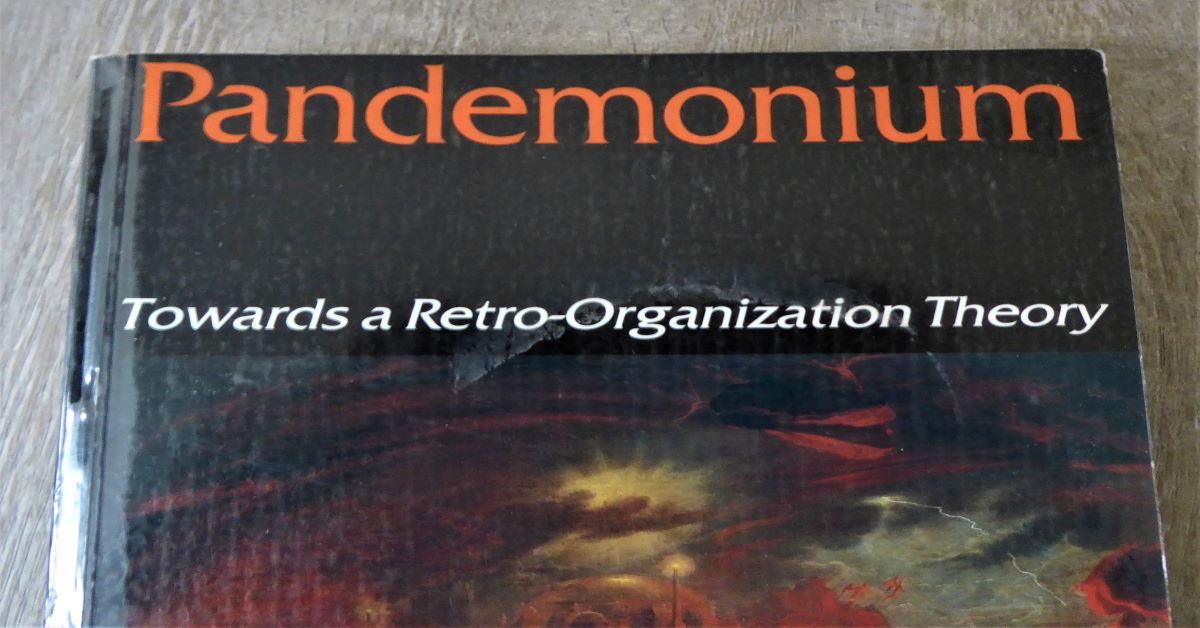
  • Pandemonium: Towards a Retro Organization Theory (Burrell, 1997)

    Pandemonium: Towards a Retro Organization Theory (Burrell, 1997)

    Withdrawn from the University of North London Library

    A wonderfully weird book

    I only managed to read half of this book, or did I?

    In the body of the book, the top half of each book page goes forward in the normal linear manner, whilst the bottom half of each page goes backward, with arrows attempting to assist the reader on what is a difficult navigation.  This is illustrated in the Linearity Kills extract below.

    Linearity Kills - Extract from Pandemonium
    Linearity Kills – Extract from Pandemonium

    I reached what we traditionally think about as the end list of references, what Burrell (1997) refers to as the pandemonium municipal library.  This was in the centre of the book, at which point there was a full-page illustration of an entrance/exit and I went through the exit as I knew I was going to struggle reading pages going backward. My specialism is organizational change – going forward.

    The book has some wonderful insights into organization theory, but I was reading the book to inform a historiography project of my own and I didn’t have the time for the playful creativity of the way the book was organized. We have an annual research conference which goes back years, there is a style guide to assist early career researchers in formatting their abstracts, Burrell (1997) is used as a best practice exemplar of formatting, playful creativity is alive and well in universities. As Burrell (1997) states linearity kills, so let’s go backward.

    Studying organizational theory in the 1980s

    I am a second-year undergraduate and my memories are very vague.  However, I remember the lecturers becoming excessively excited about a new textbook – Sociological Paradigms and Organisational Analysis (Burrell and Morgan, 1979). It was the course text for the organizational theory module and in those days, you bought the course text (or I certainly did, see photo of my student copy).   The dilemma was that the students didn’t really understand the textbook and didn’t share the excitement of the lecturers.  The lecturers decided to invite Gibson Burrell over to do a guest lecture, unfortunately, we understood the textbook even less after his talk.  Years later I learned to love the book and although it became fashionable to question the paradigmatic analysis it spawned, I still enjoy fondling this classic.

    Chronarchy in the UK

    I purchased Pandemonium (Burrell, 1997) (see photograph) after reading Burrell’s (1992) chapter ‘Back to the future’.  In this chapter, he was a pioneer making connections between temporality and organization change prefacing later debates about temporality by many years.  In what is still a very provocative chapter he warned that we are easy prey to chronarchy (oddly the spell checker keeps attempting to change this word to ‘coronary’, perhaps a precursor to the future).

    Moving forwards (ho ho), in the conclusions he suggested that the management of change as taught lacked self-reflexive analyses of issues of substantive and thematic temporalism.  He favoured spiral time which at the time seemed silly but having lived through organizational changes and the repetition of old ways of working as new ways of working, it seems eminently plausible.  He suggested that organizational analysts should be historiographers. Today this is accepted, but back then it was a bit different.  I began to appreciate that to go forwards I needed to go backward.

    The 2012 London Olympic Games

    In the spirit of avoiding linearity and avoiding chronarchy we find ourselves at the Olympic Games celebrating history and interweaving the past with the present in a creative, yet also a subversive way.  In order to appreciate the importance of the National Health Service (NHS) we had to revisit the past of the NHS in the ceremony. The opening ceremony was so special that Danny Boyle was quizzed on the inspiration behind it and Pandaemonium 1660 – 1886 (Jennnings, 2012) was acknowledged with Danny Boyle quoted in the Foreword to the 2012 edition (see photograph of the book).  I purchased this book which is best described as a compendium of moments from human history.  The subtitle helps to highlight the intent of Jennings (2012) – The coming of the machine as seen by contemporary observers.  It is an era which has fascinated me as we witness the precursors to the OD practitioners, change managers and project managers of today. At this time Projectors were very prevalent, yet rarely acknowledged today and very absent from progressive textbook histories.

    Back to the past

    I have jumped all over the place in a weird homage to Burrell (1997) we can return to his weird book and the opening page which appears perversely to be going in a linear direction.  He cites an earlier edition of Humphrey Jennings book as his inspiration and justification for mixing up the text.

    Normally, the symbolic ordering of our lives takes place textually on the page or the screen but it is laid out in very, very particular ways.  These constrain our thought and our ability to envisage a set of other possibilities. (Burrell, 1997:1)

    Two decades later this quotation has very real meaning for me. I enjoy writing but most of my writing is performance managed by peers or markets.  I am enjoying writing these posts with no need for validation by peers or market forces, it is hard to convey how liberating that feels and the possibilities such liberation raises for writing in a less ordered manner.  I am listening to Robert Merlin’s Adventures of Robinson Crusoe Soundtrack which accompanied the early sixties black and white TV series as I write this. I have reminisced about my student days and remembered the wonderful opening ceremony for the Olympic Games. Nobody is ever going to publish such meanderings or pay me to write in such an unordered manner.

    Today I have resisted textual symbolic ordering. I like to draft these posts, and then schedule posting for a later date.  Tomorrow, I may not resist textual symbolic ordering and may change this post as it is still in draft form.  Today, we do not just allude to spiral time, we can embrace it.  As Burrell (1997: 25) hasn’t featured as prominently as I hoped, but then again everything is textually permissible in the world of Pandemonium, I give him the final words.

    Thank you very much for coming.  This bunker was constructed fifteen years ago with capital provided by a book called Sociological Paradigms and Organisational Analysis.  Since its building, I have rarely ventured forth into the campus except for the occasional foray.

    WULBA Archivist

    Further Reading

    Burrell, G. (1992). Back to the future: time and organization. In M. Reed., and M. Hughes (1992) (Eds) Rethinking Organization: New Directions in Organization Theory and Analysis, pp.165-182. London: Sage Publications Ltd.

    Burrell, G. (1997). Pandemonium. London: Sage Publications Ltd.

    Burrell, G. and Morgan, G. (1979). Sociological paradigms and organisational analysis: Elements of the sociology of corporate life. Aldershot: Gower Publishing.

    Jennings, H. (2012). Pandaemonium 1660–1886: The coming of the machine as seen by contemporary observers. London: Icon Books Ltd.

  • Academic Identity and Organizational Change

    Academic Identity and Organizational Change

    Academic Identity
    An academic enthusiastically working with Blackboard intranet

    I am an academic, or perhaps I am academic

    How do academic identity and organizational change overlap? In organizational change studies ‘identity’ has become the new ‘culture’, a way of engaging with that old chestnut ‘the way we do things around here’.  In organizational change practices, there is less talk of identity, I suspect culture remains an influential mental model. I am going to use myself as an illustration of why individual transitions, identity, and psychodynamics increasingly inform understanding of the way we do things around here.

    I am an academic

    At a recent external workshop, I used myself as an example of the concept of individual identity explaining that my work as an academic was a major part of my identity.  One of the workshop participants responded that her identity was far more than what she did at work. 

    I thought how lucky she was. She made the point well that our identities may relate to sports, hobbies, families etc, we are far more than how we earn our living. Interest in organizational, group and individual identity can be traced back to the 1950s, but I have only been engaging with it over the last few years.

    The organizational culture debate moved on

    In understanding why identity is so important to theories and practices of organizational change the writings of Andrew Brown are informative.  I have been around long enough to remember when culture and cultural change were in fashion, particularly in the late eighties and nineties.  At that time the promise of changing cultures was exciting, there was alchemy at work.  However, beyond the smoke and mirrors, academic concerns remained that the promised cultural change was not being delivered.

    Despite such concerns the rhetoric continued, particularly in the practitioner orientated literature.  Brown’s (1998) Organisational Culture drew together research, scholarship and most importantly critical thinking. I would use it as my key text in workshops and his approach appeared to go down well with workshop participants.

    As the years went by, I’d say to workshop participants ‘it is dated now, but it is still a good book’.  I slowly began to realize that there would never be another edition of this book. There never could be another edition.  Andrew Brown had moved on and the organizational culture debate had moved on, or more specifically had quietened down.

    Managing culture or changing identities

    Through my literature reviewing, I was aware that Andrew Brown was increasingly focussing on identity work amongst other things.  Initially, I didn’t make the connection between his early work and his later work, but today it appears obvious.

    Identities, people’s subjectively construed understandings of who they were, are and desire to become, are implicated in, and thus key to understanding and explaining, almost everything that happens in and around organizations. (Brown, 2015: 20)

    Understanding organizational identity becomes a logical progression from understanding organizational culture.  It offers a more sophisticated way of understanding, although it isn’t an either/or choice. Ideally, we engage with organizational identity as well as organizational culture.  Brown’s (2015) identity literature review is a wonderful starting point for anyone interested in these debates.

    Universities changing cultures or changing identities?

    In the example, in the opening paragraph, I was seeking to convey in the workshop how integral being an academic was to my own identity.  In the university sector, we are rather belatedly going through transformation and change. I struggle with some of it on many levels.  Today the large business consultancies who advise all universities seem to still have a nineties mindset. This is long after academic thinking in universities has moved on. 

    Although consultants and university leaders talk far less about culture and cultural change, it still seems to be their mental model.   Between the lines of their carefully crafted corporate communications, I read ‘we need to change the culture around here’.  In some ways, they create the resistance to change which apparently strong university leaders then overcome. A case of framing the problem and then offering a solution. Or as the anarchists more crudely used to suggest – they break our legs and then offer us crutches!

    On trying to become a ‘happy robot’

    However, if we frame this scenario in terms of identity work it is easier to understand my struggles and potentially engage with such struggles in a more collaborative and collegiate manner.  For example, universities are experiencing what is breathlessly described as a ‘digital transformation’, it is going to happen, it has to happen. 

    Apart from when I am in meetings or facilitating workshops all of my work is focussed on peering into this computer screen. Every aspect of work appears to begin and end with peering into this ****ing screen.  Assignments and dissertations are submitted and marked online. I get that … however the structure and style of feedback are increasingly prescribed, all the autonomy that characterized being an academic is being sucked out of the job. 

    I sometimes feel like a skilled call centre worker, or a happy robot (if robots had feelings). My so-called resistance to change is more about my struggle to change my academic identity into someone more malleable and compliant in thinking in a more standardised manner, rather than independently and autonomously. I am trying (some say very trying), but what is required is a significant identity change.

    A simplistic textbook treatment of individuals

    I wrote my first textbook on change management at the beginning of the last decade. My big idea was a strong focus on individuals and individual transitions and bringing in more critical thinking. Today, the individualistic focus seems rather naïve and simplistic.

    Thankfully we all change and writing the first textbook enabled the later writing. Even happy robots can grasp the concept of learning.  I began to realize that there was something missing in my preoccupation with individuals and individual transitions. In writing the new textbook (Hughes, 2019) my thoughts oscillated considerably on introducing the concept of identity. 

    A chapter on individuals and individual transitions would have been conceptually easier for readers and to be honest easier to write. However, I use draft versions of chapters as workshop resources and identity seemed to go down relatively well in workshops, so I am glad I have included it in the new textbook.  Again in the spirit of honesty, normally at least one or two workshop participants perceive identity as another academic abstraction.

    You are going deeper, deeper into your earliest memories

    There was still something missing from the chapter, think back to Mark’s struggles with university change. His struggles could partially be explained in terms of his individual differences informing this individual transition.  Individual identity offered another informative lens to explore what was happening. However, still, there was something missing in terms of what was happening at the least observable level – the unconscious. Psychodynamics help to explain what is happening at this level offering another means to understand how individuals experience organizational change, through drawing on resources from psychoanalysis.

    An organization, in essence, is a collection of individuals invariably focussed on a task. In seeking to understand the very different ways individuals experience organizational change we need to look at individual differences, psychodynamics, and identities. Twenty years ago, I didn’t get that, but thankfully today I do, individuals change as well as organizations.

    Further Reading

    Brown, A. (1998). Organisational Culture. London: FT Pitman Publishing.

    Brown, A.D. (2015). Identities and Identity Work in OrganizationsInternational Journal of Management Reviews 17(1): 20-40.

    Hughes, M. (2019) Individual differences, psychodynamics, identities and organizational change. In Hughes, M. (2019)Managing and Leading Organizational Change. London: Routledge.