Category: Psychogeography

  • Understanding Sir Joseph William Bazalgette’s Battle with the Projectors

    Understanding Sir Joseph William Bazalgette’s Battle with the Projectors

    Introduction

    On the 4th November (2025) I went on an enthusiastic pilgrimage to a sewage pumping station, begging the question why?

    I discovered Sir Joseph William Bazalgette (Bazalgette) and his contribution to civil engineering about fifteen years ago. I was delving into project management pre-history, the early days, when learning about the management of large projects was still embryonic.

    I never anticipated my deep dive would take me into the world of sewage and sanitation projects and the even murkier activities of the projectors. In The Age of the Projectors, Keller (1966) offered us a definition of projectors as “the promoters of schemes for industrial expansion on the grand scale.” This firewalled History Today article is well worth a read if you are interested and have access.

    Strangely, projectors remain completely hidden to most academics and most of society. Projectors definitely did exist as I will illustrate by contrasting their activities with the achievements of Bazalgette.

    The next section introduces and explains the forgotten activities of the projectors. London would have looked very different if they had secured the funding Bazalgette secured for the London sanitation projects. Next, I contrast Bazalgette’s achievements with those of the projectors he was encountering. For myself, Bazalgette took on the guise of a super hero. Heroes need to be understood in opposition to villains, in this case projectors active in London at this time. I visit Crossness Pumping Station, and focus upon how I perceived Bazalgette tangibly differentiating himself from the projectors he was encountering. Finally, I conclude on the past, present and future of the projectors. My desire is to remember Bazalgette’s more subtle achievement – a very different way from the projectors of managing large scale industrial projects.

    The Forgotten Projectors

    It is difficult to fully appreciate and engage with the suffering of Londoners at the time of the Victorian cholera epidemics.  It is the medical advances of scientists such as John Snow which offer us something more tangible, more hopeful.  Similarly, we look to the Embankment, the Main Drainage and the Crossness Pumping Station as tangible positive outcomes of Bazalgette’s successful management of large projects.  We may lose site of others unsuccessfully competing to undertake these public works. The project environment Bazalgette and the Metropolitan Board of Works (MBW) were challenging becomes less evident.

    MBW Logo

    It was only as I delved into the murky world of the projectors that Bazalgette came into contrasting view. In all honesty, I hadn’t heard about his work and I hadn’t set out to study him.  I discovered that he was consciously and symbolically challenging the projectors when seeking funding for the programme of London sanitation projects.  His innovativeness, defiance of previous norms and social consciousness caught my imagination.

    Keller (1966) offered a very balanced historical overview of the projectors.  Whilst, he didn’t focus upon the London sanitation projects, he probably would have seen the projectors as a necessary precursor to Bazalgette’s public works.  In essence, the projectors encouraged local authorities, governments and societies to dare to dream about expensive progressive visions of the future. We take notions of progress for granted today, but this wasn’t always the case. Keller (1966) regarded projectors and their projects as characterising a phase in history up to about 1660. However, the terminology of projectors was still in use throughout the 18th and 19th Centuries and projectors were still operating at the time of the London sanitation projects (see examples in the next section). 

    Accounts of projectors cross traditional academic discipline boundaries with references to projectors evident within technology, innovation, engineering, entrepreneurship, political and literary histories.  Johnathan Swift explicitly referred to projectors in Gulliver’s Travels. This famous novel was originally published anonymously due to its critique of prominent figures and institutions within society and politics.  Swift depicted the projectors as luring the gullible into fantastic engineering schemes, yet when these works failed, the projectors departed in search of new people to trick into such schemes.  More subtly, it has been suggested that Swift was critiquing certain members of England’s Royal Society and the scientists and scholars engaged in experimentation intended to yield practical applications. Keller (1966) favoured a more balanced perspective, but did acknowledge that projectors had a bad name in terms of deceiving themselves and others and dazzling their victims with technical terms.

    Bazalgette vs The Projectors

    The challenge for Bazalgette and the MBW was to differentiate their reputable project activities from the more speculative activities of projectors. 

    What examples of projectors were evident at this time? 

    • The partnership of Napier and Hope and Thomas Ellis aimed to profit from the conversion of raw sewage from the outfalls although both ventures failed as a consequence of the collapse of the capital investment markets in 1866. 
    • The Great London Drainage Company promoted by John Morewood proposed making a profit from metropolitan sewage by applying it to agriculture. 
    • MBW had to undermine the credibility of another projector Wicksteed’s London Sewage Company
    • Railway projectors such as the Thames Railway Company wanted to develop railways into the centre of London along the banks of the Thames. 

    These examples may be regarded by some as entrepreneurs simply seeking to compete for public funds. However, my reading of Bazalgette and MBW activities was that they were concerned that such projects had the potential to undermine the public perception of the London sanitation projects and the utility of the significant public funding required.    

    How did Bazalgette seek to differentiate the London sanitation projects from the activities of the projectors?

    The London sanitation projects can be differentiated from the projects of the projectors in terms of innovations which would be regarded as project management best practices a century later. Innovations evident included; transparency, contracting, leadership and governance and process-based knowledge.      

    • Transparency – The process of undertaking major projects became far more transparent.  Government commissions preceded the London sanitation projects reflecting a desire to understand the nature of health problems affecting London with a view to finding effective solutions.  Closer scrutiny of the funding of major projects became increasingly evident.
    • Contracting – Large-scale contracting was informed by learning from the construction of barracks during the Napoleonic wars.  Competitive tendering for large projects replaced earlier arrangements whereby clients made arrangements with each master craftsman. Contractors increasingly engaged in competitive tendering processes and as part of this process agreed to penalty clauses being written into contracts. 
    • Leadership and Governance – Bazalgette and the MBW proactively challenged the activities of the projectors.  They worked closely with a range of key stakeholders including the government, the engineering profession, the contractors and the media in order to gain societal approval for their projects. 
    • Process-based knowledge – Project-based processes were beginning to be undertaken during this era, differentiating these projects from the earlier more opportunistic projects of the projectors.  

    The London sanitation projects were perceived at the time as being successful and with the benefit of hindsight they still appear successful.  The projects acted as an exemplar of what could be achieved. They gave impetus to local government in London and other local authorities beyond.  Bazalgette and the MBW through the London sanitation projects effectively addressed the number one cause of death in London at that time.  Whilst not always elegant they appear to have succeeded in both encouraging and meeting growing project expectations of government and society. Histories of project management typically begin in the 1950s, but many of the field’s subsequent best practices were evident on the London sanitation projects.

    Visiting Crossness Pumping Station

    On the 4th November 2025, I had the pleasure of visiting the Crossness Pumping Station in order to engage tangibly with the historic management of sewage in London.

    It was a pleasant surprise to undertake the final part of my journey on the Royal Arsenal Narrow Gauge railway, pulled along by the suitably named Bazalgette engine (see above). We found ourselves next to the current Thames Water treatment works. Smells in this instance added to rather than distracted from the visitor experience.

    Volunteers on the railway and at the pumping station had a passion and enthusiasm for their “work” and there was a wonderful sense of community. We started with a very informative talk on the background history. We were then taken on a fascinating guided tour by Arnie, who had effectively transitioned from plumber to charismatic tour guide.

    Previously, I had seen images inside the pumping station, but still the irony of beauty contained within the pumping station made a big impression. I want to focus on three insights relevant to the projectors which I gained from my visit and the informative narrations, although there was so much more to the tour.

    1. High up on the outside of the pumping station a carving of Bazalgette’s head was pointed out to us. Today, in an age of self-promotion and celebrity this might be viewed as ego. However, I choose to regard it as Bazalgette taking ownership/responsibility for the project. In contrast to projectors promising the world, failing to deliver and then disappearing, symbolically Bazalgette is still visible in 2025.

    Figs and Senna Pods

    2. Inside the pumping station we focus on the decorative iron working beautifully painted in rich colours. It seems excessive and out of context in a sewage pumping station, but this contradiction just adds to the beauty of the spectacle. Our guide explained how Bazalgette needed to make tangible this project, which had benefitted from large amounts of public money, at a time when such spending on infrastructure was a relatively new undertaking.  We were asked to look very closely at the decorative work and we realise that we are looking at figs and senna pods (see image above). A sanitation joke hidden in plain sight. Again, in contrast to the projectors who invariably cut financial corners, excessive decorative work symbolises the antithesis of cutting corners.

    3. We visited the building where the opening ceremony banquet was held.  I’d seen the pictures before, but the idea of a banquet in a sewage pumping station is still hard to grasp. It is explained in terms of messaging to civic dignitaries and funding bodies what their funding had enabled. Again, we encounter a contrast with the projectors of that era. You could imagine projectors hosting a banquet when seeking funding, rather than after the project was completed.

    The Projectors – Past, Present and Future

    Past – In this post, I have summarised my peer reviewed paper, The Victorian London sanitation projects and the sanitation of projects. This paper was published in 2013 in the International Journal of Project Management. I am afraid academic papers tend to be firewalled by the publishers, but if you have journal access, the paper title above leads to the journal log in page.

    If you are interested in learning more about the projectors, Steve Reeve and myself had the pleasure of supervising the doctorate of Kristina Zekonyte. Her focus shifted from my fascination with Bazalgette and the London sanitation projects towards contributing to a deeper historical understanding of the projectors. Clicking on her title below should take you to the successfully completed doctoral thesis, which thankfully is not firewalled.

    Projectors in seventeenth century England and their relevance to the field of project management

    Present – Today, forgotten projectors are rarely acknowledged in historical accounts of Bazalgette’s considerable contribution to the effective sanitation of London. More generally, the existence and prevalence of projectors is rarely acknowledged in theories and practices of project management. Today, embracing the latest artificial intelligence searching for the history of the projectors, you are likely to be taken down a history of visual aids rabbit hole.

    Future – As I wandered around the Crossness Pumping Station, I was amongst visitors and volunteers of a similar age to myself. History is very appealing and relevant when you have more past than future. However, amongst all the brave new world talk of artificial intelligence and other innovations, forgetting the past can and should be questioned. 

    Those who cannot remember the past are condemned to repeat it.” (George Santayana, 1905)

    I suspect Bazalgette would be saddened to witness how a large industrial project such as HS2 is being managed by the brightest minds in business and government today.  Grand schemes failing to deliver what societies have financed is nothing new. For myself the projectors whom Bazalgette tangibly differentiated himself from still exist, if only you look beyond the very expensive suits and top of the range smart phones.
  • Whatever happened to the best Brighton pubs of the 1990s?

    Whatever happened to the best Brighton pubs of the 1990s?

    Introduction

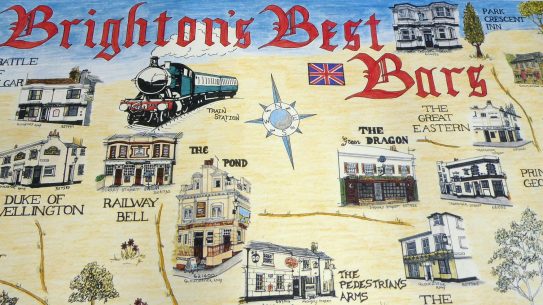
    It’s the early 1990s; I couldn’t tell you the year. I walked into an independent bookshop. It may have been the garishly painted Public House Bookshop, fitting, but I really cannot remember. I spotted an art print, the Brighton’s Best Bars, a thing of beauty, printed on high quality art paper. I purchased it, impressed with the detail of the original images of pubs hand painted and wonderfully detailed. The numbers beneath each pub refer to landline telephones, this is a time before the internet and social media.  I do not know the name of the artist and what selection criteria they applied. I do know that I visited many of these pubs in the 1990s/2000s. 

    It is autumn, 2025 and I haven’t drunk alcohol in a long time and rarely visit pubs.  Most of the pubs are still serving or have been reimagined (names/décor etc). These two categories of pub would make for an interesting walk/pub crawl, but I will leave such adventures for those “thirstier” than myself.

    The theme for posts in 2025 has been PSYCHOGEOGRAPHY – relationships between geographical landscapes and the unconscious. Famous psychogeographers would drift around cities such as Paris with little purpose to their wanderings (wonderings). I concede my urban wandering does have a purpose, I even designed a MAP of the 7 locations.

    I delayed writing this post for a few years, mindful of ghosts of distant memories and reticent to exhume my past. Psychogeography offered a framework to make sense of the changing landscape of my past.  I had to focus on the lost pubs, that was my only option. 

    I had arrived in Brighton in 1987, and discovered a city in need of exploration. I was probably more of a psychogeographer then, than today, fairly aimlessly drifting along the quieter back streets of Brighton randomly sampling the pubs I discovered.  

    In the next section, I list those pubs featured still serving and having maintained their original name. Next, I list those pubs featured, but today reimagined.  Please note this is my best effort at the time of writing, changes inevitably happen, particularly given the precarious nature of the licensed trade.  I next focus upon those pubs which no longer exist. I conclude with an intriguing Promotional offer and a section less intriguingly welcoming Updates.

    Still serving

    The following roll of honour, in alphabetical order, acknowledges the 24 pubs still serving, at the time of writing. This is approximately 35 years after the art print was published.

    Battle of Trafalgar, Bedford Tavern, Colonnade Bar, Crescent, Cricketers, Druids Head, Fortune of War, Great Eastern, Green Dragon, Hand in Hand, Heart and Hand, Ye Olde King and Queen, Ladies Mile, Lion and Lobster, Long Man of Wilmington, Marine Tavern, Park Crescent Inn, Pond, Prince George, Railway Bell, Regency Tavern, Royal Sovereign and Shakespeare’s Head and The Windmill.

    Over the decades there have been changes such as the relaxation of licensing hours and the smoking ban. Equally, there have been changes in the economy and society, such as the pandemic.  It is impressive how popular pubs thrive and adapt despite the challenges. Many pubs come and go, but the pubs chosen by the art print artist as the “best” are largely still serving.

    Reimagined

    Pubs are sometimes reimagined, the physical building remains largely intact, but the pub name, theme and décor change. It has been more challenging to identify these reimagined pubs. I believe these 13 pubs have been reimagined. I have listed them alphabetically, based on the original art print, they are as follows:

    Battle of Waterloo became Brighton Rocks

    (The) Conqueror became Bottom’s Rest

    (The) Geese Have Gone Over the Water became The Geese

    (The) George Beard became the Eagle

    (The) Lamb and Flag became Crowns

    (The) Landsdowne Arms became Cooper’s Cask

    Oliver Cromwell Tavern became The Palmeria

    (The) Pedestrians Arms became The Foundry

    Royal Exchange became Haus on the Hill

    (The) Star became The Mucky Duck

    (The) Volunteer became The Mash Tun

    (The) Windsor Tavern became The Earth and Stars

    (The) Walmer Castle became The Independent

    The scale of these reimagining’s can be major or minor. As a pub changes its identity you can feel more or less welcome. Reminiscing, I remember having to ask for a key code to access the toilets at The Star.  At The Walmer Castle, there was a lovely cosy room at the back. I wish I had gone in The Pedestrians Arms, what a wonderful name for a small pub. And the reimagined Brighton Rocks, what a clever name given the Rock Place location and the famous Graham Greene Brighton novel.

    Last orders

    Inevitably, this third category of pub proved to be the least easy to locate. Invariably, these pubs were no longer discernible as those pubs featured in the art print. Thankfully, in small print the artist included road names beneath each pub image which helped to pinpoint locations. I then established “approximate” postcodes as I searched for these pub locations today.  The upside was that postcodes worked well with Google mapping. The downside was that this wasn’t precise in locating where a pub once stood with buildings and roads changing over decades.

    In ordering these lost pub locations, I wanted to walk from the West to the East of Brighton and Hove. My early homes were in the West of the city and later homes in the East.  In essence, the locations of the 7 lost pubs provide a linear walk, starting in Hove and ending in Kemptown. After considerable desk research, my MAP of the 7 lost pubs was ready.  It was a fairly bright October morning when I started.  I needed the light for the black and white photography, but by the end of the walk, it was grey and damp and my mood similar.

    I chose to begin the walk at the beginning of Lansdowne Road walking East towards the city centre. I had forgotten how enjoyable Lansdowne Road can be, similar to a priest hole passage in an old house. I moved from West to East largely unseen and without the congestion of Western Road in search of the Montpelier Inn (BN1 3BT). This building has listed status, complicating the redevelopment of the site.  The pub appears to have had an interesting/chequered history. I remember living very nearby on York Road, as well as, on St Michaels Place, but I don’t think I ever ventured into the Montpelier Inn.  I lived in houses euphemistically labelled homes of multiple occupation (HMOs), although today, I could think of other labels. The Montpelier Inn was difficult to photograph as redevelopment was evidently ongoing. I didn’t want a builder thinking I was a HMRC investigator and equally I am not sure that they would share my interest in psychogeography.

    Next, it is a pleasant/straight forward walk continuing along Montpelier Terrace and Upper North Street to the site of the Princess Victoria (BN2 1RP).  I drank in this pub many times with my Dad, as well as on my own. Its attraction was how close it was to the centre of Brighton, although many visitors to the city seemed unaware of its existence. Dad and I would have a few drinks in here and then stroll down Regent Hill to meet my Mum outside Marks and Spencer‘s, on Western Road, happy days.

    It wouldn’t be Brighton without a visit to the seafront and the artist located Trogs Tavern on, the Kings Road, the main seafront road. So, I head South, Marlborough Street works well, before crossing the busy Western Road and then skirting around the edge of the large Churchill Square shopping centre.  I occasionally would bet on the football. As I pass the Ladbrokes bookmakers, I am tripping back in time. I remember going into this shop and the cashier had to go around the back to get my winnings from the safe. I think the bet might have been on Jose Antonio Reyes scoring the most goals for the opening month in the Premier League. It’s the safe bit of this distant memory that sticks with me, sadly Reyes died too young.

    I believe Trogs Tavern was located between the Metropole Hotel and Regency Square, but this is guesswork.  I have been unable to find a historical record of Trogs Tavern. However, the Granville Hotel was located about where the artist located Trogs Tavern.  I go through Tripadvisor reviews of the Granville Hotel from twenty years ago and find a reference to a Trogs Restaurant being attached to the hotel for a time. Trogs restaurant then appears to have moved to the site of Bom Banes on George Street and the Granville Hotel became No.124 by Guesthouse. As I stare at No.124, I am wary of being perceived as a voyeur, but I believe I am looking towards the site of Trogs Tavern.

    I now go in search of the Norfolk Arms (BN2 9QA) which was another elusive pub to trace, but first the route.  I walk East along the seafront towards the Palace Pier. This proves to be an emotive walk. It is a seafront walk I rarely do and normally only out of the tourist season. I reminisce about the site of the Shelter Hall today; in 1987 it was the Tourist Information Centre. Seafront ghosts surprise me, but the seafront always was an evocative and ever-changing area, drenched in emotions, both good and bad. I remember leaving one of the HMOs with my belongings in bin bags, walking along the seafront to my next home, a lovely flat in Kemptown. Various keys to the HMO now surplus to requirement. I ritualistically threw them into the sea; a sort of banishing ritual.

    More walking and less reminiscing are required as I reach the Palace Pier I turn North.  At the time of writing the Steine Gardens Road development project was ongoing, so hard hats might be required. I walk North past the Old Steine Gardens and head North until I reach Victoria Gardens.  I pick up Grand Parade heading North and find the now closed former location of the Brighton Brewdog.

    The desk research complication was that there was a Norfolk Arms in Brighton which the internet acknowledges goes back to 1824 before the site was used for the Norfolk Hotel on the seafront. However, the artist located the pub in question on Grand Parade. It appears that the site of this Norfolk Arms was redeveloped (not just reimagined) with another pub built on the same site called Hector’s House and subsequently the Brighton Brewdog.

    The polytechnic/university has a highly regarded Art and Design Faculty near to the location of what was the Norfolk Arms. I suspect this pub may have been very local for the artist. I never went inside the pub, but the campus location stirs up ghosts for myself, both good and bad. I decide to capture a front facing shot of the pub location. It’s challenging as I wait for a gap in the cars and lorries. Equally, I wait for a gap in the students passing by, whilst noting how they “drift” in a style unique to students.

    The route to the next pub is fairly straightforward. First, I retrace my steps back down Grand Parade until I reach Edward Street and then head East until I reach the High Street and then head South until I reach the junction with St James Street.

    I know exactly where I am going, The Ranelagh Arms (BN1 3FG). It used to be one of my boss’s locals and we would often meet up here as a work group. These were happy and sociable times.  I remember invariably it was lively with an equally vibrant outdoor area in the summer. It became the Tiki Hut, but at the time of writing it was on the market. In time it might be reimagined as a pub.  When I visited it was sadly boarded up, with the ghosts of memories trapped inside.

    I now have a very short walk to the Leconfield Arms (BN2 2JL), back up the High Street to Edward Street and then East until I reach J.W. Lennon’s. This was the John Lennon reimagining of the Leconfield Arms, which subsequently closed. So, perhaps a case of “imagine there’s no J.W. Lennon’s, it’s easy if you try.”   I went into the Leconfield a few times, but my memories are vague.  I do remember the pub layout/bar being parallel to Edward Street, but sorry that is not much of a testimonial. 

    Enough reminiscing, I need to move along to the final pub, the Stag (BN2 1JP). Again, I head East on Edward Street until I reach the crossroads. Then head a short distance South down Upper Bedford Street and find the final pub site has been completely redeveloped.

    In my drinking days, I often drank in the Stag. They served Oranjeboom on draft, which was nice. I liked the layout of the pub, many different spaces to lose yourself. I lived at the top end of Freshfield Road at that time and would visit the Freshfield, Cuthbert and Stag all in a line going downhill towards the sea.  I would then retrace my steps back up the hill.  One ironic memory was that the Cuthbert had a wonderful painting of a Stag. I do remember a time when all three of these pubs were thriving, with sing-a-longs in the Freshfield.  I also remember their decline, sitting in relatively empty pubs, today all three pubs have gone, a sad note to conclude this sentimental journey.  

    The walk took a leisurely hour and a half with stops for photography and it was just under 3 miles.  However, at the end of the walk I felt very weary, although more of an emotional weariness than a physical weariness. Its 1.45pm and I decide to stop on my way to my Saltdean home at the Lobster Pot. I don’t want a drink, but I am in need of soul food. A large portion of chips is purchased for therapeutic reasons. The wonderful Chinese proprietor remembers me, demonstrating this by acknowledging that I have retired. Yes, today I have retired from so much of my former life. That said, I am no longer lost, like I was in the 1980s and 1990s. I believe my drifting days are over.

    Promotional offer

    The art print featured here has travelled with me as I moved around Brighton over 35 years. However, I never once put it up on a wall. There are a few creases, but given the journey we have both been on, it is in very good condition. Both as art and as a piece of local history, it merits a far wider audience, than being rolled up in my study.

    If there is a publican from one of the featured “still serving” pubs, who would like to have it, please do let me know. The art print would make a great conversation piece to display in your pub and I would be happy to update this post letting readers know the particular pub to visit to see it for themselves.

    Updates

    I would like to acknowledge the name of the artist responsible for the wonderful original art print.  If anybody knows their name, please do contact me (see below).  I will not be updating this post as pub circumstances/status change. However, if anyone spots any errors do let me know and I will correct them. I was surprised how easy it was to mis locate a lost pub.

    There is a comments facility below, but the “spam police” can be overly enthusiastic. The easiest means of contact is via the CONTACT page, which generates an email to me.

  • Crime Novel Locations and Psychogeography

    Crime Novel Locations and Psychogeography

    Introduction

    This is a thought experiment exploring the psychogeography of how intimately knowing crime novel locations might impact upon reading these novels. When I read crime fiction the locations of murder mysteries are disproportionately important to me. I particularly enjoy coastal, rural and woodland settings, rather than the claustrophobia and impatience of cities. 

    I moved to Brighton in 1987, and I have lived in Saltdean since 2007. I have become very familiar with the suburb of Saltdean and the town of Newhaven, four miles from Saltdean. A thought experiment evolved, to read murder mysteries, very, very local to me. I chose three murder mysteries, one set in Saltdean and two set in Newhaven.

    The specific murder mysteries came onto my radar by happy accident, rather than conscious design.  In 2024, I attended Crime Waves, part of Shoreham Wordfest. Speakers talked about their respective crime books, and particularly relevant was Lesley Thomson, as Death of a Mermaid was set in Newhaven. Lesley referred to the music of the local mobile fishmonger. I had heard these slightly surreal tones whilst gardening, and this became Book One. Also, at Wordfest, Mark Edwards author of Keep her Secret referred to his murder mystery being set in Saltdean, which had to be Book Two. Finally, Pauline Rowson’s murder mystery, Death in the Harbour, was set in 1950s Newhaven.  A book set in a town I knew well, but before I was born. This was Book Three.

    I am not going to review these books here, and I do not want to spoil plots for others.  Each book was enjoyable to read and proved to be very thought-provoking in different ways. The first two books were more psychological than I usually read.  The third was closer to my favourite police procedurals. I found the 1950s historical context in the third book an intriguing diversion from my usual present-day focus. 

    The theme for woodlanddecay.com posts in 2025 has been psychogeography (see HERE). Psychogeography offers a creative perspective on relations between landscapes and conscious emotions and unconscious thought processes. Urban wandering around Saltdean and Newhaven enabled joining the fictional narratives of authors. In this way, I experienced Saltdean and Newhaven differently, sharing the perspective of the author.

    The next three sections focus on Books One to Three.  A section offers reflections and insights from this thought experiment, before a postscript acts as a conclusion. The inclusion of author biographies and edited book overviews taken from the Amazon site is acknowledged through italics.

    Book One – Death of a Mermaid (Lesley Thomson) Published 7th May 2020

    Amazon Biography “Lesley Thomson grew up in West London. Her first novel, A Kind of Vanishing, won the People’s Book Prize in 2010. Her second novel, The Detective’s Daughter, was a #1 bestseller and the series has sold over 750,000 copies. Visit her website at lesleythomson.co.uk.”

    Amazon Overview “When Freddy Power was eighteen, her father threw her out. Her sin had been to fall in love with a woman. Freddy waited for two decades to be invited back into the family. The summons never came. But now, in the wake of her parents’ death, Freddy feels the call of home like a siren’s song. The trawlers emerging out of the mist. Fishermen unloading their catch down at the harbour. Her best friend, Mags, exploring the cliffs at sunset. But when she arrives at Newhaven, after twenty-two years of silence, her brothers and her friends act like strangers. Then Mags goes missing, and old secrets – and old passions – are reignited. Freddy is determined to lead the hunt for Mags – even if it means confronting her past, and facing the truth about her family…”

    On reading Book One – Seeing Lesley on stage talking about this book and her other books, made the narrative more personal. My experience of fishing, Catholicism and lesbian culture, featured in this book are limited.  This was not an impediment, and in some ways, I believe I learnt, even though this was fiction. The overarching emotion I felt whilst reading was one of frustration. It is a story of frustrated romances and frustrated ambitions.  Unfortunately, I read this book at a time when health ailments precluded me from my passions of rambling and gardening. So, I found myself in a frustration waltz with these characters.

    Newhaven offers an ideal landscape for the frustrated experiences of the characters.  Once far more prosperous, Newhaven has a feel of being shortchanged by councils, developers and by economics. Lesley poetically referred to Newhaven as “the seaside town of best forgotten faces”. The lead character, Freddy, is returning to the town where she spent her formative years. The quotation alludes to the truism – never go back. Whilst set in the present, this book is all about personal histories which inform and reassure us, but can also haunt us.

    Newhaven was once a vibrant port. The tidal Ouse connects Newhaven and Lewes.  There is a reference to the mood being reflected in the yellow colour of the Ouse. Locally, we perceive the variations in the Ouse in terms of colour, but also pace and sound. The Ouse, often moving sluggishly, works well as a mood mirror. 

    I want local settings to be accurately depicted. Yet, there is no reason why an author cannot employ poetic licence to tell their story. Lewes Premier Inn and the homes opposite feature with Freddy and Andy having a heart-to-heart in the hotel bedroom.  I know exactly where the author has located them.  Having stayed in many Premier Inns over the years, I know the standardised bedroom “ambience”. It was a surprise to read about the hotel bedroom mini bar being stocked with Jack Daniel’s. I don’t remember Jack Daniels in Premier Inn mini bars, then again, I do not remember the mini bars.

    As a counterpoint to my pedanticism, Lesley introduces me to places I hadn’t encountered on my urban wanderings. In particular, Newhaven cemetery with a statue near the entrance.  I went in search of the cemetery and was impressed with the statue that greets you at the entrance (see below).

    Image of the entrance to Newhaven Cemetery with sculpture by Richard Reginald Goulden

    Lesley referred to the sounds from a mobile fish van in her talk.  In the book, she references the sounds as the “…cringeworthy fanfare…” announcing the arrival of Freddy. It was these sounds that most intimately connected me with this narrative. I have heard the sounds Freddy’s customers heard. I wondered about the “cringeworthy fanfare” as I gardened, about the story behind these ironic sounds. It transpires that the mobile fish van was operated by Tim Woodward (Catch of the Day), as acknowledged at the end of the book.

    Growing up in Newhaven, Freddy, Toni, and Mags called themselves the mermaids. The book moves from their hopes and dreams as girls to the women they became twenty years later. This was the overarching frustration and a source of sadness for me.  A story not so much about what happened as what might have happened. Equally, Newhaven suggests a story of what might have happened.

    Book Two – Keep her Secret (Mark Edwards) Published 30th May 2023

    Amazon Biography Mark Edwards writes psychological thrillers in which scary things happen to ordinary people. He has sold 4 million books since his first novel, The Magpies, was published in 2013, and has topped the bestseller lists numerous times. His other novels include Follow You Home, The Retreat, In Her Shadow, Because She Loves Me, The Hollows and Here to Stay. He has also co-authored six books with Louise Voss. Originally from Hastings in East Sussex, Mark now lives in Wolverhampton with his wife, their children and two cats. Mark loves hearing from readers and can be contacted through his website, http://www.markedwardsauthor.com, or you can find him on Facebook (@markedwardsauthor), Twitter (@mredwards) and Instagram (@markedwardsauthor).”

    Amazon Overview: “… a deadly secret turns a couple’s new romance into a nightmare. And they’re not the only ones who know the truth… After twenty years apart, Matthew and Helena have rekindled their college romance and are away in Iceland on their first holiday together. Swept up in the romance on a mountain hike, one moment they are taking the perfect photo, the next Helena is hanging from the cliff edge… Terrified, Matthew almost misses Helena’s sudden and shocking confession—but what he hears chills him to the bone. And when Helena reveals the full truth Matthew is horrified, not only by what she’s done, but why she did it. Does he really know her at all …?

    On Reading Book Two – This book cleverly conjured up strong anxieties for me.  At every twist and turn of the narrative, my anxieties were cranked up.  I felt for the two lead characters, particularly Matthew, spinning downwards into the cleverly constructed vortex of the narrative. I found this an unsettling rather than a pleasurable experience.  I prefer to align with the detective who passively observes and investigates the aftermath of crimes.  However, this is my personal preference; I am certain the excitement generated for some would be a strength.

    Overall, it was unusual and enjoyable to read a book set in Saltdean. Helena comments, “I live in Brighton … well, just outside”. Yes, we are connected to Brighton, yet simultaneously disconnected. There is a reference to Saltdean as “… a small village”. The village label seems to be fashionable, but Saltdean as a suburb works better. Suburbs sleep as stuff happens behind closed doors.

    A white house high on a cliff overlooking the sea, with large windows, features prominently in the book. There is a real house high on the cliff referred to as the White House, and elements of this appear to have inspired the author.  There is a reference to “The house looked like it had been airlifted from Miami”. We do have a bar called the L.A. Lounge in Saltdean. However, I think this is a reference to the main shopping street – Longridge Avenue, rather than Los Angeles.

    At one point, Helena and Matthew go on a 15-minute walk from Saltdean to Rottingdean. I walk with them along the cliff top and then follow the undercliff.  They reach a pub close to a pebbled beach with views over the English Channel and a nearby windmill. They eat a meal at what is now called White Horses. In the past, I have eaten meals in this pub/hotel with family and friends; memories come back to me. Rottingdean is “… a lovely place full of old houses and narrow streets lots of BMWs and Audis around”, a very good definition.

    Mark’s narrative sucks Matthew into the darkness and deceit of criminality.  Helena’s confession means that Matthew becomes increasingly implicated. Again, my personality means I would run quickly and as far away as possible. I want Matthew to walk away, but he has a strong attraction to Helena; apparently she might be the one.  This is the conflict at the heart of the book. The anxiety-provoking question becomes – should I stay or should I go? 

    In terms of place, Saltdean works well as a sleepy backdrop for dark drama unfolding behind the closed doors of the White House. At one point, the storyline takes us to Beachy Head (near Eastbourne), described as “probably England’s most notorious suicide spot.” The base of Beachy Head is not normally accessible, but I was fortunate to visit as part of an organised walk.  I was amazed by the art of an artist, referred to locally as “Planksy” (see below).

    Art at the base of Beachy Head by an artist known locally as Planksy. Image of a large fish made out of found wood.

    I have undertaken many picturesque walks close by Beachy Head.  Equally, when characters go on other journeys, to Moulscoomb, Peacehaven and Newhaven and through the Saltdean underpass by the Lido to the beach, I know these journeys well.  The book ends with an informative letter to the reader from Mark:

    …I have taken some liberties with the geography of Saltdean.  The cliff on which Helena’s house sits does not exist.  And although there really were smugglers’ tunnels in that area, as in much of Sussex – including in Rottingdean – the ones in this book are invented.

    He refers to a book about smuggling in Saltdean in the main narrative.  I enthusiastically searched for this book on the internet. It is only when I refer to my copy of The Saltdean Story that I realise his Saltdean smuggling book is a narrative device. Mark acknowledges The Saltdean Story by Douglas D’Enno as being invaluable for research into smuggling in the area.  Whilst the smugglers’ tunnels are acknowledged as invented, it makes me wonder about possible secret tunnels beneath my feet.

    I was frustrated by the “liberties with the geography of Saltdean”, but I understand the reasoning, and for over 99.9% of the audience, it wouldn’t have been evident.

    Book Three – Death in the Harbour (Pauline Rowson) Published 10th Sept 2024

    Amazon BiographyHello, thank you for visiting my author page. I love creating fast-paced, twisting crime novels, set against the backdrop of the sea and I hope you get as much pleasure out of reading them as I do writing them. I live on an island on the south coast of England and when not writing, which isn’t often, I can be found walking coastal locations looking for a good place to put a body – fictional that is. I currently write three series: the DI Andy Horton Solent Murder Mysteries; the 1950s set historical Inspector Ryga Mysteries and the contemporary set thriller style mysteries featuring former Royal Marine commando Art Marvik. Happy reading.

    Amazon Overview1950, Newhaven, East Sussex. One foggy November evening, Police Constable George Swinley disappears while working his usual beat. Four days later, his lifeless body is found floating in Newhaven Harbour. His death is ruled as an unfortunate accident, but his devoted wife Myra thinks otherwise. Then Myra herself goes missing and Inspector Alun Ryga is sent to the Sussex coast to investigate. But nothing can prepare him for what he’s about to find . . .

    On Reading Book Three Death in the Harbour imagines Newhaven in the 1950s. Quickly, we learn that the recent World Wars overshadow everything. It was interesting that perceptions of characters were grounded and judged in terms of what they did or did not do during the war.  That was a learning point for me.

    I warmed to Inspector Alun Ryga from Scotland Yard.  Despite the authority of Scotland Yard, Inspector Ryga was seeking to establish himself as a new murder detective.  He always carries his murder case/bag with him whilst investigating.  Today’s equivalent of a forensics team, but inside a bag. The murder bag also gives the Inspector some of the authority he seeks. Inspector Ryga asks too many questions of himself.  In fairness, it might be a literary device to convey that he is new to his Scotland Yard role, this inner dialogue conveying understandable insecurities.  I repeatedly warm to his vulnerability. The overarching emotion this book evoked was uncertainty.

    I join the detective in this murder mystery.  I even offer to carry the murder bag. I enjoy locating myself within the Newhaven landscape and comparing today with a keenly imagined yesterday. My perception of Newhaven today changes through immersion in Newhaven yesterday.

    Venues such as The Bridge, I remember, though now gone.  Fort Road still exists, though located on the other side of the harbour in this book.  The swing bridge at the heart of Newhaven endures regardless of everything else, the fulcrum of this harbour town.  The references to St Margaret’s in Newhaven are confusing.  Landscape clues suggest to me that this church is St Michael’s. However, perhaps there is a reason for changing the name (hint/hint).

    Wandering around Newhaven with the author, I think of the topography as being the roads, particularly the A259, I use when I go through Newhaven by bus to nearby Friston Forest. Today, I believe too many cars pass through Newhaven, to the detriment of the town.  But this book encourages me to think more in terms of waterways. Boats feature prominently, with murders happening on or near the water. Different quays, harbours, and Denton Island become more significant in my understanding of Newhaven. In 1950, the prevalence of cars would have been far less.  Tidal water flows dictate the rhythm and pace of the narrative, locating suspects and dead bodies close to water. The Ouse becomes a moody key character in Book Three.

    Inspector Ryga confronts three prime suspects he believes to be the murderer. Unfortunately, each one effectively refutes his allegations.  It is slightly comical, though possibly intended by the author.  Imagine somebody playing Cluedo or Poirot with more enthusiasm than skill.

    This book was the second in a series of five, and I am enjoying reading all of them. I do like an anti-hero stumbling around in the dark, but finally finding the light switch.  The series includes a bizarre love triangle between Inspector Ryga, Sonia (ex-landlady of The Quarry Mans Arms) and Eva (the war photographer). He seems latently attracted to both women, yet uncertain what he feels for either of them.  Consequently, storylines follow his oscillating feelings without Ryga ever acting on his feelings. This beautifully poetic sub-plot provides the mystery within the mystery. Yes, the overwhelming emotion which Book Three invokes is uncertainty.

    Reflections and Insights

    I have had five learning insights through this thought experiment.

    1)Inaccurate depictions of Saltdean and Newhaven frustrate me. It was an informative surprise that knowing locations was more of an impediment than an aid to my enjoyment. The authors did not make mistakes; they used locations as starting points, but then elaborated from these settings.  Lesley needed to introduce Jack Daniels into a Premier Inn to lubricate the conversation. I am still left wondering about the existence of some of the smugglers’ tunnels beneath Saltdean described by Mark as “invented”. Pauline had to make certain changes to Newhaven related to the 1950s plot lest there were implications for people living there today.

    The inclusion of author notes at the end of these books explains how locations are knowingly reimagined and the author’s reasoning. These notes suggest that other readers like me can be a bit too literal. Top tip: if an accurate depiction of a place is important, check for any author notes at the end, before you start!

    2)Every depiction of a place must include subjective interpretations.  Thinking a little more deeply about “inaccuracies” is informative. Anybody writing about Saltdean begins with objective facts and then inevitably moves into subjective impressions. My understanding of Saltdean is largely subjective. No literary depiction of Saltdean, however accurate, could completely match either my interpretation or my next door neighbour’s interpretation.

    3)It is not the specific place, but the type of place which matters to me.  It is the atmosphere and feelings certain places evoke which engage me.  For example, I love watching TV detectives solving murders in forests.  A natural setting can be descriptive, yet generic.  I learn that I do not have to have visited the particular forest.  I am learning that I connect with authors and, by association, their characters when they are out in nature.

    4)History informs depictions of specific landscapes. Mark rekindled my interest in local smuggling history.  There is a famous footpath out of Rottingdean known as the smugglers’ path. I enjoy imagining on my rambles following routes once used by smugglers. I was intrigued enough by the existence of a cemetery in Newhaven to visit (see earlier photograph). Pauline takes us on journeys between Seaford and Newhaven.  Invariably, I make the journey by bus, others by car. However, seventy-five years ago, walking and rail travel were far more prevalent.

    5)There is always an emotional context to places and their depictions. Various emotions were provoked whilst reading. As overarching emotions, I felt frustration, anxiety and uncertainty reading the three books. Frustrations and uncertainties certainly haunt Newhaven as the town seeks a new purpose and identity. Anxiety, though, is the antithesis of the sleepy suburb of Saltdean.  I bring emotions to the party as the reader. How I am feeling is interrelated to the emotions invoked by the author. I am certain many readers enjoy the anxieties Mark conjures up.  For myself, I am with Inspector Ryga quietly seeking certainties in an uncertain world.

    The following is an extreme, though hopefully useful, final example of the centrality of local locations and emotions. About twenty-five years ago, I purchased The West Pier by Patrick Hamilton. At that time, I was living very close to The West Pier on Brighton seafront. I wanted to do something similar to the current thought experiment. I had to abandon the book after reading about a third. It was well written, and the historical depictions of local locations were interesting and meaningful. However, the author infused characters and places with dark emotions. The emotions were too close to my own at that time. Shane MacGowan sang “some drink to remember, some drink to forget”.  In the thought experiment, reported here, I have learnt that some read to experience strong emotions, whilst others read to escape strong emotions.

    Postscript

    I wrote this post in August 2025 and continued decadently reading crime novels. It is now late January 2026 and this postscript is a sort of a conclusion to my thought experiment. I have been reading and enjoying The Fethering Mysteries by Simon Brett. They feature the South Downs and Sussex towns and villages with which I am familiar. There are references to Brighton, Lewes and Worthing which provide a kind of geographical scaffolding for locating smaller towns and villages. The novels focus upon a fictious village of Fethering with other pseudonyms used for neighbouring towns and villages.

    The intriguing bit is that if you know the area, you have an insider feel for places featured, even when pseudonyms are used. Although not named, in one novel I feel like I am in Arundel and knowing Rustington helps me to understand the quirks of Fethering. One of the novels features Austen open prison. If you live locally you will have heard about Ford open prison. It adds to the reading experience knowing this potential juxtaposition. Equally if you have not heard about Ford open prison this will not impede your reading experience. These insider/outsider literary devices work for me and my conclusion is that this is the approach I favour.

    In The Fethering Mysteries, I enjoyed the contrast between the two key characters Carole and Jude. As amateur sleuths, they are poles apart in terms of personality. At one point Simon Brett attributes these words to Jude “Lewes always had that effect on her. There was something gloomy and introverted about the town, a feeling of hidden evil that had lasted through many centuries.”

    Personally, I like the pagan/magical undercurrents of Lewes. I am surprised that Jude given her liberal/new age leanings felt the way she did. This is how you begin to appreciate the wisdom of Simon Brett in his selective use of pseudonyms in these novels. Relationships between emotions and places will differ considerably for readers. The emotions we invest in places can also be strong and either positive or negative.

  • The Haunted Houses of Oswestry

    The Haunted Houses of Oswestry

    Oswestry in the Sixties

    I was born in Oswestry in the early sixties and left the town in the early eighties. As I attempt to time travel back to the late sixties, memories from over fifty years ago are inevitably vague. Oswestry was known for being on the border between England and Wales. It was located in a rural part of Shropshire, surrounded by countryside, yet quite urban in the centre. Once, a railway town with a significant station and engineering works. The presence of the railways ended in the sixties with the Beeching cuts, and Oswestry had to change.

    The sixties were a time of transition with a need for homes for a growing population.  In the early sixties, my parents bought a semi–detached bungalow on a new housing estate at the end of Cabin Lane.  We lived on a road called Whitefriars.  At the bottom of the garden, there was a flimsy hedge. Beyond that hedge, fields, old farm houses and an enchanting world of nature which required serious exploration.

    We subsequently moved to a different part of Oswestry. We listen to Sugar, Sugar by The Archies on a portable record player and dance in the garden. Today, the ghosts are the ghosts of memories.

    Exploring nature and testing boundaries

    At a young age, Dad would sometimes take my sister (Clair) and me down the lanes beyond the hedge, and we would pass the haunted houses.  Gunnera grew along the edge of the lanes out of all proportion to us as children. These were happy times.  A little older, I explored these fields and lanes beyond my home with friends.  

    During school holidays, in the daytime, we undertook most of our explorations. Upon reflection, we had no sense of rights of way or legal constraints; we were both fearless and foolish.  I know our desire to build dams with mud and stones was dangerous for livestock and annoyed farmers.  However, this wasn’t wilful defiance, but rather learning through experimentation.  We explored and mentally mapped our local terrain, driven by a playful desire to learn about and engage with our surroundings.  The following map draws upon fifty-five-year-old memories. I make no claims to either accuracy or artistry.  It is my best effort to suggest the respective locations of the three haunted houses.

    Map based on memories of the terrain back in the 1960s.
    Memory Map of Cabin Lane (1960s)

    The three Oswestry farmhouses

    Whilst the map above was drawn from vague memories, these scanned black and white photographs below are real, if blurred. This was a time before smartphone photography and user-friendly digital photography. My Dad had a Russian camera, which he used with enthusiasm, but the results were frustratingly mixed.  

    Two black and white photograph scans. 1.Mark pointing to the countryside 2. Mark with first haunted house in the background.
    Mark in the garden at Whitefriars

    In the first photograph, I am enthusing to my audience (probably Mum, Dad and Clair) about the virtues of the countryside at the bottom of the garden. In the second photograph, the first haunted house is evident in the background. At this age, I was not exploring the haunted houses. However, the view on the horizon would have inevitably caught my imagination.

    Children passed local terminology from generation to generation.  We referred to the three farm houses as the first, second and third haunted houses. The farm houses were relatively close together, each no more than a mile apart (see earlier map). However, each house was a bit further away from the relative safety of the housing estate. So, for us, the first, second and third labels denoted moving further from home and safety. The stone-built farmhouses were quite substantial buildings. They suggested more small-scale farming than today.

    I have no memory of the health and safety signage you see attached to derelict buildings these days. However, the first and third haunted houses were physically difficult to access.  Pragmatically, the second haunted house was the most accessible.  It had a large courtyard, making for easy access, and you could move between rooms quite freely (though illegally).

    Usefully, there was a huge horse chestnut tree close to the courtyard. This tree had been repeatedly coppiced, probably due to its proximity to the building. Severe coppicing had resulted in the upward growth of a huge main trunk, stopping at about six to ten feet. Subsequently, branches had grown, forming a goblet shape. Generations before us had hammered large nails into the tree trunk, providing foot and handholds to climb the tree.

    As children, we would gather by climbing up onto the goblet-shaped natural platform. This was HQ, where we would plan the day’s adventures. I do remember once having a serious fall from this tree, thankfully, nothing was broken. My bones seemed less brittle back then.  We all affectionately referred to this horse chestnut tree as either Stumpy or Baldy, I think it was the latter.

    Paranormal investigations (yesterday)

    As a seven or eight-year-old child, I decided to visit the second haunted house to catch a ghost. Oddly, this investigation into the paranormal was a solo effort, separate from my young explorer friends.  Subsequently, these investigations were regularly recalled at family gatherings.  At least I was a paranormal pioneer, well before the television paranormal investigations.

    It is often said that children are more receptive to spirits, ghosts and otherworldly occurrences. I was certainly convinced that I was going to catch a ghost.  This may have been the overactive imagination of youth. Practically, though, what would I do with the ghost once caught?

    My paranormal apparatus was equally intriguing.  Two lengths of wood, each about three to four feet long, were connected with a piece of string approximately six feet long. The cunning plan was to throw the outstretched string over the ghost, enabling me to pull the ghost towards me. As I type, the child-like naivete is apparent, similar to a child innocently petting a dangerous animal. In my case, the mission appears to have been to befriend a ghost. Though, how would I look after and care for this ghost?

    Whilst the efficacy of my equipment and housing the ghost was highly questionable, there was a bigger problem.  My exploration curfew was teatime, with bed after that. It meant capturing a ghost in the daytime – not ideal. Each day, I told my Mum what I was doing and would return to her in the late afternoon, disheartened at my failure to catch a ghost. After a few days, I had to admit defeat and give up on my quest.

    Historical investigations (today)

    It was good to reminisce, but older and a little wiser, I am curious to learn more about the history of the local terrain featured here.  I delve into Oswestry history books, belonging to my now sadly deceased Mum and Dad (Sheila and Derek). Most illuminating is Street Names of Oswestry by John Pryce-Jones, which features Cabin Lane.  I think Dad used to play table tennis with John Pryce-Jones, but I need to stay focused.

    Cover of Street-Names of Oswestry by John Pryce Jones

    Cabin Lane ended at Burgesses Moor and Lousy Moor. Lousy Moor frustratingly doesn’t yield to internet searching.   However, the search engine artificial intelligence suggests, potentially boggy land, problematic for farming, which sounds very plausible.  Certainly, we encountered boggy fields on our explorations, not helped by our desire to dam every stream in sight.  I also have a vague memory that some of the land had been used for landfill before building the bungalows in the sixties, which would have been “lousy”.  

    Cabin Lane was the tarmacked road leading to Whitefriars and many other roads in this part of Oswestry.  Beyond Whitefriars, Cabin Lane wasn’t tarmacked. It continued as a simple and beautiful traditional soil lane, providing access to the three haunted houses with hedgerows on either side. The existence of a Cabin Lane certainly can be traced back five centuries.  Unable to offer a definitive rationale for the derivation of the Cabin Lane name, John Pryce-Jones suggests it may have been as simple as referring to the existence of a cabin or shelter at one point.

    Focusing on Cabin Lane as a nearby location is useful in engaging with old maps.  I wanted to compare my memory map (see earlier) with more accurate, published old maps.  The most accessible free site I found was the National Library of Scotland.  I respect the copyright, so I will not copy the map. However, it allowed me to view and magnify Cabin Lane on a 1900 map.  You may be able to access the map HERE, alternatively, search on their site for Oswestry, Cabin Lane.

    On the 1900 map, the second haunted house appears to be the main farm, with the other two haunted houses depicted as far smaller satellites, possibly homes for labourers or tenant farmers.  On the 1900 map, Cabin Lane ended at the third haunted house. The map depicts a lane branching off near the second haunted house, woodland and a pond. Reassuringly, the 1900 map fitted with my memories of the late sixties.

    Today, the farm houses and fields no longer exist.  Hopefully, the ghosts were respectfully rehoused; we will never know. The landscape I once enthusiastically explored was inevitably developed. Pragmatically, there was a need for homes in the sixties, and there is a similar need today.

    It is fitting that an extended Cabin Lane is now the central thoroughfare through the new housing development.  Cabin Lane served the three farms when they were in operation, as well as centuries earlier.  Everything else changed, but Cabin Lane remains a story of a bygone era hidden in plain sight.

    Updates

    If anyone has any further information/photographs about the three haunted houses, please do let me know, and I will update this post. The Contact page generates an email to me. Alternatively, I have enabled comments on this post, though the spam filters, beyond my control, can be too enthusiastic!