Woodland Decay Broadcasting, pretentious nonsense, or postmodern parody, I am really not sure. The plan in the summer of 2019 was a simple one. After 32 years working at Brighton Business School, in later years as a Reader in Organizational Change, I would take a year out. My thinking was that I would rest my body, mind and soul and then in the summer of 2020 take on a part-time academic role, perhaps doing some talks and ad-hoc occasional workshops, nice!
As we now know the world changed in 2020 and my simple plan seemed far less feasible. I was being challenged by changes in the wider environment to change – oh the irony. I’d enjoyed the honest toil of gardening and DiY and part of me wanted to carry on gardening. I am not sure if it is the lockdown mentality that has been culturally engineered, but I had also lost my enthusiasm to travel and visit organizations (hopefully it will return).
As a teenager in the seventies, punk rock had a big influence upon me. The ethos was that anyone could make music, regardless of ability or resources. I was surprised how I could publish books using Kindle Direct Publishing without any expenditure and YouTube could be used in a similar way. The learning curve for these creative enterprises has frustrated me at times, but also it has energized me.
A listing of the videos on the Organizational Change Review Desk playlist on You Tube is available on this post.
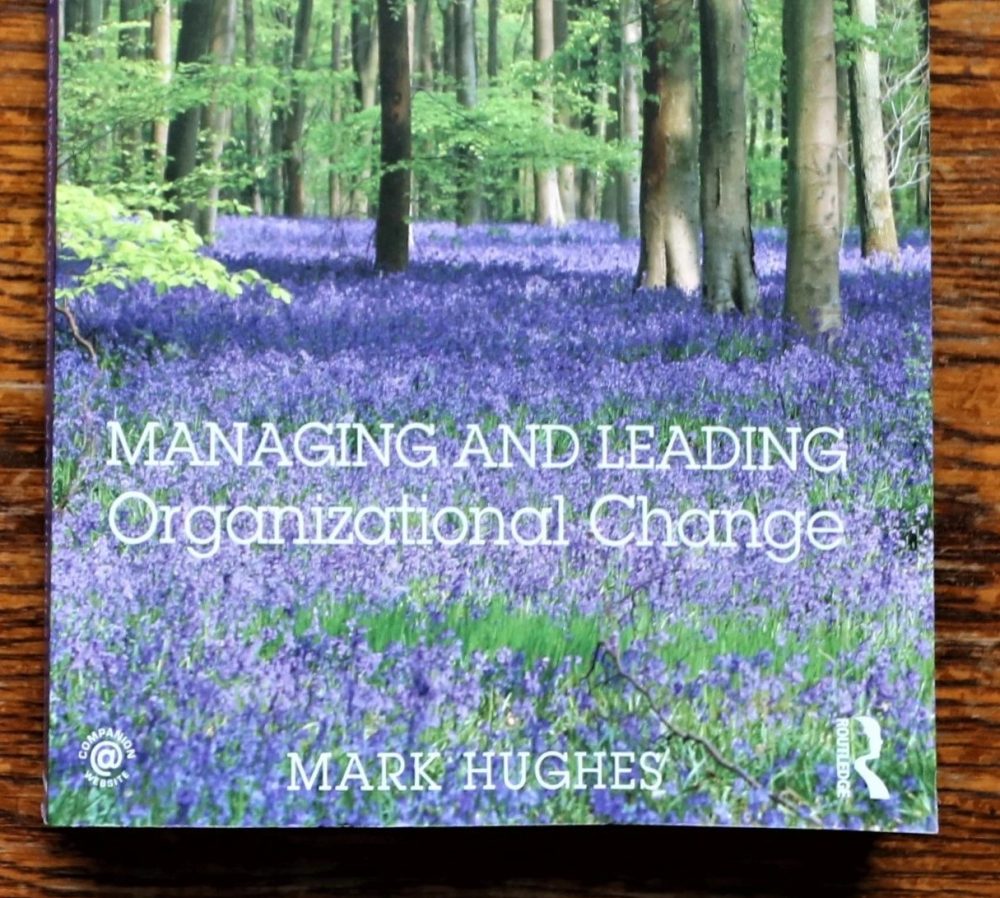
I was delighted to read this appreciative review of my final textbook Managing and Leading Organizational Change and grateful to Dr David Wilkinson for taking the time to write it.
In academic circles, despite the money students and university libraries invest in such texts, textbook authoring is surprisingly unfashionable. David fairly explains why such academic scepticism about textbooks exists, thankfully for myself he doesn’t bracket me in this category.
What I most appreciated in his review was that he appeared to understand the deeply embedded intent in my writing. In an ideal world organizational change theories and practices would be informed by the latest research in the leading academic journals. The danger is that we assume that this ideal is the reality, I don’t believe it is.
After decades of reading organizational change journal papers, I struggle with some of the content. In all honesty, some of it is too intellectual for me to comprehend – my bad! Other papers about organizational change leave me pondering if an organizational change is the primary interest of the author or an instrumental means to an end – publication in a prestigious journal. My workshops and writing have largely been informed by reading journal papers, but sometimes the most useful contributions to organizational change theory and practice are not in the most prestigious journals, but instead they are in the less prestigious journals and books.
As a textbook author I see my role as a scholar, rather than a researcher. A researcher gathers new knowledge, a scholar critically interprets existing knowledge. I explain this further in the preface of the new textbook, this preface should be freely available on the preview pages of the book on online sites.
As a scholar I see my role as acting as an intermediary between what is being written and published by trustworthy academics and student and practitioner audiences. I want to guide readers towards the more reliable and valid literature. Also, I want to guide readers away from less reliable and valid literature. I remain troubled by the simplistic associations that the most prestigious Business Schools always offer the most reliable and valid organizational change insights. My academic life has involved questioning organizational change knowledge. As I move into a later phase of my academic life, I now have more questions than answers, but I wouldn’t have it any other way.
Myth-understanding Organizational Change
The first chapter of the textbook compiles many of the organizational change myths I encountered during my career. In hindsight, the chapter was far too philosophical for an introductory chapter of a textbook. However, I do provocatively believe that engaging with and understanding organizational change myths is as important as busting these myths.
We need to question the currently favoured persuasive narrative that organizational change tends to fail. This post introduces Notebook No.1 and its chapter content questioning currently favoured change failure framing.
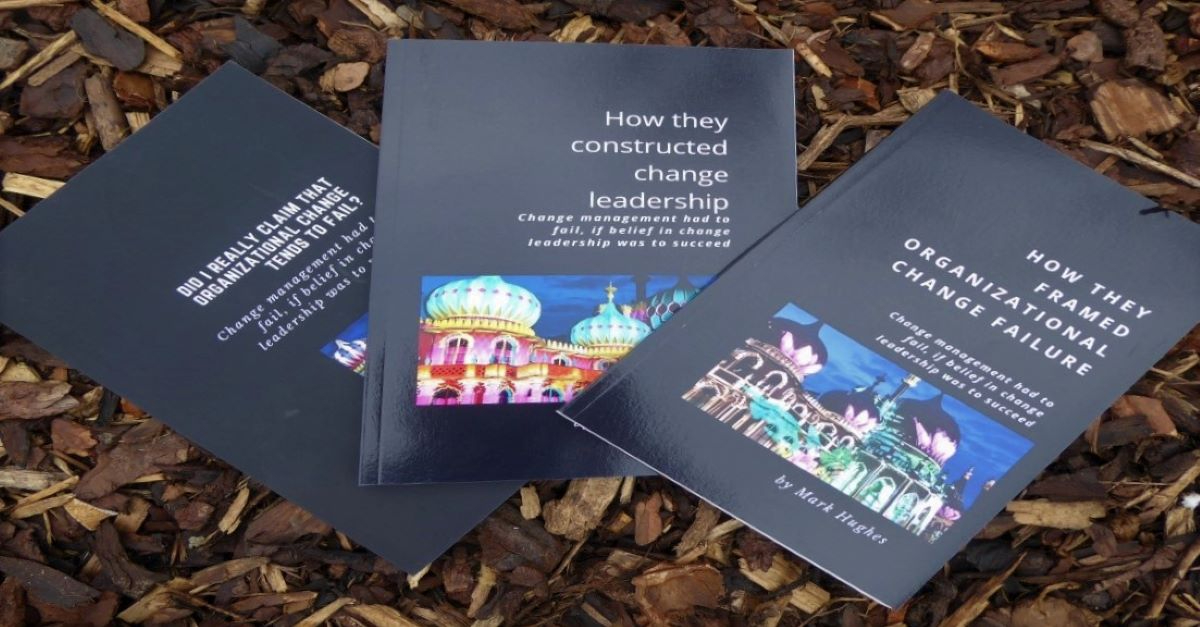
Notebook No.1 Cover Image
Problematic Generalizations
Academic journals, monographs and textbooks repeatedly claim that organizational change tends to fail. However, the more that you examine this persuasive narrative the more doubtful you become.
The label organizational change covers many types of change. Change is undertaken in different sectors and different countries. Approaches to making change happen are many and varied. Specific organizational changes will succeed and fail with considerable variation given the contextual differences. Depicting organizational change as tending to fail is a problematic generalization. It is problematic like a sexist or racist generalization and we know such generalizations do great harm.
Persuasive Narratives
If still persuaded by the narrative that change tends to fail, look to the main proponents Harvard Business School (HBS) professors. They claimed that change and transformation initiatives failed. However, a large part of the work of their school involves facilitating change and transformation.
Should we applaud a business school for its social responsibility in sacrificing all that income through so publicly acknowledging change failure? Or was a far more subtle narrative at work?
Today I believe that it was change management which they wanted to depict as failing, this was so that we would believe that change leadership would succeed. Unfortunately, my insight has turned into an albatross for myself. I have been unable to convince academic journal Editors and their reviewers about the wisdom of my little epiphany. They reasonably want evidence, they rightly claim that in telling my story, multiple stories are at work. Notebook No.1 and Notebook No.2 are my best effort to retrace my steps in clarifying and explaining my thinking.
I feel oddly obligated to offer an alternative narrative to the current dominant narrative that organizational change tends to fail. In Notebook No.1, I reflect on my successes and failures, perhaps a little too candidly. The idea of the Notebook label is to signpost that these aren’t the usual sanitized and contorted words we commit to paper.
Notebook No 1 – The Chapters
The following discussion introduces the chapters in Notebook No.1. In, Do 70% of organizational change initiatives really fail, I tell the story of how I came to write the paper of the same name. I tell the story of how one of the HBS professors reviewed the paper and what I learnt from him.
Who killed change management also shares a title with a paper. This chapter takes an enjoyable postmodern turn when I decide to investigate the conceptual murder of change management. I begin to appreciate that it wasn’t organizational change which was failing it was change management. The role of textbooks in framing organizational change failure asks an awkward question. If we believe change tends to fail, why is there so little coverage of evaluating organizational change in textbooks?
In A tale of change management failure on the misty literature mountains, I share my learning from writing the monograph The leadership of organizational change. In that monograph, I wanted to establish the origins of change leadership which required a narrative review of 35 years writing. The chapter tells the tale of an author going off on a Tolkienesque adventure in search of the precious thing.
A different organizational change failure story is the penultimate chapter. I offer my account of an alternative organizational change failure frame. In Beyond the rhetoric of failure, I reflect on my successes and failures and the need to do things differently. I also reflect on my hopes for the future framing of organizational change failure.
The first two Notebooks include unusual appendices which require a little explanation. Ernst Bloch’s (1995) The Principle of Hope made a big impression on me. Bloch (1995:195) wrote ‘even disappointed hope wanders around agonizing, a ghost that has lost its way back to the cemetery and clings to refuted images.’ Academics invest hopes in unpublished papers. The graveyard of disappointed hope offers a public resting place for an unpublished paper.
I do hope that these Notebooks might provoke meaningful practically orientated organizational change debate beyond the firewalled academic journals and costly academic books. As change is all about moving into an unknown future only time will tell…
Accessing Notebook No.1
Notebook No.1 and the other two were available on the Amazon self-publishing platform in paperback format. I enjoyed being a publisher – cover design, proof reading, layout etc. The Notebook even sold a few copies, which was a pleasant bonus. Today, if you would like a digital copy of the draft please contact me using the Contact page.
References
Bloch, E. (1995) The Principle of Hope. Translated by N. Plaice, S. Plaice, and P. Knight. Cambridge Massachusetts: The MIT Press.