Memories and memorabilia, the distant dreams of a naïve teenage T.G. fan including a 1979 Genesis P. Orridge letter.
Introduction
One Saturday morning late in 1978 the postman handed me my vinyl copy of D.o.A – The Third and Final Report of Throbbing Gristle (TG). I was excited and confused. In an era of neither internet nor online shopping, you posted a cheque to the record store and once your cheque cleared, they posted you the album. If this was the third and final report what about the first and second annual reports, were TG about to split? I was sixteen and confused about far more than this band. I gravitated to them because they were described as ‘dangerous music’. Taboo warning messages are marketing for teenagers.
- “Stunning, but dangerous music” (John Gill)
- “The very dangerous visions of Throbbing Gristle” (Jon “Tesco” Savage)
- “These people are the wreckers of civilisation” (Daily Mail)
I remember an interview in which Genesis P. Orridge asserted that if he kicked somebody in the face and they woke up for fifteen minutes, he would kick them in the face. In a non-violent way, I took on board the creative importance of provocation throughout the rest of my life. However, others responded violently to being provoked. Side Two of D.o.A contains a track “Death Threats” taken from the Industrial Records answering machine. These chilling death threats were real and made by fellow musicians, hostile to TG, this was never going to be easy listening.
In the late seventies, I wore my D.o.A button badge with pride and there was a large Music from the Death Factory poster on my bedroom wall. Today some of the imagery and ideological referencing which attracted me repulses me. TG were undoubtedly musical and cultural pioneers and forty years on their legacy is as evident as ever. On, a personal level, TG and the groups that they splintered into considerably widened my musical and cultural interests. I am glad that I attended those TG – Music, Art and Provocation 101 classes in the late 1970s and early 1980s. Today with the hindsight of a lifetime I better understand their desire to provoke, question and subvert everything.
Industrial Music for Industrial People (Music Newspapers and Fanzines)
The NME hate us … They decided that young people should not be encouraged to listen to us, that was their policy and I have proof of that.
(Genesis P. Orridge quoted in RE/Search 4/5)
Music newspapers were extremely influential in the 1980s. It was a bit tribal in that you would align with a newspaper. New Musical Express was big on culture and Marxism. Sounds didn’t take itself as seriously. Melody Maker had the longest pedigree as the newspaper for musicians, though often it appeared to look backwards, rather than forwards.
1970s punk rock gave birth to underground fanzines. I have kept many music newspaper cuttings, but it is the fanzines which capture the distant spirit of the age for this fan. Advances in photocopying made these hand-made publications easier to produce. Fanzines had an enchanting innocence and randomness (please see image).

Whereas the music newspapers were commercial ventures, which eventually all went out of business, the fanzines were labours of love. Often made in bedrooms, with no budget, yet fuelled with enthusiasm ready to be sold at venues and/or by mail order.
Industrial Records
TG was four equals, each bringing their unique life experiences, talents and abilities to the melting pot. And we were strong individuals who, once united, formed a solid unshakeable whole – which had its setbacks.
(Art Sex Music, 2017, pg.185)
This insight is from Cosey Fanni Tutti, the other three members of this unshakeable quartet were Chris Carter, Peter ‘sleazy’ Christopherson and Genesis P. Orridge. I had just missed out on the punk rock era and at sixteen, I was ready and willing to surf the industrial music wave. I was curious about life and TG was made for curious male teenagers. It was the right music at the right time. If you wanted to buy a single or an album you wrote a letter to a specialist record shop or in the case of TG to Industrial Records. The slow pace was oddly preferable to the on-demand culture of today.
Industrial Records were based at Martello Street in Hackney (before Hackney apparently became cool). All communications with the band and purchases went through Industrial Records. There was an art to their choreographed communications with fans. They appeared to offer far more than information which becomes evident when reading three issues of Industrial News (please see image).
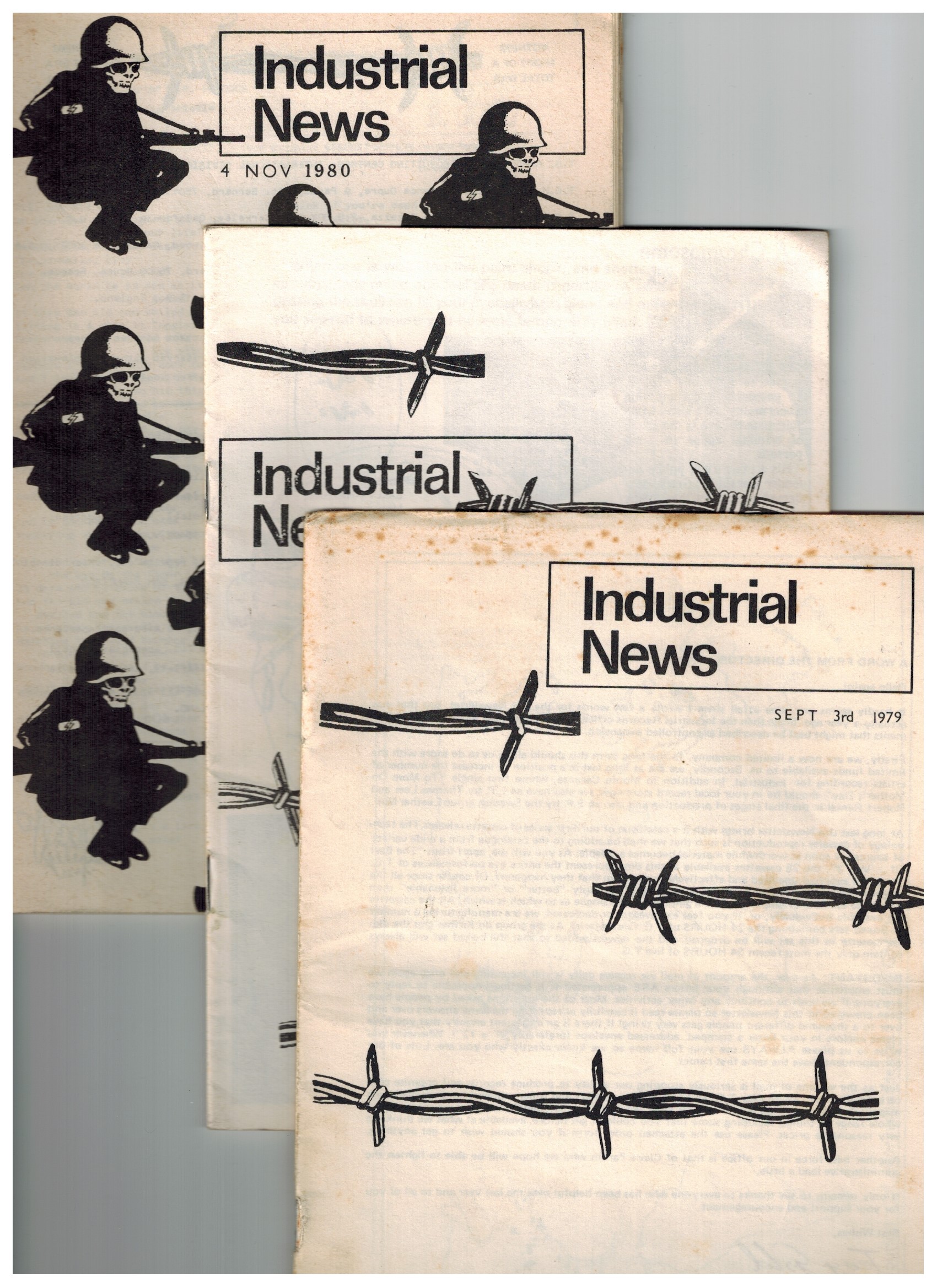
It has been a revelation going through memorabilia from four decades ago. Some pages would be black and white cut-ups and collages, this was particularly the case with Issue 2, a Monte Cazazza special. In a pre – General Data Protection Regulation era, Industrial News contained many names and addresses of fans, musicians and other relevant enterprises, as well as, song lyrics. There were pen pictures of TG band members (favourite colour, favourite drink, food etc) which appeared to parody the teen magazines of this time.

In the image above it was fascinating to see the approximate numbers attending the earliest TG concerts. At Brighton Polytechnic on the 26th March 1977 approximately 300 people attended and they also played Brighton Polytechnic on the 28th February 1978. Apparently Brighton Polytechnic was the place to be!
I started work at Brighton Polytechnic in 1987 specializing in change yet paradoxically remaining there for the next three decades. My employment location was by default rather than conscious design (although TG were interested in subliminal messaging). Whenever I found myself in the Salis Benney Theatre for institutional events I would imagine that I was at those very early TG concerts. I acquired IRCD 05 which was part of TG 24. This CD provided audio accompaniment for my time travels. That early Brighton Polytechnic concert was exceptionally confrontational, in later years institutional management embraced such confrontation though without the art.
Another interesting insight gleaned from this copy of Industrial News (Sept 3rd 1979) was the names of bands/musicians sending prospective tapes to Industrial Records; S.P.K, Cabaret Voltaire, Clock DVA, Matt Johnson, and the Lemon Kittens.
Industrial Music for Industrial People (Fan Mail)
In the late 1970s and early 1980s, industrial people (fans) could connect with industrial musicians (TG) through letter writing. Today, it sounds alien, when did you last write a letter? These letters were far more than the ‘thank you for your interest in our band, here are some signed photographs’ style letters, that you might imagine. These were engaged and engaging letters. Four decades later I still have three of these letters from TG.
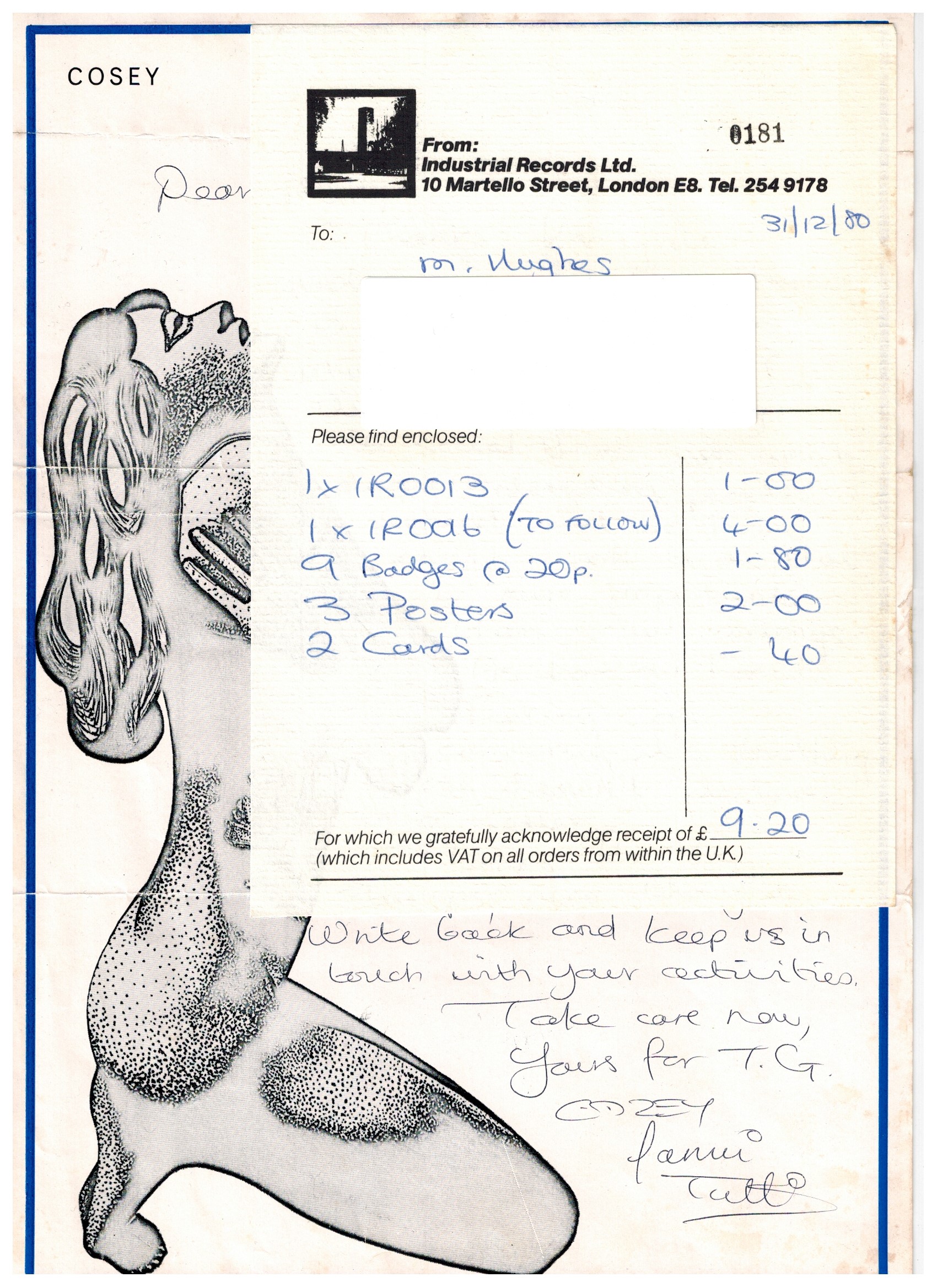
Oddly, I have kept very few other letters from my earlier life. Two of these letters were from Cosey and one was from Genesis. Cosey begins one letter, “You ask many questions”, but goes on to answer them in a friendly and thorough manner. I squirm imagining the letters I sent to TG and the naïve nature of some of my questions. In mitigation in those days, I was genuinely curious, today that youthful curiosity has largely burnt out.
Older and wiser, I have recently read Art, Sex, Music. Today, I appreciate how much ‘other work’ Cosey was engaged in at this time. I am grateful for the time she took to write to this overly enthusiastic teenage fan. In the image above, hopefully you noted the Cosey embossed writing paper, it meant the world to my teenage self.
In the image there is also an Industrial Records invoice. IR 0016 was the William S Burroughs – Nothing here but the recordings album sold at the very reasonable price of £4.00. The band were closely aligned with William Burroughs. They introduced me to his writings and art, as well as, other beatniks such as Bryon Gysin and Jack Kerouac at just the right stage in my life. Novels such as Junky and On the Road spoke loudly to me about counter-cultural possibilities, though jumping British Rail goods carriages was never going to happen.
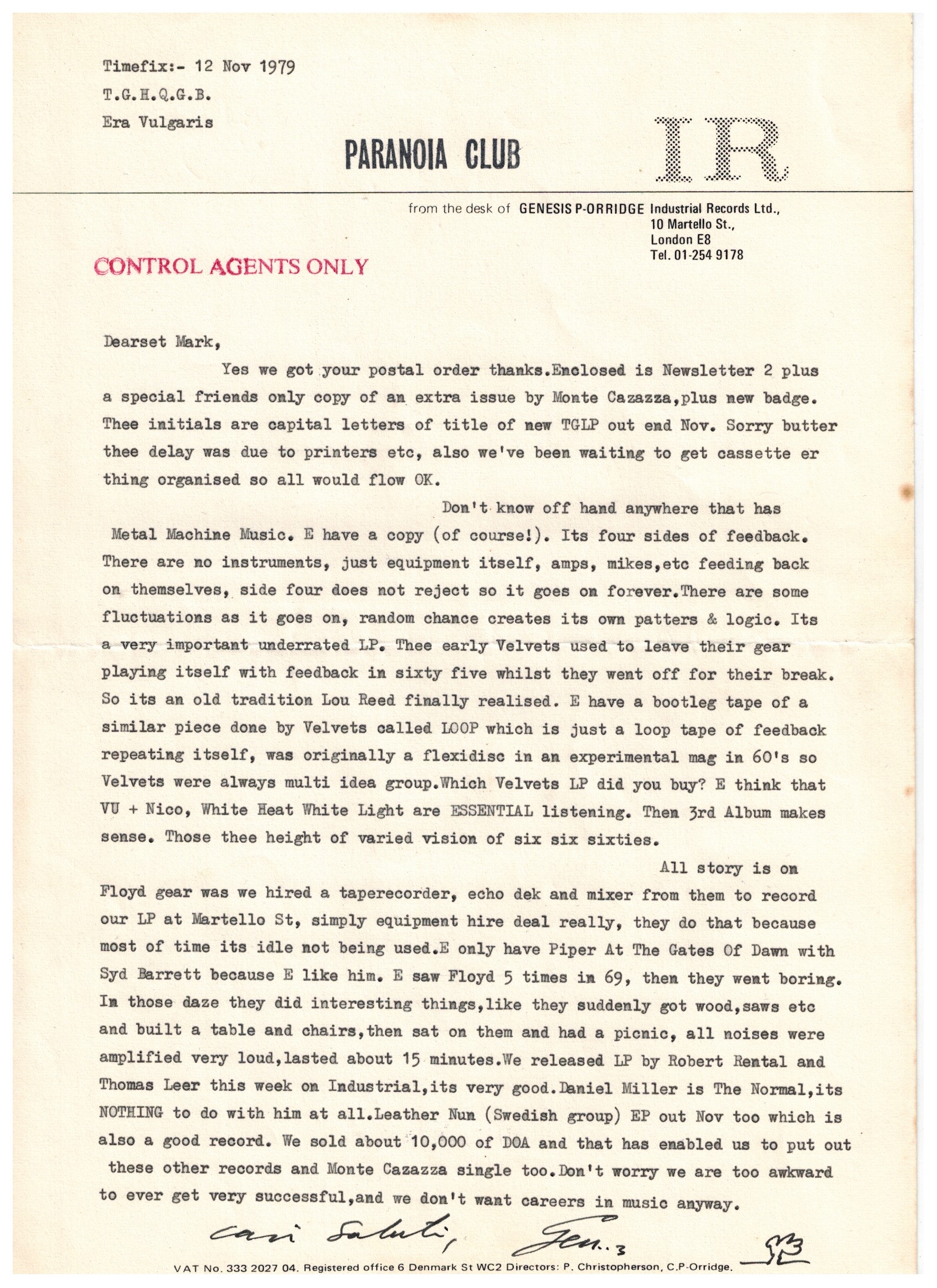
Genesis conjured up the most controversy within the band (please see Art, Sex, Music) and beyond the band. As a fan I was never close enough to know what was actually going on. That said, I have decided to make his letter public, as it offers a window on a warm, human and patient side to his complex personality. I don’t think he will haunt me for sharing a gentle letter to an enthusiastic fan. Incidentally, some of the letters I received appeared to have been opened and resealed in transit, this may have been my paranoia or an extension of the GPO vs GPO investigations. In those days, mail interceptions were the equivalent of the widespread electronic eavesdropping of today.
I am asking about how I can get a copy of Metal Machine Music and about the Velvet Underground and Pink Floyd. I did manage to secure the double vinyl Metal Machine Music, though to this day I have been unable to listen to all of the album. I also became a fan of the Velvet Underground and early Pink Floyd and these interests were initiated through wanting to listen to the music which influenced TG. I purchased and enjoyed Live in 1969 by the Velvet Underground, but it didn’t fit with the sound of TG music. I think that is what we are talking about in the letter.
Genesis explains loops and feedback which were not as mainstream as they are today. I remember the arrival of Jesus and the Mary Chain like a breath of fresh air, but they were mining a much deeper musical feedback seam. Since the letter, I have seen many live bands ending their sets with feedback loops, including Godspeed You! Black Emperor. Genesis was patiently in his letter giving me a musical education, I just didn’t realize it at the time. I have a feeling Genesis’s outlook changed from 1979 and mine certainly did. In this context, his final sentence is very poignant.
‘Don’t worry we are too awkward to ever get very successful, and we don’t want careers in music anyway.’
Genesis P. Orridge (12/11/79)
The Sound of Throbbing Gristle Music
There is something important within ‘we don’t want careers in music anyway’, but the sound of TG music was a big part of the story. In honesty, I rarely listen to TG music these days. Mute billing the band as ‘…one of the most politically and sonically antagonistic bands of all time’ is not an exaggeration. Decades ago, as a teenage fan, I did enjoy the confrontation of ‘Blood on the Floor’, ‘Hit by a Rock’ and ‘Discipline’. Although even then it was the more melodic contributions by Chris Carter which appealed, such as Distant Dreams Pt.2 and AB/7A. The Throbbing Gristle: Mission is Terminated album included a track Damaru Sunrise which was a personal favourite, though inaccessible on vinyl at present.

There were strong elements of improvisation and experimentation particularly in live TG shows. I did enjoy the Heathen Earth album recorded live at Martello Street, whereas I found the Second Annual Report based on the Brighton Polytechnic concert hard work. Even Mute Records who were licenced to subsequently sell the album chose not to sugar the pill.
The Second Annual Report came out originally on 4 November 1977, the first album from Throbbing Gristle, one of the most politically and sonically antagonistic bands of all time.
Mute Records Website
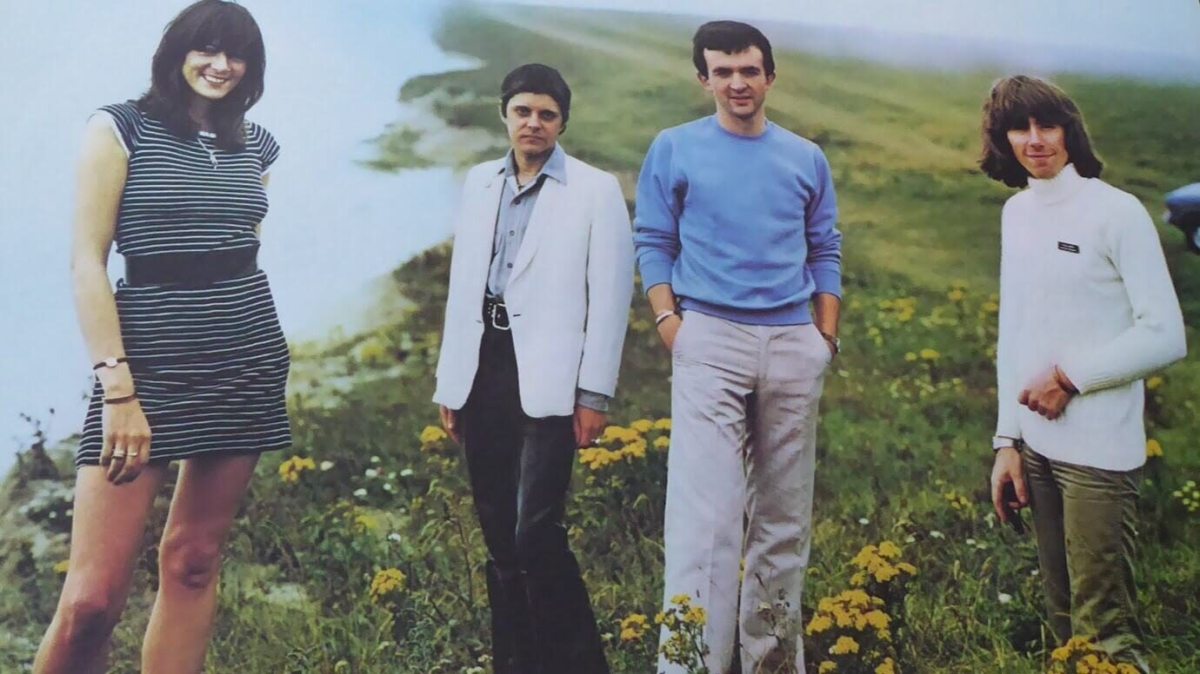
The header image for this post is a photograph of the cover of 20 Jazz Funk Greats. The band appeared to confront media stereotypes of their evil and dangerous nature with this benign image. However, Beachy Head the photograph setting is known locally for suicides, so not as benign as it first appears. I live fairly close to Beachy Head and often walk along the nearby Seven Sisters cliff tops. Whilst typing I play the Beachy Head track from 20 Jazz Funk Greats. It is a very eerie track laden in emotion. It has aged very well, echoes of electronic film music of today. I am not sure if the seagulls are on the recording or my neighbourhood seagulls and have to open a window to check? Regardless, 20 Jazz Funk Greats remains the most accessible album by the band, though equally not the most representative.
Punk bands encouraged/empowered anyone to pick up a guitar and become three-chord wonders. TG picked up and carried the Do-it-Yourself baton on from the punk bands. However, reading the letter from Genesis reminded me that in 1969 Pink Floyd were very experimental, in essence playing with sounds, subverting sounds. I am not a musician, but over the years the technology has become available and affordable to make subversive sounds myself.

Genesis in his letter to me wrote about Lou Reed, as well as, the Velvets making loops of music. Years back, I bought a little pocket FM3 Buddha machine which enabled me to play back these weird loops (see also the Gristleism machine). During the pandemic I bought myself a Teenage Engineering – Pocket Operator 33, to save my sanity as much as anything else. The PO 33 enabled me to sample sounds in a manner similar to my favourite bands. Recently I was able to buy a UNO synth and pretend to be Chris Carter as I noodled grooves to my heart’s content. Today, I even have access to PO Pixel and Koala samplers on my mobile phone. I collect found sounds on the phone recorder and odd video images for subsequent use as artistic materials. For example, listen and watch music sampled and manipulated from a video of silver birch trees here.
The sound of TG music was troubling and provocative, but also pioneering and inspiring. This band inspired many musicians and even myself as a non-musician. TG visual and audio cut-ups and collages fascinated me and today I enjoy such creative experiments myself. As Cass Elliott sang many decades earlier ‘make your own kind of music’. The objective was to sing your own song, and make your own music, even if nobody else sang along. I do not think I would be singing my own song (writing this post) and making my own kind of music (birch trees grooving) if I hadn’t encountered TG as a teenager.
The Mission is Terminated
A postcard dated 23rd June 1981 informed me that TG had ceased to exist. In reading Art, Sex Music (Tutti 2017) Cosey offers a window into the artistic and romantic tensions within the band. In this sense, the end of TG was predestined. However, at the time it was a surprise to this teenage fan. The black edging around the wording Throbbing Gristle: The Mission is Terminated was very powerful and very final.

My old address is hidden beneath some button badges purchased from Industrial Records. I’ve featured the back of the termination postcard, for information, as often it is the front image which is featured. The archetype had been investigated and the information stored. The moment for myself had passed. TG later performed live at Camber Sands and recorded new material, but I was no longer interested, the information was already stored.
I never saw Throbbing Gristle perform live. I was fortunate to attend the Art, Sex Music (Tutti 2017) book launch at Rough Trade East. The added highlight was that I was within touching distance of Chris Carter, though decided against stroking his arm. The late Peter Christopherson in person was a complete, though wonderful enigma to me.

On the 18th of August 1990, I attended what was billed as a lecture by Genesis P. Orridge at the Scala Cinema. The evening included Coum Transmission and Dream Machine films. At the end of the evening, Genesis did his vicar bit, individually saying goodbye to each of us. I jumped when I encountered him at the exit doorway and he jumped in playful mimicry, it was a special moment. I saw and enjoyed watching Genesis and Psychic TV quite a few times live, no longer a teenager now roaming freely in the big bad world, making my own metaphorical music.
The termination of the mission was accompanied by creative splintering. Industrial Records and their mailing lists for a time provided an important communication channel concerning what happened next. Genesis and Peter formed Psychic TV. Subsequently, Peter departed to form Coil. Chris and Cosey became a band in their own right. I remember being bewildered, not knowing which way to turn, so in the end I followed all of them. If there is sufficient interest in this post and I have the inclination, I will share memories and memorabilia about these musicians post-TG.
And finally, the names Sinclair/Brooks were very evident in my dealings with Industrial Records and the credits on TG recordings. They did sound like smartly dressed business types. I imagined them as the business-orientated and disciplined Ying to the creative and experimental Yang of the band. Whilst researching this post, I visited the informative Discogs site only to discover that Sinclair/Brooks was a pseudonym used by TG for production purposes.
Not everything in this world is as it seems.
Links
A quick Google search suggests over two million TG hits (not the musical kind). I have not attempted to offer a comprehensive account, but rather a personal account. These links may be helpful, if you want to learn more.
Art, sex music by Cosey Fanni Tutti
This book offers a fascinating and very readable account of the evolution, life cycle and demise of TG and the creativity and turmoil inherent within the band.
https://www.faber.co.uk/product/9780571328529-art-sex-music/
Chris Carter and Cosi Fanni Tutti
The website of the two surviving members of TG is worth checking out. On their homepage they neatly capture their musical identity ‘sometimes we are Chris & Cosey, sometimes CTI & Carter Tutti Void & sometimes we are Throbbing Gristle.’
Discogs
The site ‘about us’, neatly sums up the site as ‘a platform for music discovery and collection’.
https://www.discogs.com/artist/778177-SinclairBrooks
Mute.com
Throbbing Gristle music is licenced to Mute and is available at this link.
https://mute.com/artists/throbbing-gristle
RE Search
I was pleasantly surprised given the ephemeral nature of the artefacts featured here that RE/Search publications are still thriving. I have copies of RE/Search 4/5 and 6/7 which both feature Throbbing Gristle.
Throbbing-gristle.com
A wonderful information resource about TG’s past and present and curated future.
Memories of a Teenage Throbbing Gristle Fan Woodlanddecay