Introduction
This is a thought experiment exploring the psychogeography of how intimately knowing a location setting impacts upon reading a crime novel in that setting. When I read crime fiction the locations of murder mysteries are disproportionately important to me. I particularly enjoy coastal, rural and woodland settings, rather than the claustrophobia and impatience of cities.
I moved to Brighton in 1987, and I have lived in Saltdean since 2007. I have become very familiar with the suburb of Saltdean and the town of Newhaven, four miles from Saltdean. A thought experiment evolved, to read murder mysteries, very, very local to me. I chose three murder mysteries, one set in Saltdean and two set in Newhaven.
The specific murder mysteries came onto my radar by happy accident, rather than conscious design. In 2024, I attended Crime Waves, part of Shoreham Wordfest. Speakers talked about their respective crime books, and particularly relevant was Lesley Thomson, as Death of a Mermaid was set in Newhaven. Lesley referred to the music of the local mobile fishmonger. I had heard these slightly surreal tones whilst gardening, and this became Book One. Also, at Wordfest, Mark Edwards author of Keep her Secret referred to his murder mystery being set in Saltdean, which had to be Book Two. Finally, Pauline Rowson’s murder mystery, Death in the Harbour, was set in 1950s Newhaven. A book set in a town I knew well, but before I was born. This was Book Three.
I am not going to review these books here, and I do not want to spoil plots for others. Each book was enjoyable to read and proved to be very thought-provoking in different ways. The first two books were more psychological than I usually read. The third was closer to my favourite police procedurals. I found the 1950s historical context in the third book an intriguing diversion from my usual present-day focus.
The theme for woodlanddecay.com posts in 2025 has been psychogeography (see HERE). Psychogeography offers a creative perspective on relations between landscapes and conscious emotions and unconscious thought processes. Urban wandering around Saltdean and Newhaven enabled joining the fictional narratives of authors. In this way, I experienced Saltdean and Newhaven differently, sharing the perspective of the author.
The next three sections focus on Books One to Three. A section offers reflections and insights from this thought experiment, before a postscript acts as a conclusion. The inclusion of author biographies and edited book overviews taken from the Amazon site is acknowledged through italics.
Book One – Death of a Mermaid (Lesley Thomson) Published 7th May 2020
Amazon Biography “Lesley Thomson grew up in West London. Her first novel, A Kind of Vanishing, won the People’s Book Prize in 2010. Her second novel, The Detective’s Daughter, was a #1 bestseller and the series has sold over 750,000 copies. Visit her website at lesleythomson.co.uk.”
Amazon Overview “When Freddy Power was eighteen, her father threw her out. Her sin had been to fall in love with a woman. Freddy waited for two decades to be invited back into the family. The summons never came. But now, in the wake of her parents’ death, Freddy feels the call of home like a siren’s song. The trawlers emerging out of the mist. Fishermen unloading their catch down at the harbour. Her best friend, Mags, exploring the cliffs at sunset. But when she arrives at Newhaven, after twenty-two years of silence, her brothers and her friends act like strangers. Then Mags goes missing, and old secrets – and old passions – are reignited. Freddy is determined to lead the hunt for Mags – even if it means confronting her past, and facing the truth about her family…”
On reading Book One – Seeing Lesley on stage talking about this book and her other books, made the narrative more personal. My experience of fishing, Catholicism and lesbian culture, featured in this book are limited. This was not an impediment, and in some ways, I believe I learnt, even though this was fiction. The overarching emotion I felt whilst reading was one of frustration. It is a story of frustrated romances and frustrated ambitions. Unfortunately, I read this book at a time when health ailments precluded me from my passions of rambling and gardening. So, I found myself in a frustration waltz with these characters.
Newhaven offers an ideal landscape for the frustrated experiences of the characters. Once far more prosperous, Newhaven has a feel of being shortchanged by councils, developers and by economics. Lesley poetically referred to Newhaven as “the seaside town of best forgotten faces”. The lead character, Freddy, is returning to the town where she spent her formative years. The quotation alludes to the truism – never go back. Whilst set in the present, this book is all about personal histories which inform and reassure us, but can also haunt us.
Newhaven was once a vibrant port. The tidal Ouse connects Newhaven and Lewes. There is a reference to the mood being reflected in the yellow colour of the Ouse. Locally, we perceive the variations in the Ouse in terms of colour, but also pace and sound. The Ouse, often moving sluggishly, works well as a mood mirror.
I want local settings to be accurately depicted. Yet, there is no reason why an author cannot employ poetic licence to tell their story. Lewes Premier Inn and the homes opposite feature with Freddy and Andy having a heart-to-heart in the hotel bedroom. I know exactly where the author has located them. Having stayed in many Premier Inns over the years, I know the standardised bedroom “ambience”. It was a surprise to read about the hotel bedroom mini bar being stocked with Jack Daniel’s. I don’t remember Jack Daniels in Premier Inn mini bars, then again, I do not remember the mini bars.
As a counterpoint to my pedanticism, Lesley introduces me to places I hadn’t encountered on my urban wanderings. In particular, Newhaven cemetery with a statue near the entrance. I went in search of the cemetery and was impressed with the statue that greets you at the entrance (see below).

Lesley referred to the sounds from a mobile fish van in her talk. In the book, she references the sounds as the “…cringeworthy fanfare…” announcing the arrival of Freddy. It was these sounds that most intimately connected me with this narrative. I have heard the sounds Freddy’s customers heard. I wondered about the “cringeworthy fanfare” as I gardened, about the story behind these ironic sounds. It transpires that the mobile fish van was operated by Tim Woodward (Catch of the Day), as acknowledged at the end of the book.
Growing up in Newhaven, Freddy, Toni, and Mags called themselves the mermaids. The book moves from their hopes and dreams as girls to the women they became twenty years later. This was the overarching frustration and a source of sadness for me. A story not so much about what happened as what might have happened. Equally, Newhaven suggests a story of what might have happened.
Book Two – Keep her Secret (Mark Edwards) Published 30th May 2023
Amazon Biography “Mark Edwards writes psychological thrillers in which scary things happen to ordinary people. He has sold 4 million books since his first novel, The Magpies, was published in 2013, and has topped the bestseller lists numerous times. His other novels include Follow You Home, The Retreat, In Her Shadow, Because She Loves Me, The Hollows and Here to Stay. He has also co-authored six books with Louise Voss. Originally from Hastings in East Sussex, Mark now lives in Wolverhampton with his wife, their children and two cats. Mark loves hearing from readers and can be contacted through his website, http://www.markedwardsauthor.com, or you can find him on Facebook (@markedwardsauthor), Twitter (@mredwards) and Instagram (@markedwardsauthor).”
Amazon Overview: “… a deadly secret turns a couple’s new romance into a nightmare. And they’re not the only ones who know the truth… After twenty years apart, Matthew and Helena have rekindled their college romance and are away in Iceland on their first holiday together. Swept up in the romance on a mountain hike, one moment they are taking the perfect photo, the next Helena is hanging from the cliff edge… Terrified, Matthew almost misses Helena’s sudden and shocking confession—but what he hears chills him to the bone. And when Helena reveals the full truth Matthew is horrified, not only by what she’s done, but why she did it. Does he really know her at all …?
On Reading Book Two – This book cleverly conjured up strong anxieties for me. At every twist and turn of the narrative, my anxieties were cranked up. I felt for the two lead characters, particularly Matthew, spinning downwards into the cleverly constructed vortex of the narrative. I found this an unsettling rather than a pleasurable experience. I prefer to align with the detective who passively observes and investigates the aftermath of crimes. However, this is my personal preference; I am certain the excitement generated for some would be a strength.
Overall, it was unusual and enjoyable to read a book set in Saltdean. Helena comments, “I live in Brighton … well, just outside”. Yes, we are connected to Brighton, yet simultaneously disconnected. There is a reference to Saltdean as “… a small village”. The village label seems to be fashionable, but Saltdean as a suburb works better. Suburbs sleep as stuff happens behind closed doors.
A white house high on a cliff overlooking the sea, with large windows, features prominently in the book. There is a real house high on the cliff referred to as the White House, and elements of this appear to have inspired the author. There is a reference to “The house looked like it had been airlifted from Miami”. We do have a bar called the L.A. Lounge in Saltdean. However, I think this is a reference to the main shopping street – Longridge Avenue, rather than Los Angeles.
At one point, Helena and Matthew go on a 15-minute walk from Saltdean to Rottingdean. I walk with them along the cliff top and then follow the undercliff. They reach a pub close to a pebbled beach with views over the English Channel and a nearby windmill. They eat a meal at what is now called White Horses. In the past, I have eaten meals in this pub/hotel with family and friends; memories come back to me. Rottingdean is “… a lovely place full of old houses and narrow streets lots of BMWs and Audis around”, a very good definition.
Mark’s narrative sucks Matthew into the darkness and deceit of criminality. Helena’s confession means that Matthew becomes increasingly implicated. Again, my personality means I would run quickly and as far away as possible. I want Matthew to walk away, but he has a strong attraction to Helena; apparently she might be the one. This is the conflict at the heart of the book. The anxiety-provoking question becomes – should I stay or should I go?
In terms of place, Saltdean works well as a sleepy backdrop for dark drama unfolding behind the closed doors of the White House. At one point, the storyline takes us to Beachy Head (near Eastbourne), described as “probably England’s most notorious suicide spot.” The base of Beachy Head is not normally accessible, but I was fortunate to visit as part of an organised walk. I was amazed by the art of an artist, referred to locally as “Planksy” (see below).
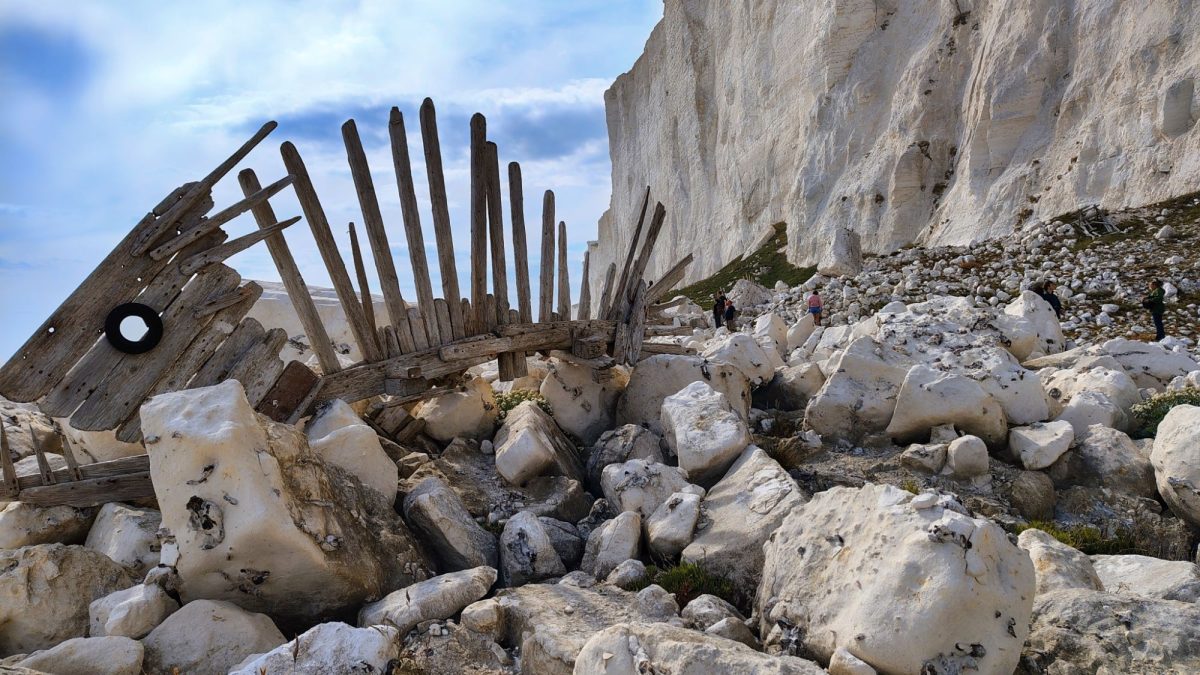
I have undertaken many picturesque walks close by Beachy Head. Equally, when characters go on other journeys, to Moulscoomb, Peacehaven and Newhaven and through the Saltdean underpass by the Lido to the beach, I know these journeys well. The book ends with an informative letter to the reader from Mark:
…I have taken some liberties with the geography of Saltdean. The cliff on which Helena’s house sits does not exist. And although there really were smugglers’ tunnels in that area, as in much of Sussex – including in Rottingdean – the ones in this book are invented.
He refers to a book about smuggling in Saltdean in the main narrative. I enthusiastically searched for this book on the internet. It is only when I refer to my copy of The Saltdean Story that I realise his Saltdean smuggling book is a narrative device. Mark acknowledges The Saltdean Story by Douglas D’Enno as being invaluable for research into smuggling in the area. Whilst the smugglers’ tunnels are acknowledged as invented, it makes me wonder about possible secret tunnels beneath my feet.
I was frustrated by the “liberties with the geography of Saltdean”, but I understand the reasoning, and for over 99.9% of the audience, it wouldn’t have been evident.
Book Three – Death in the Harbour (Pauline Rowson) Published 10th Sept 2024
Amazon Biography– Hello, thank you for visiting my author page. I love creating fast-paced, twisting crime novels, set against the backdrop of the sea and I hope you get as much pleasure out of reading them as I do writing them. I live on an island on the south coast of England and when not writing, which isn’t often, I can be found walking coastal locations looking for a good place to put a body – fictional that is. I currently write three series: the DI Andy Horton Solent Murder Mysteries; the 1950s set historical Inspector Ryga Mysteries and the contemporary set thriller style mysteries featuring former Royal Marine commando Art Marvik. Happy reading.
Amazon Overview – 1950, Newhaven, East Sussex. One foggy November evening, Police Constable George Swinley disappears while working his usual beat. Four days later, his lifeless body is found floating in Newhaven Harbour. His death is ruled as an unfortunate accident, but his devoted wife Myra thinks otherwise. Then Myra herself goes missing and Inspector Alun Ryga is sent to the Sussex coast to investigate. But nothing can prepare him for what he’s about to find . . .
On Reading Book Three Death in the Harbour imagines Newhaven in the 1950s. Quickly, we learn that the recent World Wars overshadow everything. It was interesting that perceptions of characters were grounded and judged in terms of what they did or did not do during the war. That was a learning point for me.
I warmed to Inspector Alun Ryga from Scotland Yard. Despite the authority of Scotland Yard, Inspector Ryga was seeking to establish himself as a new murder detective. He always carries his murder case/bag with him whilst investigating. Today’s equivalent of a forensics team, but inside a bag. The murder bag also gives the Inspector some of the authority he seeks. Inspector Ryga asks too many questions of himself. In fairness, it might be a literary device to convey that he is new to his Scotland Yard role, this inner dialogue conveying understandable insecurities. I repeatedly warm to his vulnerability. The overarching emotion this book evoked was uncertainty.
I join the detective in this murder mystery. I even offer to carry the murder bag. I enjoy locating myself within the Newhaven landscape and comparing today with a keenly imagined yesterday. My perception of Newhaven today changes through immersion in Newhaven yesterday.
Venues such as The Bridge, I remember, though now gone. Fort Road still exists, though located on the other side of the harbour in this book. The swing bridge at the heart of Newhaven endures regardless of everything else, the fulcrum of this harbour town. The references to St Margaret’s in Newhaven are confusing. Landscape clues suggest to me that this church is St Michael’s. However, perhaps there is a reason for changing the name (hint/hint).
Wandering around Newhaven with the author, I think of the topography as being the roads, particularly the A259, I use when I go through Newhaven by bus to nearby Friston Forest. Today, I believe too many cars pass through Newhaven, to the detriment of the town. But this book encourages me to think more in terms of waterways. Boats feature prominently, with murders happening on or near the water. Different quays, harbours, and Denton Island become more significant in my understanding of Newhaven. In 1950, the prevalence of cars would have been far less. Tidal water flows dictate the rhythm and pace of the narrative, locating suspects and dead bodies close to water. The Ouse becomes a moody key character in Book Three.
Inspector Ryga confronts three prime suspects he believes to be the murderer. Unfortunately, each one effectively refutes his allegations. It is slightly comical, though possibly intended by the author. Imagine somebody playing Cluedo or Poirot with more enthusiasm than skill.
This book was the second in a series of five, and I am enjoying reading all of them. I do like an anti-hero stumbling around in the dark, but finally finding the light switch. The series includes a bizarre love triangle between Inspector Ryga, Sonia (ex-landlady of The Quarry Mans Arms) and Eva (the war photographer). He seems latently attracted to both women, yet uncertain what he feels for either of them. Consequently, storylines follow his oscillating feelings without Ryga ever acting on his feelings. This beautifully poetic sub-plot provides the mystery within the mystery. Yes, the overwhelming emotion which Book Three invokes is uncertainty.
Reflections and Insights
I have had five learning insights through this thought experiment.
1)Inaccurate depictions of Saltdean and Newhaven frustrate me. It was an informative surprise that knowing locations was more of an impediment than an aid to my enjoyment. The authors did not make mistakes; they used locations as starting points, but then elaborated from these settings. Lesley needed to introduce Jack Daniels into a Premier Inn to lubricate the conversation. I am still left wondering about the existence of some of the smugglers’ tunnels beneath Saltdean described by Mark as “invented”. Pauline had to make certain changes to Newhaven related to the 1950s plot lest there were implications for people living there today.
The inclusion of author notes at the end of these books explains how locations are knowingly reimagined and the author’s reasoning. These notes suggest that other readers like me can be a bit too literal. Top tip: if an accurate depiction of a place is important, check for any author notes at the end, before you start!
2)Every depiction of a place must include subjective interpretations. Thinking a little more deeply about “inaccuracies” is informative. Anybody writing about Saltdean begins with objective facts and then inevitably moves into subjective impressions. My understanding of Saltdean is largely subjective. No literary depiction of Saltdean, however accurate, could completely match either my interpretation or my next door neighbour’s interpretation.
3)It is not the specific place, but the type of place which matters to me. It is the atmosphere and feelings certain places evoke which engage me. For example, I love watching TV detectives solving murders in forests. A natural setting can be descriptive, yet generic. I learn that I do not have to have visited the particular forest. I am learning that I connect with authors and, by association, their characters when they are out in nature.
4)History informs depictions of specific landscapes. Mark rekindled my interest in local smuggling history. There is a famous footpath out of Rottingdean known as the smugglers’ path. I enjoy imagining on my rambles following routes once used by smugglers. I was intrigued enough by the existence of a cemetery in Newhaven to visit (see earlier photograph). Pauline takes us on journeys between Seaford and Newhaven. Invariably, I make the journey by bus, others by car. However, seventy-five years ago, walking and rail travel were far more prevalent.
5)There is always an emotional context to places and their depictions. Various emotions were provoked whilst reading. As overarching emotions, I felt frustration, anxiety and uncertainty reading the three books. Frustrations and uncertainties certainly haunt Newhaven as the town seeks a new purpose and identity. Anxiety, though, is the antithesis of the sleepy suburb of Saltdean. I bring emotions to the party as the reader. How I am feeling is interrelated to the emotions invoked by the author. I am certain many readers enjoy the anxieties Mark conjures up. For myself, I am with Inspector Ryga quietly seeking certainties in an uncertain world.
The following is an extreme, though hopefully useful, final example of the centrality of local locations and emotions. About twenty-five years ago, I purchased The West Pier by Patrick Hamilton. At that time, I was living very close to The West Pier on Brighton seafront. I wanted to do something similar to the current thought experiment. I had to abandon the book after reading about a third. It was well written, and the historical depictions of local locations were interesting and meaningful. However, the author infused characters and places with dark emotions. The emotions were too close to my own at that time. Shane MacGowan sang “some drink to remember, some drink to forget”. In the thought experiment, reported here, I have learnt that some read to experience strong emotions, whilst others read to escape strong emotions.
Postscript
I wrote this post in August 2025 and continued decadently reading crime novels. It is now late January 2026 and this postscript is a sort of a conclusion to my thought experiment. I have been reading and enjoying The Fethering Mysteries by Simon Brett. They feature the South Downs and Sussex towns and villages with which I am familiar. There are references to Brighton, Lewes and Worthing which provide a kind of geographical scaffolding for locating smaller towns and villages. The novels focus upon a fictious village of Fethering with other pseudonyms used for neighbouring towns and villages.
The intriguing bit is that if you know the area, you have an insider feel for places featured, even when pseudonyms are used. Although not named, in one novel I feel like I am in Arundel and knowing Rustington helps me to understand the quirks of Fethering. One of the novels features Austen open prison. If you live locally you will have heard about Ford open prison. It adds to the reading experience knowing this potential juxtaposition. Equally if you have not heard about Ford open prison this will not impede your reading experience. These insider/outsider literary devices work for me and my conclusion is that this is the approach I favour.
In The Fethering Mysteries, I enjoyed the contrast between the two key characters Carole and Jude. As amateur sleuths, they are poles apart in terms of personality. At one point Simon Brett attributes these words to Jude “Lewes always had that effect on her. There was something gloomy and introverted about the town, a feeling of hidden evil that had lasted through many centuries.”
Personally, I like the pagan/magical undercurrents of Lewes. I am surprised that Jude given her liberal/new age leanings felt the way she did. This is how you begin to appreciate the wisdom of Simon Brett in his selective use of pseudonyms in these novels. Relationships between emotions and places will differ considerably for readers. The emotions we invest in places can also be strong and either positive or negative.
 Woodlanddecay