Introducing the Mary trees
The term “Mary tree” refers to an individual sculpture made out of old contorted woody rosemary plant stems. I see beauty and meaning in what others might regard as ugly. I recycle and craft stems which most gardeners would put onto their compost heaps. A process very compatible with the cycle of life ethos of woodlanddecay.com.
The first Mary tree was created as a sculpture about five years ago, but at that time it was never fully realised. At the beginning of 2026, I knew that I needed to shift from reading, writing and thinking towards feeling, sensing and intuiting. Whilst, here I am writing again, the creative shift I am writing about has been meaningful and enjoyable. The theme for this site last year was psychogeography. This year I am consciously engaging with arts and crafts, in many ways though an unconscious undercurrent of psychogeography accompanies my crafting.
I enjoy reflecting upon what a rosemary stem say’s to me. The following four labels here, frame the results of my reflections; The Mary Tree, The Ruminator, Time’s Erosion and The Lightning Tree. In one way, the contorted beauty of these stems does not require the imposition of labels. In another way, labelling encourages deeper active engagement with each sculpture and for myself at least this has proved meaningful.
The Mary Tree
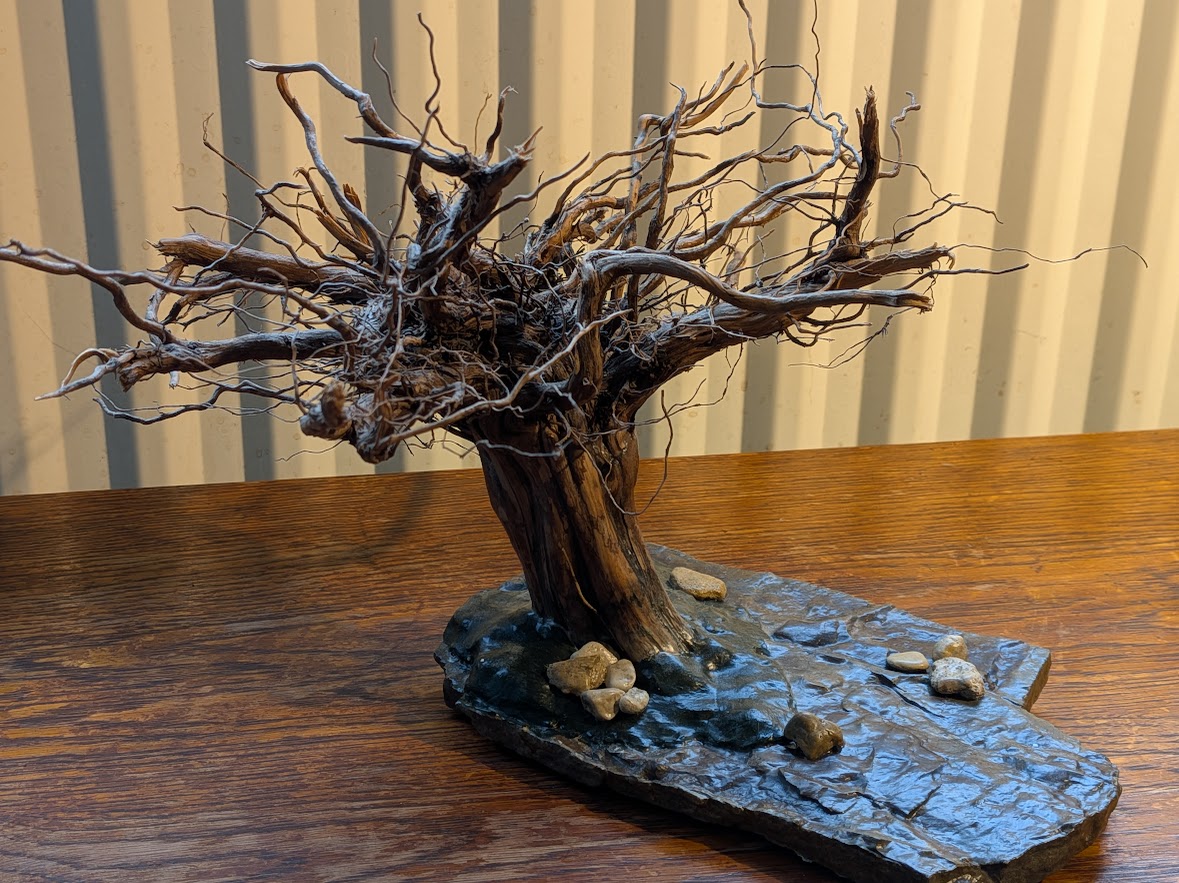
The original Mary tree is known simply as The Mary Tree. About five years ago I was struck by the beauty of this rosemary stem. In particular the stem, up close looked like the trunk of a hundred-year-old tree. The roots inverted here look like the branches of a tree.
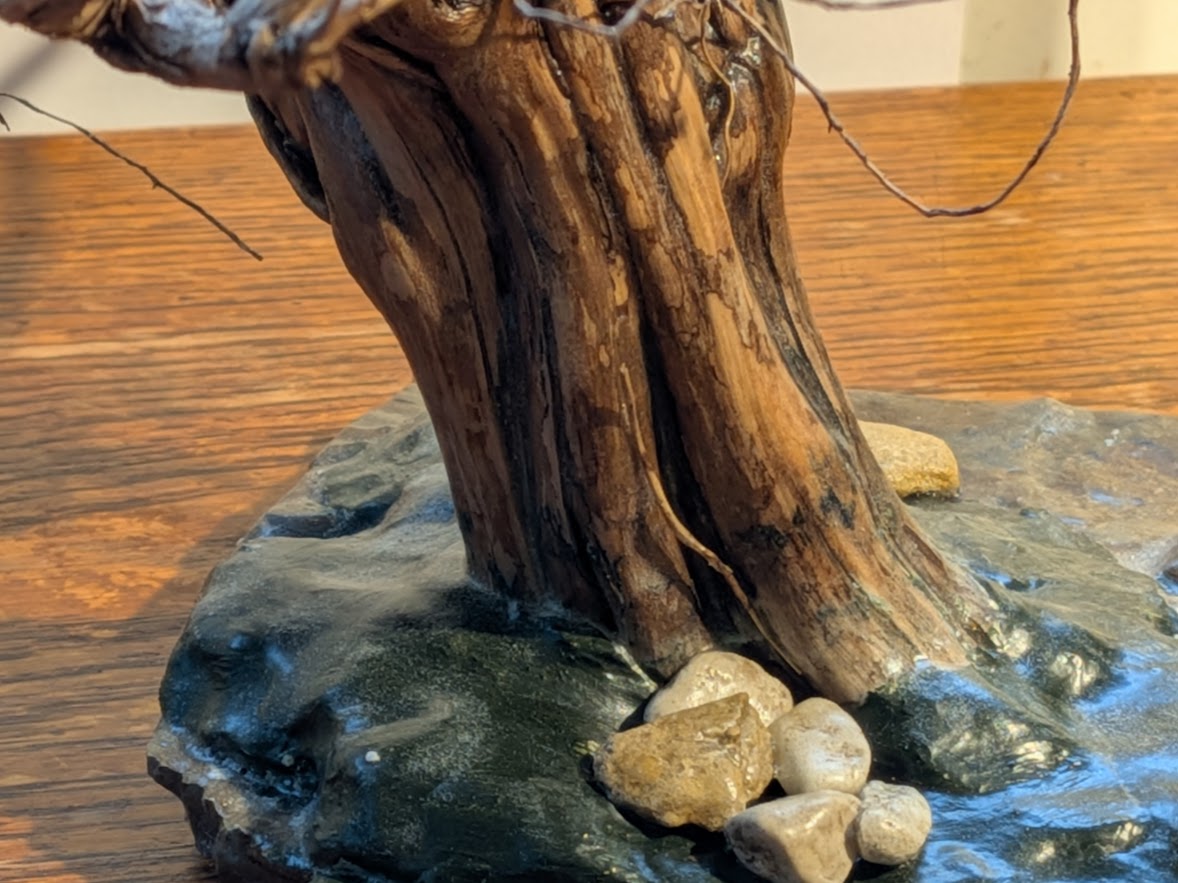
These roots once searched underground for water and now we glimpse their hidden beauty. Staging these sculptures became a necessity and I began to appreciate the need for a base. In nature these plants had been grounded and in art they needed to be grounded. In this case, I used a hand-crafted piece of Welsh slate I found as the base. I created a simple diorama with some small rocks and grass growing around the base of The Mary Tree, which is struggling to grow out of a gap in the slate.
The Ruminator
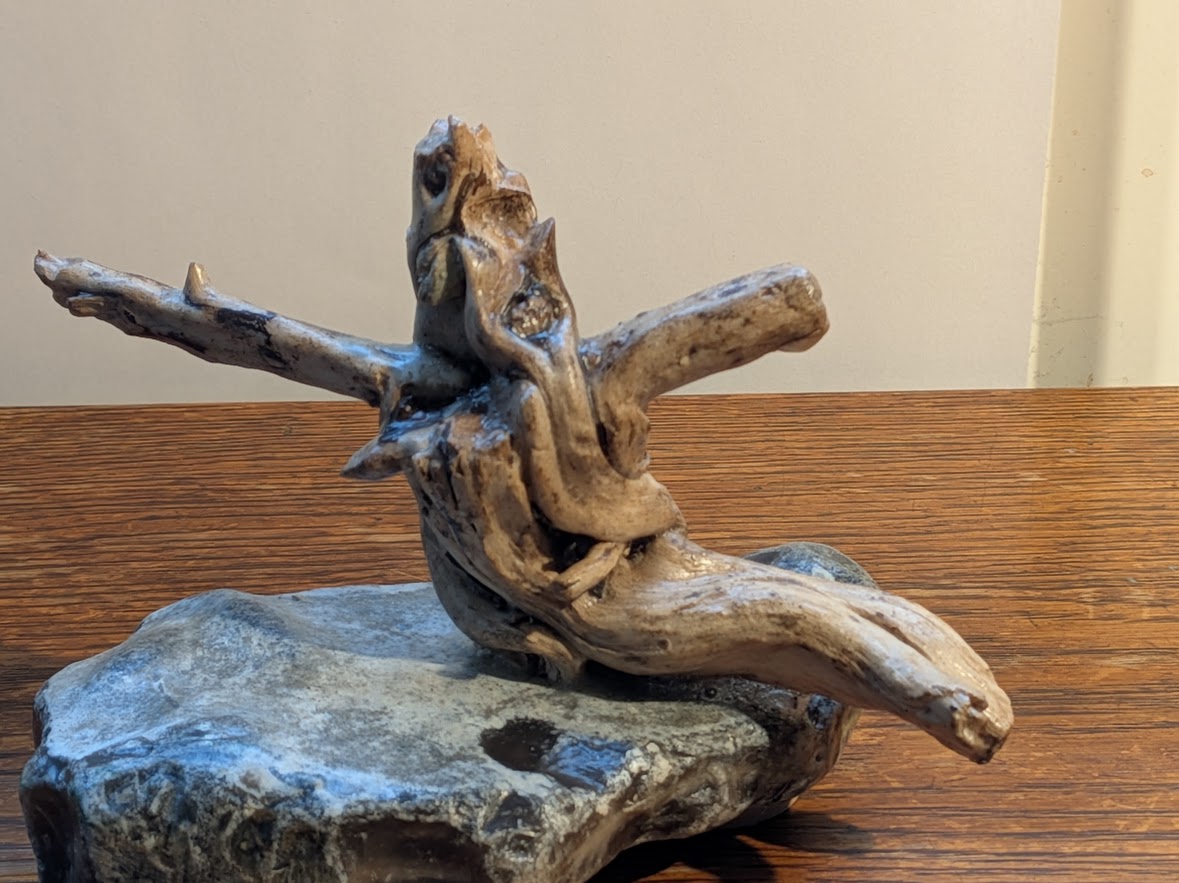
A person sits very, very alone on a lump of flint. The dark blackness of the flint shines through in places, echoing a dark depression. This is not a happy place. The person is cast adrift on this rock, the healing balm of human interaction missing from their repetitive deliberations. The thoughts of The Ruminator are contorted and twisted, hopefully evident in this contorted sculpture. Yearning arms out stretched, yet legs tightly and paradoxically crossed – simultaneously suggesting hold me/go away! The faces of some people reflect the worries of a lifetime in frown lines and wrinkles. Similarly, The Ruminator has become contorted and caught up in the dark thoughts of a lifetime.
Time’s Erosion
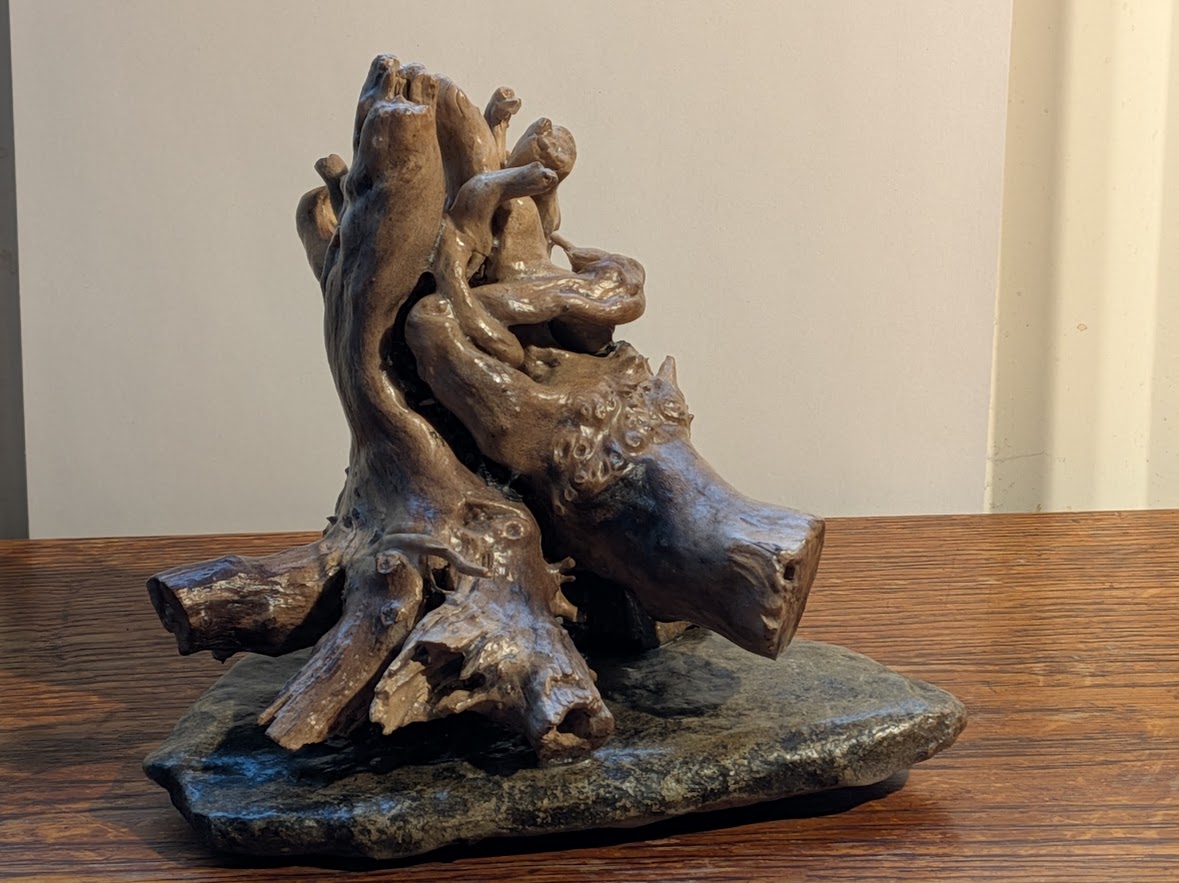
Time’s Erosion is by far my favourite sculpture.
In parallel to working with this Mary tree I was reading a novel. There was a reference to one of the older characters displaying time’s erosion. I thought what a wonderful phrase to capture what we all experience in later life. I then understood what this sculpture was talking to me about – the heavy, yet inevitable toll of the passage of time. I began to see the sculpture in a similar way to an autopsy image of an old human heart. A once beating heart removed from the centre of the chest of an old body. In a similar way to a surgeon, I removed this central part of the rosemary plant, severely severing stems as part of this process. The central part of this rosemary plant fulfilled a similar role to the heart, pumping the nutrients of life around the plant.
Time’s Erosion sits on a piece of old rock. I was pleasantly surprised when I added the sealant. The sealant brought out colours in the rock and the Mary tree that were very compatible, yet this was a pleasing surprise, rather than a conscious choice. When I gaze upon Time’s Erosion, I see something different every time, a beautiful carrier of a remembered past. This is not a sad sculpture, more a healthy acknowledgement of inevitability.
The Lightning Tree
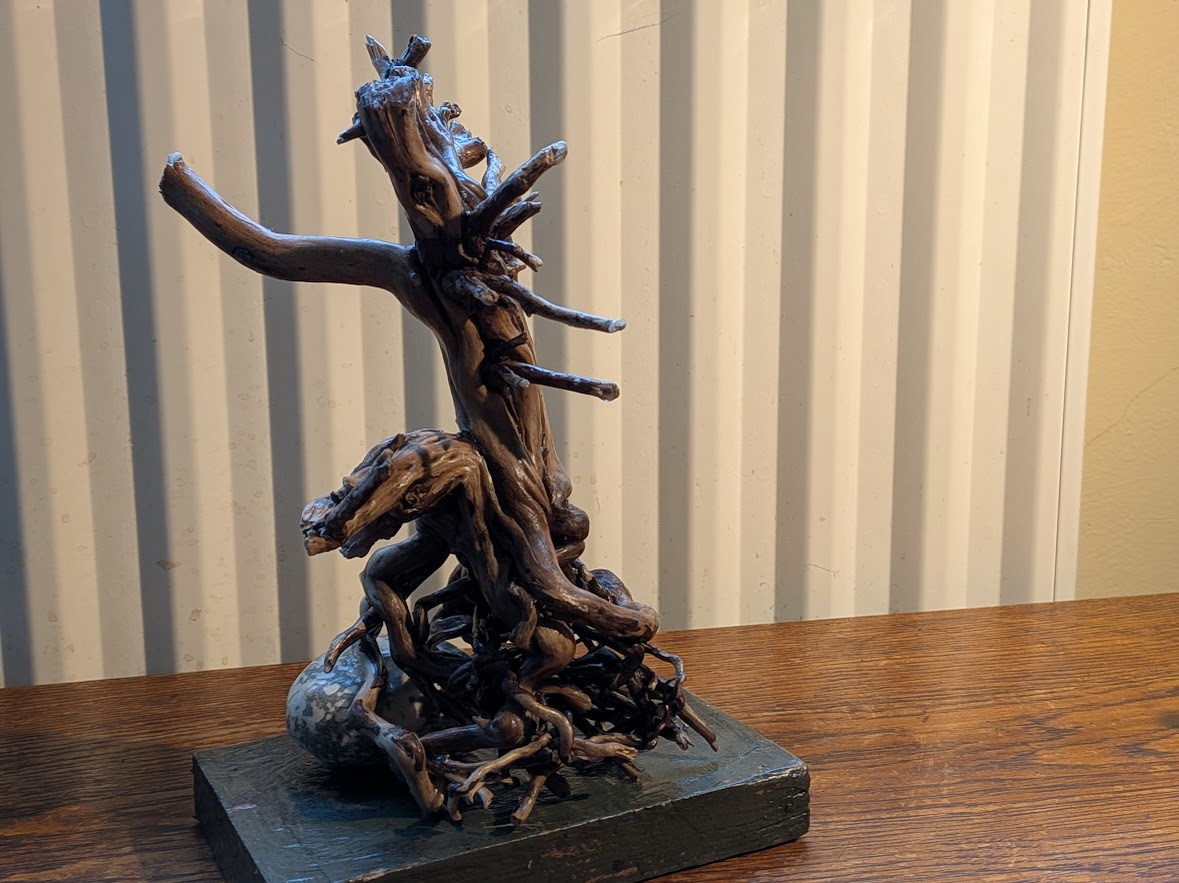
Once a suitable woody rosemary plant has been selected, I tend to hang it in the apple tree. The elements of wind, rain and sun clear away any debris and help to dry out the plant. However, there is still work to be done with the “raw” woody material. There is an outer bark-like skin which has to be removed with a knife and tweezers. Whilst, this could be left on, it would be prone to mould and also experience has taught me that this outer skin often becomes lose when applying the sealant.
A pleasant consequence of this stripping down is becoming intimate with your Mary Tree. You feel it, you see it from different angles and you sense it in different ways. Initially, I thought of this sculpture as an alien lifeform. Viewed horizontally I imagined it crawling over the surface of our earth looking for signs of life. However, with time it increasingly suggested to me a tree struck by lightning. Desolate yet proud trees, you sometimes see standing alone in fields. There was a rationale to remove the roots to make it look more realistic. There was also a rationale to leave the roots and celebrate their rarely seen art and twisted charm. I decided to set this sculpture on a rough old piece of wood which had already been treated with green preservative. I added the round stone to rest the sculpture upon and make some sense out of the inclusion of the roots.
The creative realisation of a Mary tree is sometimes aided through looking at related images. On googling “The Lightning Tree” I had an unexpected epiphany. I am always on the lookout for folklore/mythology relevant to what I sculpt. I noted the strong associations between rosemary and memory/remembering. The top Google hit was a surprise – The Settlers singing The Lightning Tree, used as the theme for the children’s television series Follyfoot. This took me back to my childhood and Sunday teatimes. We would have freshly baked cake/bread, which my Mum, Dad, sister and myself would eat watching family Sunday teatime television. Follyfoot and Black Beauty were family favourites on those Sundays, along with Catweazle and Stig of the Dump. Happy memories, today, the Settlers singing The Lightning Tree also evokes the light and darkness depicted in the film The Wicker Man. The wonderful lyrics urge us to grow, grow the lightning tree, it’s never to late for you and me and I am completely captivated in the singer’s spell.
Rosemary practicalities and possibilities
Understandably, in a world a wash with internet guidance and now supplemented by artificial intelligence, advice on how to grow woody rosemary is lacking. I do like the heretical nature of the task at hand. Initially to grow rosemary so that it becomes woody. The task is frustrating, but nature’s message to me, is that this process requires patience. Typically, it takes six or seven years for a rosemary plant to become woody. Even then properly cultivated rosemary does not become woody. There isn’t the opportunity to buy woody rosemary at your local garden centre. I have cultivated herbs for decades and it was a happy accident that I began to notice the beauty emerging from forgotten rosemary plants in old pots. Whilst rosemary plants in the ground can and do go woody, such stems are likely to be far larger than the stems featured here. Rosemary has to be forgotten, before it can be reimagined.
Dreams come true if you want them to, if you want them to, then it’s up to you. (The Lightning Tree – The Settlers)
As our climate changes, rosemary in pots exemplifies the struggle these plants have with the drought conditions on our South Coast. The positive news is that rosemary is easy to propagate. I have plants in preparation which are about four years old. They were propagated by putting cuttings in water for a fortnight until roots had formed and then putting these small plants into potting compost. I am using some soft wire to pull stems together on the four-year-old plants, but this is experimental. The key is patiently forgetting rosemary, rather than cultivation. I do have some more old rosemary stems, which I am waiting to speak to me. I am certain, I will create another Mary tree, but I do not know when and what form will be suggested to me.
 Woodlanddecay