Tag: Leadingchange

  • Exploring Change: My Podcast Journey

    Exploring Change: My Podcast Journey

    Book Cover - Managing and Leading Organizational Change (Hughes, 2019)

    These are the links to my podcast journey. I can guarantee the links still work, but I know these podcasts happened.

    In June 2020, I enjoyed talking with Jane Stewart and James Carrier as part of their now closed World of Work podcast series (Episode 83).

    In May 2022, I enjoyed being interviewed by Susanne Evans for her ChangeStories podcast.

    In December 2022, I enjoyed becoming a podcast interviewer, interviewing Susanne about her PhD.

    In July 2025, I enjoyed doing a webinar with Steve Hearsum, on the theme of Mythunderstanding Organizational Change.

    TBC – Possibly…

  • Notebook No.1 – Framing Organizational Change Failure

    Notebook No.1 – Framing Organizational Change Failure

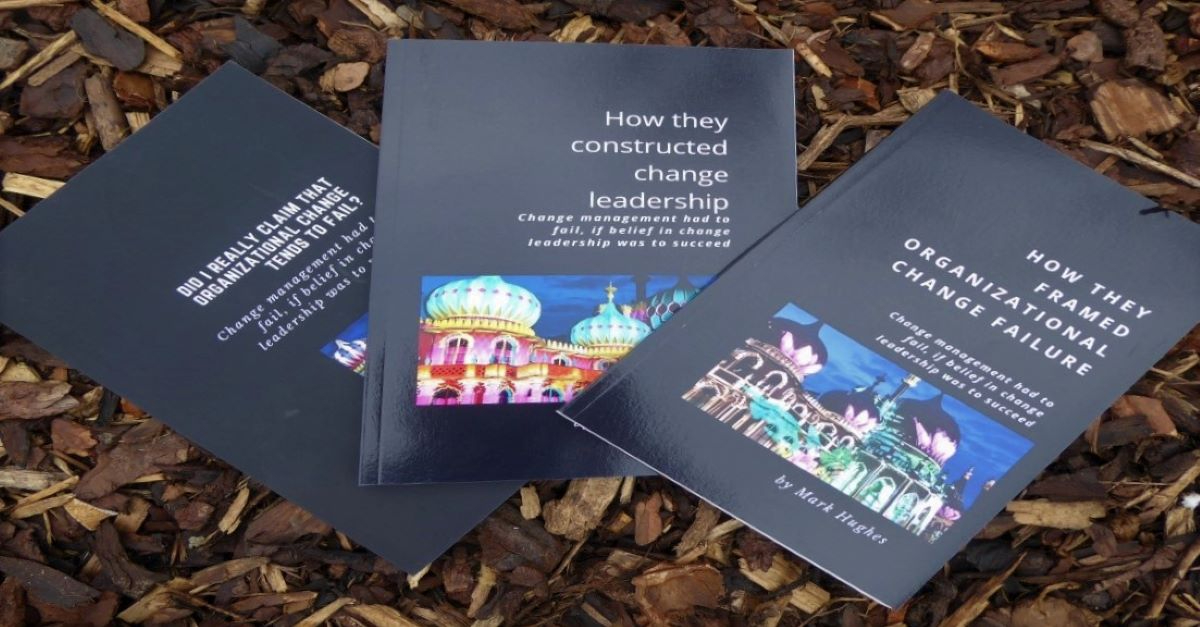
    We need to question the currently favoured persuasive narrative that organizational change tends to fail. This post introduces Notebook No.1 and its chapter content questioning currently favoured change failure framing.

    Notebook No.1 Cover Image
    Notebook No.1 Cover Image

    Problematic Generalizations

    Academic journals, monographs and textbooks repeatedly claim that organizational change tends to fail.  However, the more that you examine this persuasive narrative the more doubtful you become.

    The label organizational change covers many types of change. Change is undertaken in different sectors and different countries. Approaches to making change happen are many and varied.  Specific organizational changes will succeed and fail with considerable variation given the contextual differences. Depicting organizational change as tending to fail is a problematic generalization.  It is problematic like a sexist or racist generalization and we know such generalizations do great harm.

    Persuasive Narratives

    If still persuaded by the narrative that change tends to fail, look to the main proponents Harvard Business School (HBS) professors.  They claimed that change and transformation initiatives failed. However, a large part of the work of their school involves facilitating change and transformation.

    Should we applaud a business school for its social responsibility in sacrificing all that income through so publicly acknowledging change failure? Or was a far more subtle narrative at work?

    Today I believe that it was change management which they wanted to depict as failing, this was so that we would believe that change leadership would succeed.  Unfortunately, my insight has turned into an albatross for myself.  I have been unable to convince academic journal Editors and their reviewers about the wisdom of my little epiphany.  They reasonably want evidence, they rightly claim that in telling my story, multiple stories are at work.  Notebook No.1 and Notebook No.2 are my best effort to retrace my steps in clarifying and explaining my thinking. 

    I feel oddly obligated to offer an alternative narrative to the current dominant narrative that organizational change tends to fail. In this first Notebook, I reflect on my successes and failures, perhaps a little too candidly. The idea of the Notebook label is to signpost that these aren’t the usual sanitized and contorted words we commit to paper. 

    The Chapters

    The following discussion introduces the chapters in this first Notebook. In, Do 70% of organizational change initiatives really fail, I tell the story of how I came to write the paper of the same name. I tell the story of how one of the HBS professors reviewed the paper and what I learnt from him.  Who killed change management also shares a title with a paper. This chapter takes an enjoyable postmodern turn when I decide to investigate the conceptual murder of change management. I begin to appreciate that it wasn’t organizational change which was failing it was change management. The role of textbooks in framing organizational change failure asks an awkward question. If we believe change tends to fail, why is there so little coverage of evaluating organizational change in textbooks?  In A tale of change management failure on the misty literature mountains, I share my learning from writing the monograph The leadership of organizational change. In that monograph, I wanted to establish the origins of change leadership which required a narrative review of 35 years writing. The chapter tells the tale of an author going off on a Tolkienesque adventure in search of the precious thing. A different organizational change failure story is the penultimate chapter. I offer my account of an alternative organizational change failure frame.  In Beyond the rhetoric of failure, I reflect on my successes and failures and the need to do things differently. I also reflect on my hopes for the future framing of organizational change failure.

    The first two Notebooks include unusual appendices which require a little explanation. Ernst Bloch’s (1995) The Principle of Hope made a big impression on me.  Bloch (1995:195) wrote ‘even disappointed hope wanders around agonizing, a ghost that has lost its way back to the cemetery and clings to refuted images.’ Academics invest hopes in unpublished papers. The graveyard of disappointed hope offers a public resting place for an unpublished paper.

    I do hope that these Notebooks might provoke meaningful practically orientated organizational change debate beyond the firewalled academic journals and costly academic books. As change is all about moving into an unknown future only time will tell…

    Accessing Notebook No.1 

    This Notebook and the other two were available on the Amazon self-publishing platform in paperback format. I enjoyed being a publisher – cover design, proof reading, layout etc. The Notebook even sold a few copies, which was a pleasant bonus. Today, if you would like a digital copy of the draft please contact me using the Contact page.

    References

    Bloch, E. (1995) The Principle of Hope. Translated by N. Plaice, S. Plaice, and P. Knight. Cambridge Massachusetts: The MIT Press.

    Hughes, M. (2011) Do 70 per cent of organizational change initiatives really fail? Journal of Change Management, 11 (4): 451-464.

    Hughes, M. (2016) Who killed change management? Culture and Organization, 22(4): 330-347.

    Hughes, M. (2016) The leadership of organizational change. London, Routledge.

  • Notebook No.2- Constructing Change Leadership

    Notebook No.2- Constructing Change Leadership

    This post introduces the second Notebook No.2 and its chapters.  The shift from change management to change leadership begs a question? Everybody seems to place faith in leading change, but why?

    Updated February 2023

    Introduction

    I worked at Brighton Business School from 1987 to 2019. During a lot of that time I undertook organizational change scholarship and facilitated organizational change workshops. In the early days my focus and the focus of workshop participants was change management. Over time that focus shifted to change leadership.  In organizations including my own I witnessed a growing enthusiasm for change leadership and leading change. 

    I began wondering why this shift had taken place, had I missed the relevant memo?

    There is a lack of research/evidence that change leadership delivers successful organizational change.  However, I have been surprised at how many bright academics believe such evidence exists and that it is just waiting to be discovered.  I have been surprised in the UK how much faith hospitals, schools and even universities have placed in the benefits of leading change.

    In The leadership of organizational change, I searched for the origins of change leadership over the past 35 years. This search mirrored my earlier challenging of the belief that 70% of all change initiatives failed. By happy accident rather than intelligent design, I realized that it was change management that they were depicting as failing so that we might believe in change leadership as succeeding. 

    I believe that the shift from change management to change leadership was merely a change of narrative.  That was the easy bit, how do you convince fellow academics about your ecstatic revelation. If the shift to change leadership was more research implied, than research informed, how do you counter a dominant narrative? The succinct answer is with great difficulty.

    The clearer my realization became in my mind the less clear my academic journal submissions became.  My counter-narrative didn’t convince Editors and reviewers and I could only ever offer them parts of this story in specific focussed journal submissions.  In this second Notebook, I tell the story of how they constructed change leadership. My desire to explain the construction of change leadership is not a purely academic exercise. I am concerned about how much organizations and governments have invested in change leadership, at a time when societies have suffered through extreme austerity policies.  My story is not a neutral story, I do want to challenge current thinking about change leadership and the implications for practice.

    Notebook No.2 Cover Image
    Notebook No.2 Cover Image

    The Chapters

    In the second chapter, Anarchy in the UK, anxiety in the USA, I contrast the anarchy of rock music in the 1970s/1980s with anxieties corporate America was experiencing.  In, Reality used to be a friend of mine, I introduce social constructionism. Your change leader is very real, but are some of the strengths and weaknesses you imagine she possesses real? The title, Eight steps towards successfully leading change, is sarcastic. I do not believe that the eight steps which Professor John Kotter prescribed for leading change deliver successful change. This debate has been confused through references to transformational leadership. Robust research does inform transformational leadership, but transformational leadership is concerned with transforming subordinates rather than organizational transformation. I explain this further in the chapter, Transformational leadership misrepresented and misunderstood. I suspect I am sarcastic in the penultimate chapter Let’s assume change leadership works. The title is based upon a textbook author who suggested that we assume change leadership works in the absence of evidence. I consider depictions of change leadership in textbooks, academic handbooks and journals. The tone is more positive in the final chapter in which I encourage a greater emphasis on differentiating Commanding, managing and leading change.

    In the appendix, I include an unpublished paper Questioning the leadership of change in Higher Education. I was troubled when I read A handbook for leaders in higher education: Transforming teaching and learning (Marshall, 2016). This handbook targeted at university leaders, celebrated Kotter’s (1996/2012) eight leading change steps with the book described as a ‘classic’.  I thought enough is enough. I knew I needed to be far more proactive in challenging the change leadership fetish.  Even if these Notebooks, are perceived by readers as nonsense, at least I had a go!

    Accessing Notebook.No2

    This Notebook and the other two were available on the Amazon self-publishing platform in paperback format. I enjoyed being a publisher – cover design, proof reading, layout etc. The Notebook even sold a few copies, which was a pleasant bonus. Today, if you would like a digital copy of the draft please contact me using the Contact page.

    References

    Hughes, M. (2016) The leadership of organizational change. London: Routledge.

    Kotter, J.P. (1996/2012)Leading change. Boston: Harvard Business Press.

    Marshall, S. (2016). A handbook for leaders in higher education: Transforming teaching and learning. London: Routledge.

  • Tools and Techniques of Change Management

    Tools and Techniques of Change Management

    The tools and techniques of change management (Hughes, 2007) was a catchy title for a paper, yet revisiting the paper a decade later much of my thinking has subsequently evolved.  In the new textbook (Hughes, 2019) I included a chapter on tools and techniques, something which I hadn’t done in previous textbooks. 

    Textbook proposals go through a scrutiny process in terms of what to include.  There was interest from some reviewers in tools and techniques, which I could have resisted, but I wanted to respond to interest in tools and techniques, although probably not in the way reviewers wanted…

    Often critical scholars disparage me as merely peddling tools and techniques, as their worlds move forward informed by the writings of Foucault, Bourdieu, and Greek philosophers. Whereas practitioners disparage me for not placing enough emphasis on tools, techniques and their application.  I exist between these two very different worlds. At times it feels very uncomfortable writing for the liminal space between worlds.  Most of the time I enjoy the creative tension between these very different world views and the demands their proponents make. 

    There are at least five ways in which Hughes (2007) would be very different if written today.

    • That change management thingy
    • Change as dynamic
    • Subject expertise, definitions, language and discourse
    • Context is everything
    • Practical judgement

    That change management thingy – In UK universities change management really arrived in the mid-nineties. At Brighton, we were pioneers in launching an MA Change Management in 1995. Today, the words appear very rusty and dated implying that change management is a thing to be accomplished, a tick-box ticked and then onto the next tick-box.  However, academics and practitioners had this realization that they were dealing with something far more fluid.  It was a process, although even claims that there was a beginning, a middle and an end were increasingly questioned.

    We began to appreciate that an organizational change such as a cultural change could take years to bed down and even then, it would be a fluid and emerging phenomenon, rather than a thing.   An appreciation of processes and process thinking was not restricted to change, increasingly, for example, we engaged with the nursing process and education processes. Back to organizational change and we increasingly moved away from change management as a thing towards managing change as a process.  So today the paper would embrace the processual nature of managing change tools and techniques.

    Change as dynamic – Closely related to appreciating the processual nature of organizational change has been a greater appreciation of the dynamic and ambiguous nature of organizational change. Mantras such as ‘change is the only constant around here’ and ‘we are living through an era of unprecedented change’ are misleading rhetoric.

    Many constants in organizations do exist, think of staff working relationships which may last over many years.  Every decade I have lived through is billed as an era of unprecedented change, every era by definition cannot be one of unprecedented change? Beneath the empty words, we need to better appreciate the dynamic nature of organizational change. In terms of evaluation, today’s failed change with time may be perceived as a success and vice versa.  Different managing change tools and techniques may be more or less appropriate at different stages of dynamic changing processes.

    Subject expertise, definitions, language and discourse – In 2007 I was naïve in assuming the existence of a bounded set of change management tools and techniques, with certain tools included and excluded from the change management toolbox.  Today, I appreciate that the world isn’t like this, subjects such as strategy, organizational development, project management and HR have their own tools and techniques. Some of these tools and techniques are relevant to organizational change, others less so.

    Tools and techniques raise issues of definition and I like the notion of tools being nested in a technique. In the past quality circles may have been labelled as a tool, nested within a total quality management technique. The language of tools and techniques is slippery and equally the discourses of the latest management fashions seek to persuade and shape our thinking.  So today if I was writing the paper it would have been bounded such as managing change tools and techniques for quality management or for HR development.

    Context is everything – I was mindful of the significance of context back in 2007, unfortunately however perhaps we pay lip service to context.  I have seen Harvard Business School models applied in voluntary and public service in the UK.  The implication being that such application brings business acumen from the world’s leading business school to these sectors.   However, the HBS models tend to be based upon American businesses, in terms of their underpinning research, their target audience and their application.  It’s like taking some daffodils which look lovely in an English country garden and expecting them to flourish in the Sahara, context really is everything.  So today if I was writing the paper it would be set in a specific context such as managing change tools and techniques for quality management in hospitals.

    Practical judgement – One of the best books I have read recently is Tools and techniques of leadership and management (Stacey, 2012).  The book informs organizational change understanding without featuring that much about organizational change.  The book’s title must have frustrated many readers, I must admit the reason I came to the book was when I was writing the new chapter.  Early on you realize that Stacey (2012) is not selling notions of tools and techniques. Instead, he appears to have become disillusioned with an emphasis on tools and techniques in management and leadership.

    He draws on his experiences of working with managers and leaders, suggesting that the more experienced managers were far less reliant on tools and techniques and far more reliant on exercising practical judgment.

    Practical judgement is the experience-based ability to notice more of what is going on and intuit what is most important about a situation. (Stacey, 2012:108)

    So today if I had been informed by Stacey’s (2012) account of tools and techniques I probably wouldn’t have attempted to write a paper on change management tools and techniques.

    Further Reading

    Hughes, M. (2007)The Tools and Techniques of Change ManagementJournal of Change Management 7 (1): 37-49.

    Hughes, M. (2019) Management and leadership tools and techniques. In Hughes, M. (2019) Managing and Leading Organizational Change. London: Routledge.

    Stacey, R.D. (2012) Tools and Techniques of Leadership and Management: Meeting the Challenge of Complexity. London: Routledge.

    The Tools and Techniques of Change Management